

228
M. Fattore and A. Arcagni
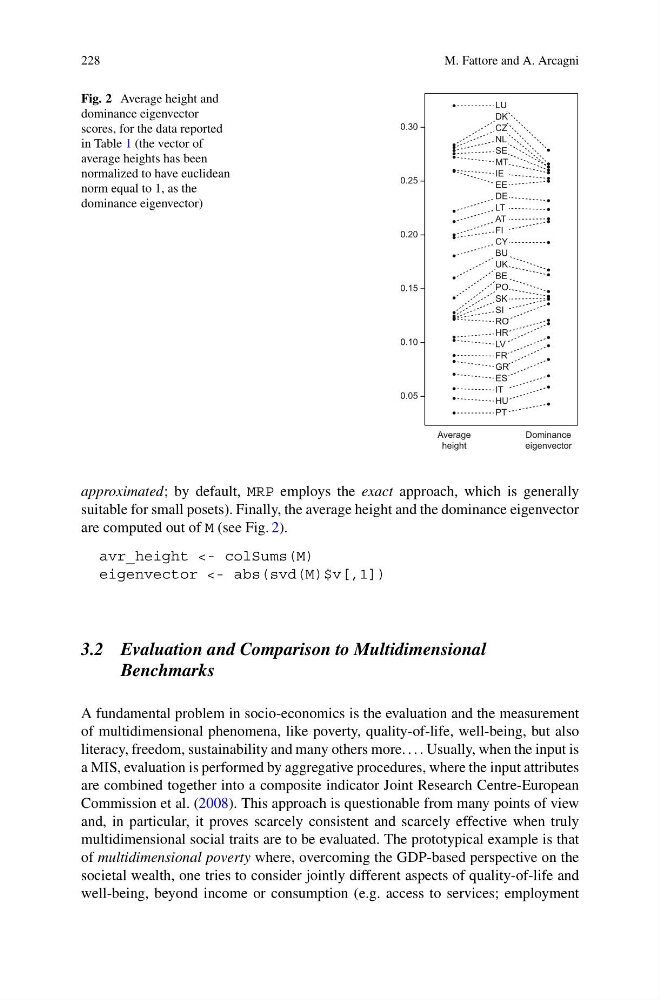
Fig. 2 Average height and
dominance eigenvector
scores, for the data reported
in Table 1 (the vector of
average heights has been
normalized to have euclidean
norm equal to 1, as the
dominance eigenvector)
l
l
l
l
l
l
l
l
l
l
l
l
l
l
l
l
l
l
l
l
l
l
l l l
l
l
l
l
l
l
l
l
l
l
l
l
l
l
l
l
l
l
l
l
l
l
l
l
l
l
l l
l
l
l
AT
BE
BU
HR
CY
CZ
DK
EE
FI
FR
DE
GR
HU
IE
IT
LV
LT
LU
MT
NL
PO
PT
RO
SK
SI
ES
SE
UK
0.05
0.10
0.15
0.20
0.25
0.30
Average
height
Dominance
eigenvector
approximated; by default, MRP employs the exact approach, which is generally
suitable for small posets). Finally, the average height and the dominance eigenvector
are computed out of M (see Fig. 2).
avr_height <- colSums(M)
eigenvector <- abs(svd(M)$v[,1])
3.2 Evaluation and Comparison to Multidimensional
Benchmarks
A fundamental problem in socio-economics is the evaluation and the measurement
of multidimensional phenomena, like poverty, quality-of-life, well-being, but also
literacy, freedom, sustainability and many others more. . . . Usually, when the input is
a MIS, evaluation is performed by aggregative procedures, where the input attributes
are combined together into a composite indicator Joint Research Centre-European
Commission et al. (2008). This approach is questionable from many points of view
and, in particular, it proves scarcely consistent and scarcely effective when truly
multidimensional social traits are to be evaluated. The prototypical example is that
of multidimensional poverty where, overcoming the GDP-based perspective on the
societal wealth, one tries to consider jointly different aspects of quality-of-life and
well-being, beyond income or consumption (e.g. access to services; employment
M. Fattore and A. Arcagni
Fig. 2 Average height and
dominance eigenvector
scores, for the data reported
in Table 1 (the vector of
average heights has been
normalized to have euclidean
norm equal to 1, as the
dominance eigenvector)
l
l
l
l
l
l
l
l
l
l
l
l
l
l
l
l
l
l
l
l
l
l
l l l
l
l
l
l
l
l
l
l
l
l
l
l
l
l
l
l
l
l
l
l
l
l
l
l
l
l
l l
l
l
l
AT
BE
BU
HR
CY
CZ
DK
EE
FI
FR
DE
GR
HU
IE
IT
LV
LT
LU
MT
NL
PO
PT
RO
SK
SI
ES
SE
UK
0.05
0.10
0.15
0.20
0.25
0.30
Average
height
Dominance
eigenvector
approximated; by default, MRP employs the exact approach, which is generally
suitable for small posets). Finally, the average height and the dominance eigenvector
are computed out of M (see Fig. 2).
avr_height <- colSums(M)
eigenvector <- abs(svd(M)$v[,1])
3.2 Evaluation and Comparison to Multidimensional
Benchmarks
A fundamental problem in socio-economics is the evaluation and the measurement
of multidimensional phenomena, like poverty, quality-of-life, well-being, but also
literacy, freedom, sustainability and many others more. . . . Usually, when the input is
a MIS, evaluation is performed by aggregative procedures, where the input attributes
are combined together into a composite indicator Joint Research Centre-European
Commission et al. (2008). This approach is questionable from many points of view
and, in particular, it proves scarcely consistent and scarcely effective when truly
multidimensional social traits are to be evaluated. The prototypical example is that
of multidimensional poverty where, overcoming the GDP-based perspective on the
societal wealth, one tries to consider jointly different aspects of quality-of-life and
well-being, beyond income or consumption (e.g. access to services; employment