

Looking for Alternatives? Split-Shots as an Exemplary Case
163
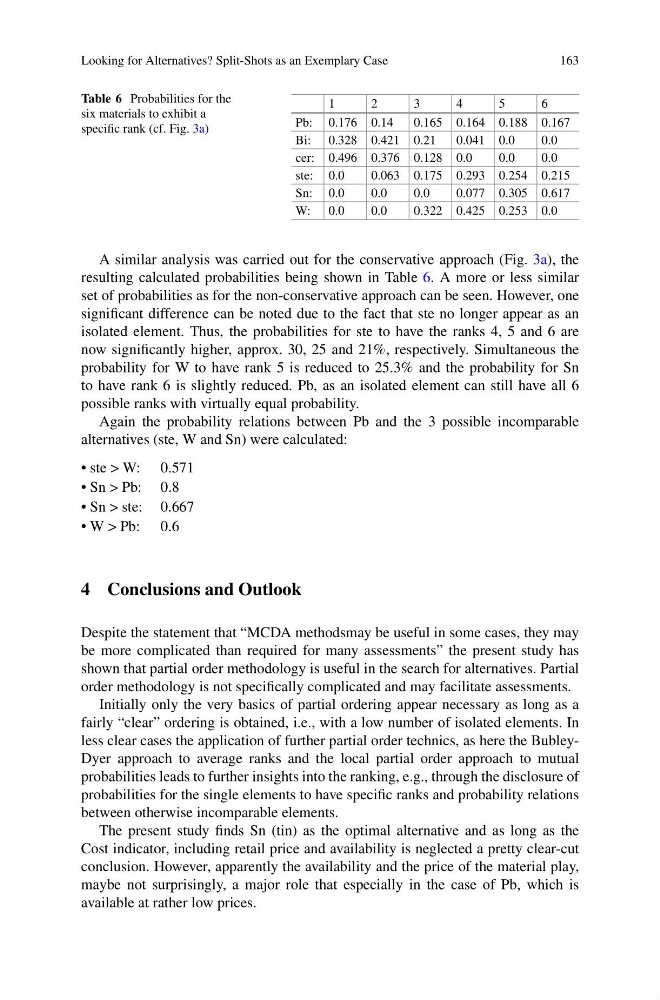
Table 6 Probabilities for the
six materials to exhibit a
specific rank (cf. Fig. 3a)
1
2
3
4
5
6
Pb: 0.176 0.14
0.165 0.164 0.188 0.167
Bi: 0.328 0.421 0.21
0.041 0.0
0.0
cer: 0.496 0.376 0.128 0.0
0.0
0.0
ste: 0.0
0.063 0.175 0.293 0.254 0.215
Sn: 0.0
0.0
0.0
0.077 0.305 0.617
W: 0.0
0.0
0.322 0.425 0.253 0.0
A similar analysis was carried out for the conservative approach (Fig. 3a), the
resulting calculated probabilities being shown in Table 6. A more or less similar
set of probabilities as for the non-conservative approach can be seen. However, one
significant difference can be noted due to the fact that ste no longer appear as an
isolated element. Thus, the probabilities for ste to have the ranks 4, 5 and 6 are
now significantly higher, approx. 30, 25 and 21%, respectively. Simultaneous the
probability for W to have rank 5 is reduced to 25.3% and the probability for Sn
to have rank 6 is slightly reduced. Pb, as an isolated element can still have all 6
possible ranks with virtually equal probability.
Again the probability relations between Pb and the 3 possible incomparable
alternatives (ste, W and Sn) were calculated:
• ste > W: 0.571
• Sn > Pb: 0.8
• Sn > ste: 0.667
• W > Pb: 0.6
4 Conclusions and Outlook
Despite the statement that “MCDA methodsmay be useful in some cases, they may
be more complicated than required for many assessments” the present study has
shown that partial order methodology is useful in the search for alternatives. Partial
order methodology is not specifically complicated and may facilitate assessments.
Initially only the very basics of partial ordering appear necessary as long as a
fairly “clear” ordering is obtained, i.e., with a low number of isolated elements. In
less clear cases the application of further partial order technics, as here the BubleyDyer approach to average ranks and the local partial order approach to mutual
probabilities leads to further insights into the ranking, e.g., through the disclosure of
probabilities for the single elements to have specific ranks and probability relations
between otherwise incomparable elements.
The present study finds Sn (tin) as the optimal alternative and as long as the
Cost indicator, including retail price and availability is neglected a pretty clear-cut
conclusion. However, apparently the availability and the price of the material play,
maybe not surprisingly, a major role that especially in the case of Pb, which is
available at rather low prices.
163
Table 6 Probabilities for the
six materials to exhibit a
specific rank (cf. Fig. 3a)
1
2
3
4
5
6
Pb: 0.176 0.14
0.165 0.164 0.188 0.167
Bi: 0.328 0.421 0.21
0.041 0.0
0.0
cer: 0.496 0.376 0.128 0.0
0.0
0.0
ste: 0.0
0.063 0.175 0.293 0.254 0.215
Sn: 0.0
0.0
0.0
0.077 0.305 0.617
W: 0.0
0.0
0.322 0.425 0.253 0.0
A similar analysis was carried out for the conservative approach (Fig. 3a), the
resulting calculated probabilities being shown in Table 6. A more or less similar
set of probabilities as for the non-conservative approach can be seen. However, one
significant difference can be noted due to the fact that ste no longer appear as an
isolated element. Thus, the probabilities for ste to have the ranks 4, 5 and 6 are
now significantly higher, approx. 30, 25 and 21%, respectively. Simultaneous the
probability for W to have rank 5 is reduced to 25.3% and the probability for Sn
to have rank 6 is slightly reduced. Pb, as an isolated element can still have all 6
possible ranks with virtually equal probability.
Again the probability relations between Pb and the 3 possible incomparable
alternatives (ste, W and Sn) were calculated:
• ste > W: 0.571
• Sn > Pb: 0.8
• Sn > ste: 0.667
• W > Pb: 0.6
4 Conclusions and Outlook
Despite the statement that “MCDA methodsmay be useful in some cases, they may
be more complicated than required for many assessments” the present study has
shown that partial order methodology is useful in the search for alternatives. Partial
order methodology is not specifically complicated and may facilitate assessments.
Initially only the very basics of partial ordering appear necessary as long as a
fairly “clear” ordering is obtained, i.e., with a low number of isolated elements. In
less clear cases the application of further partial order technics, as here the BubleyDyer approach to average ranks and the local partial order approach to mutual
probabilities leads to further insights into the ranking, e.g., through the disclosure of
probabilities for the single elements to have specific ranks and probability relations
between otherwise incomparable elements.
The present study finds Sn (tin) as the optimal alternative and as long as the
Cost indicator, including retail price and availability is neglected a pretty clear-cut
conclusion. However, apparently the availability and the price of the material play,
maybe not surprisingly, a major role that especially in the case of Pb, which is
available at rather low prices.