

Introduction into Sampling Theory, Applying Partial Order Concepts
149
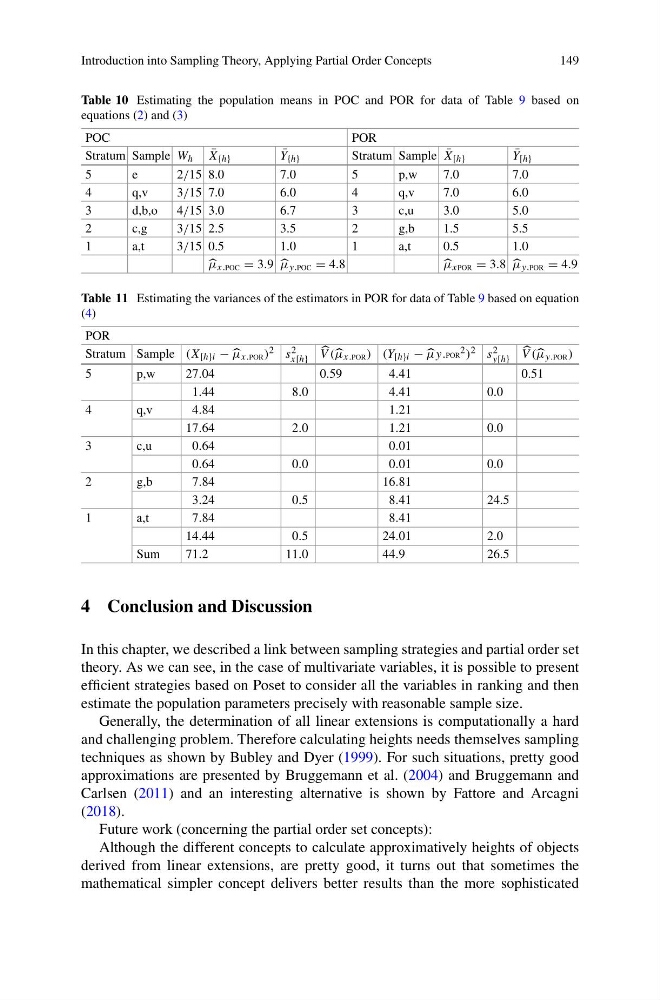
Table 10 Estimating the population means in POC and POR for data of Table 9 based on
equations (2) and (3)
POC
POR
Stratum Sample W h ¯
X {h}
¯
Y {h}
Stratum Sample ¯
X [h}
¯
Y [h}
5
e
2/15 8.0
7.0
5
p,w
7.0
7.0
4
q,v
3/15 7.0
6.0
4
q,v
7.0
6.0
3
d,b,o
4/15 3.0
6.7
3
c,u
3.0
5.0
2
c,g
3/15 2.5
3.5
2
g,b
1.5
5.5
1
a,t
3/15 0.5
1.0
1
a,t
0.5
1.0
μ x.POC = 3.9 μ y.POC = 4.8
μ xPOR = 3.8 μ y.POR = 4.9
Table 11 Estimating the variances of the estimators in POR for data of Table 9 based on equation
(4)
POR
Stratum Sample (X [h}i − μ x.POR ) 2 s 2
x[h}
V ( μ x.POR ) (Y [h}i − μy.POR 2 ) 2 s 2
y[h}
V ( μ y.POR )
5
p,w
27.04
0.59
4.41
0.51
1.44
8.0
4.41
0.0
4
q,v
4.84
1.21
17.64
2.0
1.21
0.0
3
c,u
0.64
0.01
0.64
0.0
0.01
0.0
2
g,b
7.84
16.81
3.24
0.5
8.41
24.5
1
a,t
7.84
8.41
14.44
0.5
24.01
2.0
Sum
71.2
11.0
44.9
26.5
4 Conclusion and Discussion
In this chapter, we described a link between sampling strategies and partial order set
theory. As we can see, in the case of multivariate variables, it is possible to present
efficient strategies based on Poset to consider all the variables in ranking and then
estimate the population parameters precisely with reasonable sample size.
Generally, the determination of all linear extensions is computationally a hard
and challenging problem. Therefore calculating heights needs themselves sampling
techniques as shown by Bubley and Dyer (1999). For such situations, pretty good
approximations are presented by Bruggemann et al. (2004) and Bruggemann and
Carlsen (2011) and an interesting alternative is shown by Fattore and Arcagni
(2018).
Future work (concerning the partial order set concepts):
Although the different concepts to calculate approximatively heights of objects
derived from linear extensions, are pretty good, it turns out that sometimes the
mathematical simpler concept delivers better results than the more sophisticated
149
Table 10 Estimating the population means in POC and POR for data of Table 9 based on
equations (2) and (3)
POC
POR
Stratum Sample W h ¯
X {h}
¯
Y {h}
Stratum Sample ¯
X [h}
¯
Y [h}
5
e
2/15 8.0
7.0
5
p,w
7.0
7.0
4
q,v
3/15 7.0
6.0
4
q,v
7.0
6.0
3
d,b,o
4/15 3.0
6.7
3
c,u
3.0
5.0
2
c,g
3/15 2.5
3.5
2
g,b
1.5
5.5
1
a,t
3/15 0.5
1.0
1
a,t
0.5
1.0
μ x.POC = 3.9 μ y.POC = 4.8
μ xPOR = 3.8 μ y.POR = 4.9
Table 11 Estimating the variances of the estimators in POR for data of Table 9 based on equation
(4)
POR
Stratum Sample (X [h}i − μ x.POR ) 2 s 2
x[h}
V ( μ x.POR ) (Y [h}i − μy.POR 2 ) 2 s 2
y[h}
V ( μ y.POR )
5
p,w
27.04
0.59
4.41
0.51
1.44
8.0
4.41
0.0
4
q,v
4.84
1.21
17.64
2.0
1.21
0.0
3
c,u
0.64
0.01
0.64
0.0
0.01
0.0
2
g,b
7.84
16.81
3.24
0.5
8.41
24.5
1
a,t
7.84
8.41
14.44
0.5
24.01
2.0
Sum
71.2
11.0
44.9
26.5
4 Conclusion and Discussion
In this chapter, we described a link between sampling strategies and partial order set
theory. As we can see, in the case of multivariate variables, it is possible to present
efficient strategies based on Poset to consider all the variables in ranking and then
estimate the population parameters precisely with reasonable sample size.
Generally, the determination of all linear extensions is computationally a hard
and challenging problem. Therefore calculating heights needs themselves sampling
techniques as shown by Bubley and Dyer (1999). For such situations, pretty good
approximations are presented by Bruggemann et al. (2004) and Bruggemann and
Carlsen (2011) and an interesting alternative is shown by Fattore and Arcagni
(2018).
Future work (concerning the partial order set concepts):
Although the different concepts to calculate approximatively heights of objects
derived from linear extensions, are pretty good, it turns out that sometimes the
mathematical simpler concept delivers better results than the more sophisticated