

Introduction into Sampling Theory, Applying Partial Order Concepts
147
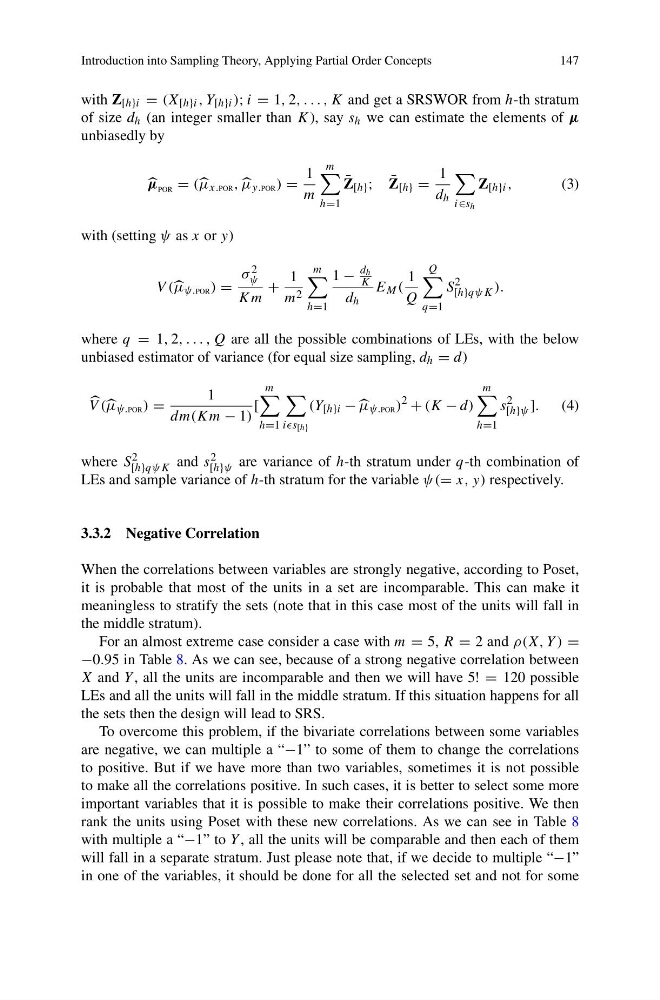
with Z [h}i = (X [h}i , Y [h}i ); i = 1, 2, . . . , K and get a SRSWOR from h-th stratum
of size d h (an integer smaller than K), say s h we can estimate the elements of µ
unbiasedly by
µ POR = ( μ x.POR , μ y.POR ) =
1
m
m
h=1
¯
Z [h} ; ¯
Z [h} =
1
d h
i∈s h
Z [h}i ,
(3)
with (setting ψ as x or y)
V ( μ ψ.POR ) =
σ 2
ψ
Km
+
1
m 2
m
h=1
1 −
d h
K
d h
E M (
1
Q
Q
q=1
S
2
[h}qψK ).
where q = 1, 2, . . . , Q are all the possible combinations of LEs, with the below
unbiased estimator of variance (for equal size sampling, d h = d)
V ( μ ψ.POR ) =
1
dm(Km − 1)
[
m
h=1
iis [h}
(Y [h}i − μ ψ.POR )
2
+ (K − d)
m
h=1
s
2
[h}ψ ].
(4)
where S 2
[h}qψK and s 2
[h}ψ are variance of h-th stratum under q-th combination of
LEs and sample variance of h-th stratum for the variable ψ(= x, y) respectively.
3.3.2 Negative Correlation
When the correlations between variables are strongly negative, according to Poset,
it is probable that most of the units in a set are incomparable. This can make it
meaningless to stratify the sets (note that in this case most of the units will fall in
the middle stratum).
For an almost extreme case consider a case with m = 5, R = 2 and ρ(X, Y ) =
−0.95 in Table 8. As we can see, because of a strong negative correlation between
X and Y , all the units are incomparable and then we will have 5! = 120 possible
LEs and all the units will fall in the middle stratum. If this situation happens for all
the sets then the design will lead to SRS.
To overcome this problem, if the bivariate correlations between some variables
are negative, we can multiple a “−1” to some of them to change the correlations
to positive. But if we have more than two variables, sometimes it is not possible
to make all the correlations positive. In such cases, it is better to select some more
important variables that it is possible to make their correlations positive. We then
rank the units using Poset with these new correlations. As we can see in Table 8
with multiple a “−1” to Y , all the units will be comparable and then each of them
will fall in a separate stratum. Just please note that, if we decide to multiple “−1”
in one of the variables, it should be done for all the selected set and not for some
147
with Z [h}i = (X [h}i , Y [h}i ); i = 1, 2, . . . , K and get a SRSWOR from h-th stratum
of size d h (an integer smaller than K), say s h we can estimate the elements of µ
unbiasedly by
µ POR = ( μ x.POR , μ y.POR ) =
1
m
m
h=1
¯
Z [h} ; ¯
Z [h} =
1
d h
i∈s h
Z [h}i ,
(3)
with (setting ψ as x or y)
V ( μ ψ.POR ) =
σ 2
ψ
Km
+
1
m 2
m
h=1
1 −
d h
K
d h
E M (
1
Q
Q
q=1
S
2
[h}qψK ).
where q = 1, 2, . . . , Q are all the possible combinations of LEs, with the below
unbiased estimator of variance (for equal size sampling, d h = d)
V ( μ ψ.POR ) =
1
dm(Km − 1)
[
m
h=1
iis [h}
(Y [h}i − μ ψ.POR )
2
+ (K − d)
m
h=1
s
2
[h}ψ ].
(4)
where S 2
[h}qψK and s 2
[h}ψ are variance of h-th stratum under q-th combination of
LEs and sample variance of h-th stratum for the variable ψ(= x, y) respectively.
3.3.2 Negative Correlation
When the correlations between variables are strongly negative, according to Poset,
it is probable that most of the units in a set are incomparable. This can make it
meaningless to stratify the sets (note that in this case most of the units will fall in
the middle stratum).
For an almost extreme case consider a case with m = 5, R = 2 and ρ(X, Y ) =
−0.95 in Table 8. As we can see, because of a strong negative correlation between
X and Y , all the units are incomparable and then we will have 5! = 120 possible
LEs and all the units will fall in the middle stratum. If this situation happens for all
the sets then the design will lead to SRS.
To overcome this problem, if the bivariate correlations between some variables
are negative, we can multiple a “−1” to some of them to change the correlations
to positive. But if we have more than two variables, sometimes it is not possible
to make all the correlations positive. In such cases, it is better to select some more
important variables that it is possible to make their correlations positive. We then
rank the units using Poset with these new correlations. As we can see in Table 8
with multiple a “−1” to Y , all the units will be comparable and then each of them
will fall in a separate stratum. Just please note that, if we decide to multiple “−1”
in one of the variables, it should be done for all the selected set and not for some