

Introduction into Sampling Theory, Applying Partial Order Concepts
139
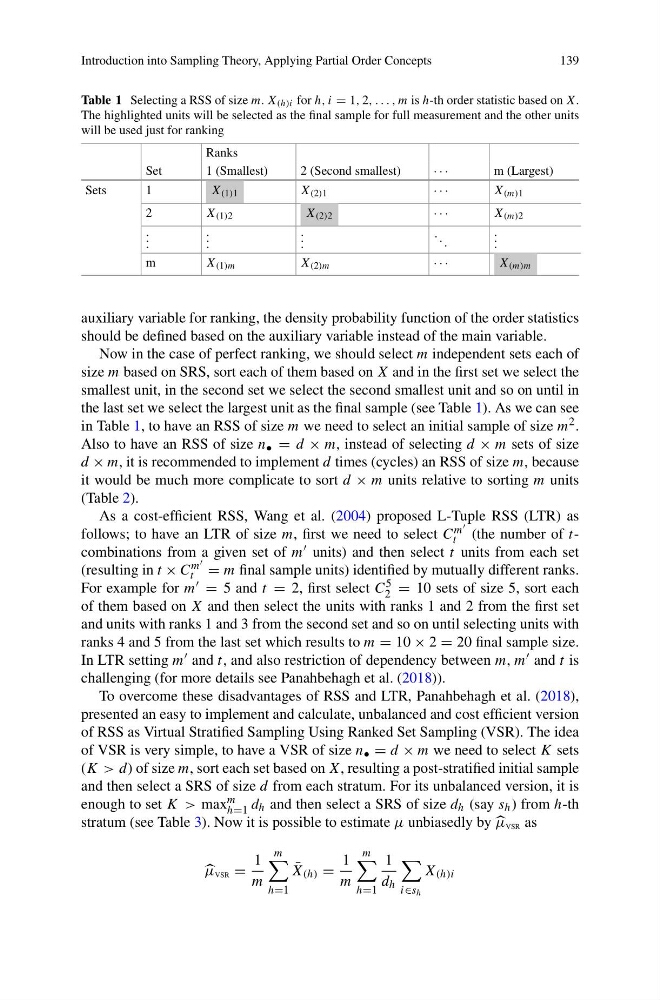
Table 1 Selecting a RSS of size m. X (h)i for h, i = 1, 2, . . . , m is h-th order statistic based on X.
The highlighted units will be selected as the final sample for full measurement and the other units
will be used just for ranking
Ranks
Set
1 (Smallest)
2 (Second smallest)
· · ·
m (Largest)
Sets
1
X (1)1
X (2)1
· · ·
X (m)1
2
X (1)2
X (2)2
· · ·
X (m)2
. . .
. . .
. . .
. . .
. . .
m
X (1)m
X (2)m
· · ·
X (m)m
auxiliary variable for ranking, the density probability function of the order statistics
should be defined based on the auxiliary variable instead of the main variable.
Now in the case of perfect ranking, we should select m independent sets each of
size m based on SRS, sort each of them based on X and in the first set we select the
smallest unit, in the second set we select the second smallest unit and so on until in
the last set we select the largest unit as the final sample (see Table 1). As we can see
in Table 1, to have an RSS of size m we need to select an initial sample of size m 2 .
Also to have an RSS of size n • = d × m, instead of selecting d × m sets of size
d × m, it is recommended to implement d times (cycles) an RSS of size m, because
it would be much more complicate to sort d × m units relative to sorting m units
(Table 2).
As a cost-efficient RSS, Wang et al. (2004) proposed L-Tuple RSS (LTR) as
follows; to have an LTR of size m, first we need to select C m
t (the number of tcombinations from a given set of m units) and then select t units from each set
(resulting in t × C m
t = m final sample units) identified by mutually different ranks.
For example for m = 5 and t = 2, first select C 5
2 = 10 sets of size 5, sort each
of them based on X and then select the units with ranks 1 and 2 from the first set
and units with ranks 1 and 3 from the second set and so on until selecting units with
ranks 4 and 5 from the last set which results to m = 10 × 2 = 20 final sample size.
In LTR setting m and t, and also restriction of dependency between m, m and t is
challenging (for more details see Panahbehagh et al. (2018)).
To overcome these disadvantages of RSS and LTR, Panahbehagh et al. (2018),
presented an easy to implement and calculate, unbalanced and cost efficient version
of RSS as Virtual Stratified Sampling Using Ranked Set Sampling (VSR). The idea
of VSR is very simple, to have a VSR of size n • = d × m we need to select K sets
(K > d) of size m, sort each set based on X, resulting a post-stratified initial sample
and then select a SRS of size d from each stratum. For its unbalanced version, it is
enough to set K > max m
h=1 d h and then select a SRS of size d h (say s h ) from h-th
stratum (see Table 3). Now it is possible to estimate μ unbiasedly by μ VSR as
μ VSR =
1
m
m
h=1
¯
X (h) =
1
m
m
h=1
1
d h
i∈s h
X (h)i
139
Table 1 Selecting a RSS of size m. X (h)i for h, i = 1, 2, . . . , m is h-th order statistic based on X.
The highlighted units will be selected as the final sample for full measurement and the other units
will be used just for ranking
Ranks
Set
1 (Smallest)
2 (Second smallest)
· · ·
m (Largest)
Sets
1
X (1)1
X (2)1
· · ·
X (m)1
2
X (1)2
X (2)2
· · ·
X (m)2
. . .
. . .
. . .
. . .
. . .
m
X (1)m
X (2)m
· · ·
X (m)m
auxiliary variable for ranking, the density probability function of the order statistics
should be defined based on the auxiliary variable instead of the main variable.
Now in the case of perfect ranking, we should select m independent sets each of
size m based on SRS, sort each of them based on X and in the first set we select the
smallest unit, in the second set we select the second smallest unit and so on until in
the last set we select the largest unit as the final sample (see Table 1). As we can see
in Table 1, to have an RSS of size m we need to select an initial sample of size m 2 .
Also to have an RSS of size n • = d × m, instead of selecting d × m sets of size
d × m, it is recommended to implement d times (cycles) an RSS of size m, because
it would be much more complicate to sort d × m units relative to sorting m units
(Table 2).
As a cost-efficient RSS, Wang et al. (2004) proposed L-Tuple RSS (LTR) as
follows; to have an LTR of size m, first we need to select C m
t (the number of tcombinations from a given set of m units) and then select t units from each set
(resulting in t × C m
t = m final sample units) identified by mutually different ranks.
For example for m = 5 and t = 2, first select C 5
2 = 10 sets of size 5, sort each
of them based on X and then select the units with ranks 1 and 2 from the first set
and units with ranks 1 and 3 from the second set and so on until selecting units with
ranks 4 and 5 from the last set which results to m = 10 × 2 = 20 final sample size.
In LTR setting m and t, and also restriction of dependency between m, m and t is
challenging (for more details see Panahbehagh et al. (2018)).
To overcome these disadvantages of RSS and LTR, Panahbehagh et al. (2018),
presented an easy to implement and calculate, unbalanced and cost efficient version
of RSS as Virtual Stratified Sampling Using Ranked Set Sampling (VSR). The idea
of VSR is very simple, to have a VSR of size n • = d × m we need to select K sets
(K > d) of size m, sort each set based on X, resulting a post-stratified initial sample
and then select a SRS of size d from each stratum. For its unbalanced version, it is
enough to set K > max m
h=1 d h and then select a SRS of size d h (say s h ) from h-th
stratum (see Table 3). Now it is possible to estimate μ unbiasedly by μ VSR as
μ VSR =
1
m
m
h=1
¯
X (h) =
1
m
m
h=1
1
d h
i∈s h
X (h)i