

138
B. Panahbehagh and R. Bruggemann
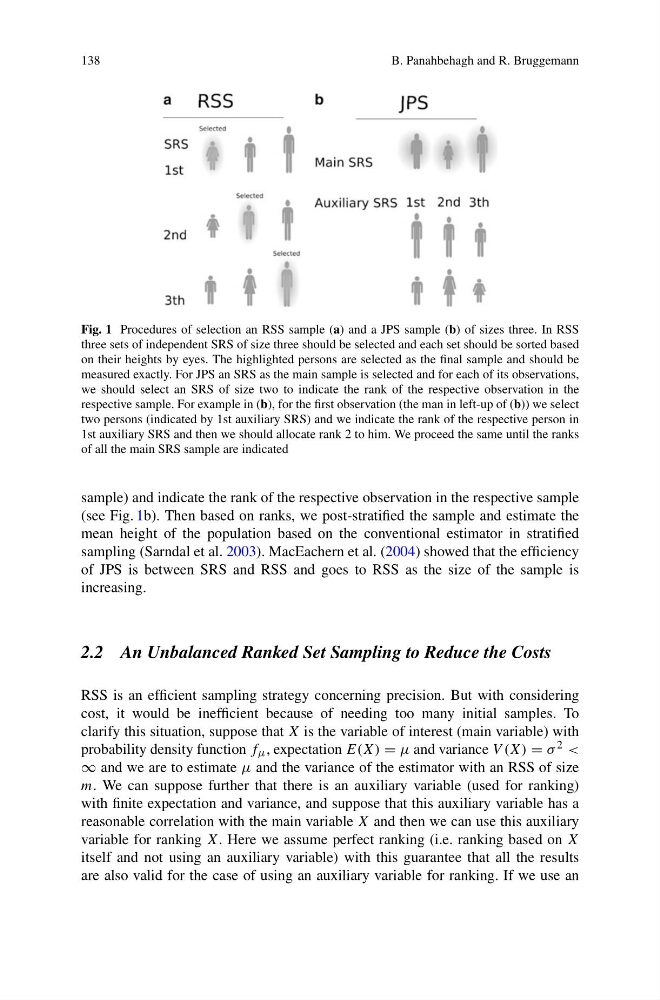
Fig. 1 Procedures of selection an RSS sample (a) and a JPS sample (b) of sizes three. In RSS
three sets of independent SRS of size three should be selected and each set should be sorted based
on their heights by eyes. The highlighted persons are selected as the final sample and should be
measured exactly. For JPS an SRS as the main sample is selected and for each of its observations,
we should select an SRS of size two to indicate the rank of the respective observation in the
respective sample. For example in (b), for the first observation (the man in left-up of (b)) we select
two persons (indicated by 1st auxiliary SRS) and we indicate the rank of the respective person in
1st auxiliary SRS and then we should allocate rank 2 to him. We proceed the same until the ranks
of all the main SRS sample are indicated
sample) and indicate the rank of the respective observation in the respective sample
(see Fig. 1b). Then based on ranks, we post-stratified the sample and estimate the
mean height of the population based on the conventional estimator in stratified
sampling (Sarndal et al. 2003). MacEachern et al. (2004) showed that the efficiency
of JPS is between SRS and RSS and goes to RSS as the size of the sample is
increasing.
2.2 An Unbalanced Ranked Set Sampling to Reduce the Costs
RSS is an efficient sampling strategy concerning precision. But with considering
cost, it would be inefficient because of needing too many initial samples. To
clarify this situation, suppose that X is the variable of interest (main variable) with
probability density function f μ , expectation E(X) = μ and variance V (X) = σ 2 <
∞ and we are to estimate μ and the variance of the estimator with an RSS of size
m. We can suppose further that there is an auxiliary variable (used for ranking)
with finite expectation and variance, and suppose that this auxiliary variable has a
reasonable correlation with the main variable X and then we can use this auxiliary
variable for ranking X. Here we assume perfect ranking (i.e. ranking based on X
itself and not using an auxiliary variable) with this guarantee that all the results
are also valid for the case of using an auxiliary variable for ranking. If we use an
B. Panahbehagh and R. Bruggemann
Fig. 1 Procedures of selection an RSS sample (a) and a JPS sample (b) of sizes three. In RSS
three sets of independent SRS of size three should be selected and each set should be sorted based
on their heights by eyes. The highlighted persons are selected as the final sample and should be
measured exactly. For JPS an SRS as the main sample is selected and for each of its observations,
we should select an SRS of size two to indicate the rank of the respective observation in the
respective sample. For example in (b), for the first observation (the man in left-up of (b)) we select
two persons (indicated by 1st auxiliary SRS) and we indicate the rank of the respective person in
1st auxiliary SRS and then we should allocate rank 2 to him. We proceed the same until the ranks
of all the main SRS sample are indicated
sample) and indicate the rank of the respective observation in the respective sample
(see Fig. 1b). Then based on ranks, we post-stratified the sample and estimate the
mean height of the population based on the conventional estimator in stratified
sampling (Sarndal et al. 2003). MacEachern et al. (2004) showed that the efficiency
of JPS is between SRS and RSS and goes to RSS as the size of the sample is
increasing.
2.2 An Unbalanced Ranked Set Sampling to Reduce the Costs
RSS is an efficient sampling strategy concerning precision. But with considering
cost, it would be inefficient because of needing too many initial samples. To
clarify this situation, suppose that X is the variable of interest (main variable) with
probability density function f μ , expectation E(X) = μ and variance V (X) = σ 2 <
∞ and we are to estimate μ and the variance of the estimator with an RSS of size
m. We can suppose further that there is an auxiliary variable (used for ranking)
with finite expectation and variance, and suppose that this auxiliary variable has a
reasonable correlation with the main variable X and then we can use this auxiliary
variable for ranking X. Here we assume perfect ranking (i.e. ranking based on X
itself and not using an auxiliary variable) with this guarantee that all the results
are also valid for the case of using an auxiliary variable for ranking. If we use an