

Problem Orientable Evaluations as L-Subsets
87
{nODP’}
= ⇒{ Cl,F}
{nGWP’}
= ⇒{ F}
{nALT’}
= ⇒{ F}
{nC,Cl}
= ⇒ { F}
{nALT ∗ ,Cl,F}
=⇒{nODP ∗ ,nC}
{nGWP’,nC,F}
=⇒{nALT ∗ }
{Br}
= ⇒ { nODP ∗ ,Cl,F}
{I}
= ⇒ { F}’
{ether}
= ⇒ { nC}
{nALT’,nC,F,ether} =⇒ {nGWP ∗ }
Summarizing we suggest: In order to explore an evaluation of objects o ∈ O
according to given attributes a ∈ A do the following:
– Choose a suitable set theory, i.e. a residual τ and its τ * ,
– use Bruggemann’s¨ PyHasse (Bruggemann et al. 2014), to avoid the tedious
manually operations,
– evaluate, using CONEXP (Yevtushenko 2000) if it is binary, the Duquenne/
Guigues basis
– evaluate, using CONEXP (Yevtushenko 2000) if it is binary, the Duquenne/
Guigues basis (Duquenne 1987), a set of hypotheses on possibly interesting
bigger sets ⊃ O of objects. Try to prove (or at least to check) these!
2 A Further Example
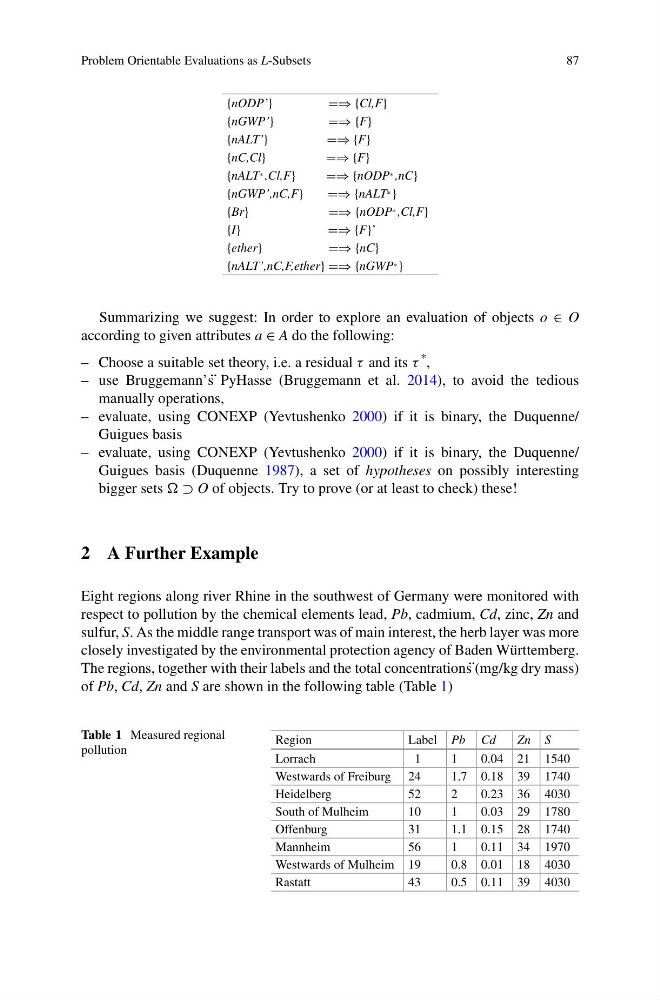
Eight regions along river Rhine in the southwest of Germany were monitored with
respect to pollution by the chemical elements lead, Pb, cadmium, Cd, zinc, Zn and
sulfur, S. As the middle range transport was of main interest, the herb layer was more
closely investigated by the environmental protection agency of Baden Württemberg.
The regions, together with their labels and the total concentrations¨(mg/kg dry mass)
of Pb, Cd, Zn and S are shown in the following table (Table 1)
Table 1 Measured regional
pollution
Region
Label Pb Cd
Zn S
Lorrach
1
1
0.04 21 1540
Westwards of Freiburg 24
1.7 0.18 39 1740
Heidelberg
52
2
0.23 36 4030
South of Mulheim
10
1
0.03 29 1780
Offenburg
31
1.1 0.15 28 1740
Mannheim
56
1
0.11 34 1970
Westwards of Mulheim 19
0.8 0.01 18 4030
Rastatt
43
0.5 0.11 39 4030
87
{nODP’}
= ⇒{ Cl,F}
{nGWP’}
= ⇒{ F}
{nALT’}
= ⇒{ F}
{nC,Cl}
= ⇒ { F}
{nALT ∗ ,Cl,F}
=⇒{nODP ∗ ,nC}
{nGWP’,nC,F}
=⇒{nALT ∗ }
{Br}
= ⇒ { nODP ∗ ,Cl,F}
{I}
= ⇒ { F}’
{ether}
= ⇒ { nC}
{nALT’,nC,F,ether} =⇒ {nGWP ∗ }
Summarizing we suggest: In order to explore an evaluation of objects o ∈ O
according to given attributes a ∈ A do the following:
– Choose a suitable set theory, i.e. a residual τ and its τ * ,
– use Bruggemann’s¨ PyHasse (Bruggemann et al. 2014), to avoid the tedious
manually operations,
– evaluate, using CONEXP (Yevtushenko 2000) if it is binary, the Duquenne/
Guigues basis
– evaluate, using CONEXP (Yevtushenko 2000) if it is binary, the Duquenne/
Guigues basis (Duquenne 1987), a set of hypotheses on possibly interesting
bigger sets ⊃ O of objects. Try to prove (or at least to check) these!
2 A Further Example
Eight regions along river Rhine in the southwest of Germany were monitored with
respect to pollution by the chemical elements lead, Pb, cadmium, Cd, zinc, Zn and
sulfur, S. As the middle range transport was of main interest, the herb layer was more
closely investigated by the environmental protection agency of Baden Württemberg.
The regions, together with their labels and the total concentrations¨(mg/kg dry mass)
of Pb, Cd, Zn and S are shown in the following table (Table 1)
Table 1 Measured regional
pollution
Region
Label Pb Cd
Zn S
Lorrach
1
1
0.04 21 1540
Westwards of Freiburg 24
1.7 0.18 39 1740
Heidelberg
52
2
0.23 36 4030
South of Mulheim
10
1
0.03 29 1780
Offenburg
31
1.1 0.15 28 1740
Mannheim
56
1
0.11 34 1970
Westwards of Mulheim 19
0.8 0.01 18 4030
Rastatt
43
0.5 0.11 39 4030