

1.7. LIMITS, CONTINUITY, AND DIFFERENTIABILITY
73
Activity 1.20.
In this activity, we explore two different functions and classify the points at which each
is not differentiable. Let g be the function given by the rule g(x) = |x|, and let f be the
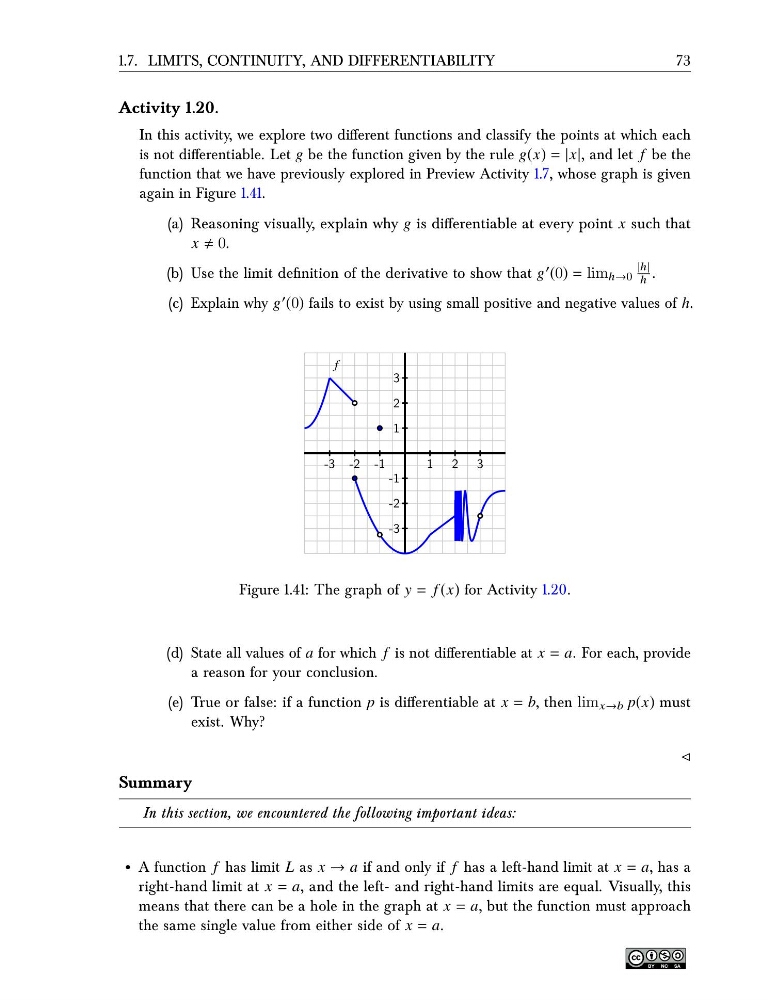
function that we have previously explored in Preview Activity 1.7, whose graph is given
again in Figure 1.41.
(a) Reasoning visually, explain why g is differentiable at every point x such that
x 0.
(b) Use the limit definition of the derivative to show that g ′ (0) = lim h→0
|h|
h .
(c) Explain why g ′ (0) fails to exist by using small positive and negative values of h.
-3 -2 -1
1 2 3
-3
-2
-1
1
2
3
f
Figure 1.41: The graph of y = f (x) for Activity 1.20.
(d) State all values of a for which f is not differentiable at x = a. For each, provide
a reason for your conclusion.
(e) True or false: if a function p is differentiable at x = b, then lim x→b p(x) must
exist. Why?
⊳
Summary
In this section, we encountered the following important ideas:
• A function f has limit L as x → a if and only if f has a left-hand limit at x = a, has a
right-hand limit at x = a, and the left- and right-hand limits are equal. Visually, this
means that there can be a hole in the graph at x = a, but the function must approach
the same single value from either side of x = a.
73
Activity 1.20.
In this activity, we explore two different functions and classify the points at which each
is not differentiable. Let g be the function given by the rule g(x) = |x|, and let f be the
function that we have previously explored in Preview Activity 1.7, whose graph is given
again in Figure 1.41.
(a) Reasoning visually, explain why g is differentiable at every point x such that
x 0.
(b) Use the limit definition of the derivative to show that g ′ (0) = lim h→0
|h|
h .
(c) Explain why g ′ (0) fails to exist by using small positive and negative values of h.
-3 -2 -1
1 2 3
-3
-2
-1
1
2
3
f
Figure 1.41: The graph of y = f (x) for Activity 1.20.
(d) State all values of a for which f is not differentiable at x = a. For each, provide
a reason for your conclusion.
(e) True or false: if a function p is differentiable at x = b, then lim x→b p(x) must
exist. Why?
⊳
Summary
In this section, we encountered the following important ideas:
• A function f has limit L as x → a if and only if f has a left-hand limit at x = a, has a
right-hand limit at x = a, and the left- and right-hand limits are equal. Visually, this
means that there can be a hole in the graph at x = a, but the function must approach
the same single value from either side of x = a.