

72
1.7. LIMITS, CONTINUITY, AND DIFFERENTIABILITY
1
1
f
(1, 1)
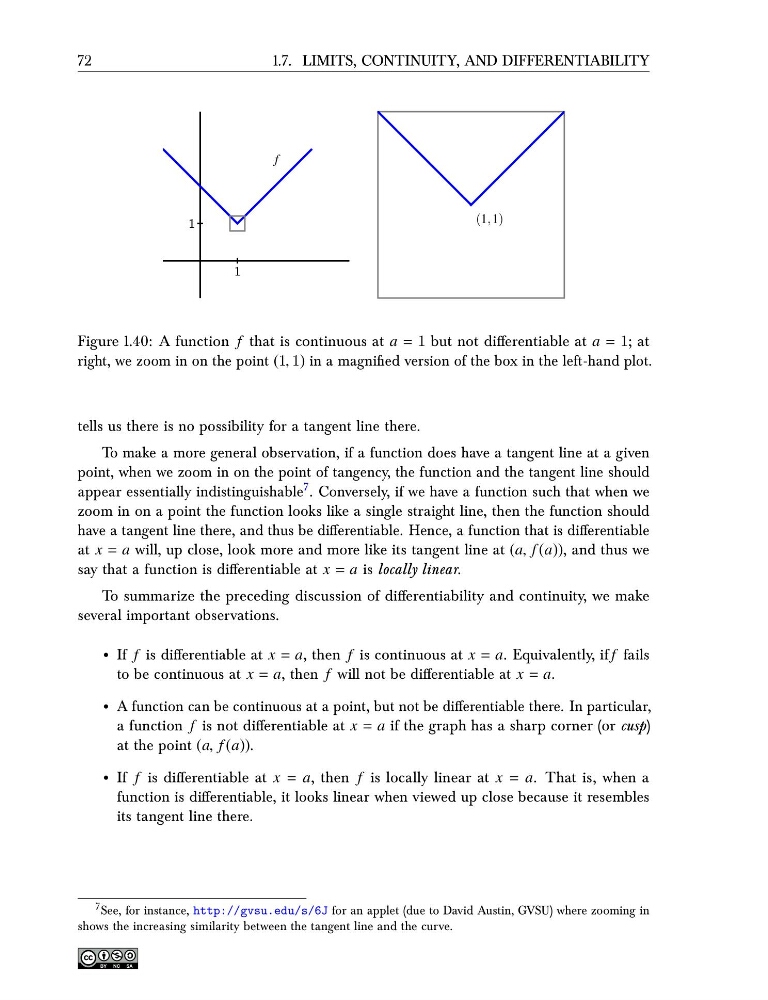
Figure 1.40: A function f that is continuous at a = 1 but not differentiable at a = 1; at
right, we zoom in on the point (1, 1) in a magnified version of the box in the left-hand plot.
tells us there is no possibility for a tangent line there.
To make a more general observation, if a function does have a tangent line at a given
point, when we zoom in on the point of tangency, the function and the tangent line should
appear essentially indistinguishable 7 . Conversely, if we have a function such that when we
zoom in on a point the function looks like a single straight line, then the function should
have a tangent line there, and thus be differentiable. Hence, a function that is differentiable
at x = a will, up close, look more and more like its tangent line at (a, f (a)), and thus we
say that a function is differentiable at x = a is locally linear.
To summarize the preceding discussion of differentiability and continuity, we make
several important observations.
• If f is differentiable at x = a, then f is continuous at x = a. Equivalently, if f fails
to be continuous at x = a, then f will not be differentiable at x = a.
• A function can be continuous at a point, but not be differentiable there. In particular,
a function f is not differentiable at x = a if the graph has a sharp corner (or cusp)
at the point (a, f (a)).
• If f is differentiable at x = a, then f is locally linear at x = a. That is, when a
function is differentiable, it looks linear when viewed up close because it resembles
its tangent line there.
7 See, for instance, http://gvsu.edu/s/6J for an applet (due to David Austin, GVSU) where zooming in
shows the increasing similarity between the tangent line and the curve.
1.7. LIMITS, CONTINUITY, AND DIFFERENTIABILITY
1
1
f
(1, 1)
Figure 1.40: A function f that is continuous at a = 1 but not differentiable at a = 1; at
right, we zoom in on the point (1, 1) in a magnified version of the box in the left-hand plot.
tells us there is no possibility for a tangent line there.
To make a more general observation, if a function does have a tangent line at a given
point, when we zoom in on the point of tangency, the function and the tangent line should
appear essentially indistinguishable 7 . Conversely, if we have a function such that when we
zoom in on a point the function looks like a single straight line, then the function should
have a tangent line there, and thus be differentiable. Hence, a function that is differentiable
at x = a will, up close, look more and more like its tangent line at (a, f (a)), and thus we
say that a function is differentiable at x = a is locally linear.
To summarize the preceding discussion of differentiability and continuity, we make
several important observations.
• If f is differentiable at x = a, then f is continuous at x = a. Equivalently, if f fails
to be continuous at x = a, then f will not be differentiable at x = a.
• A function can be continuous at a point, but not be differentiable there. In particular,
a function f is not differentiable at x = a if the graph has a sharp corner (or cusp)
at the point (a, f (a)).
• If f is differentiable at x = a, then f is locally linear at x = a. That is, when a
function is differentiable, it looks linear when viewed up close because it resembles
its tangent line there.
7 See, for instance, http://gvsu.edu/s/6J for an applet (due to David Austin, GVSU) where zooming in
shows the increasing similarity between the tangent line and the curve.