

68
1.7. LIMITS, CONTINUITY, AND DIFFERENTIABILITY
right-hand limits are not equal to each other, the overall limit will not exist. Said differently,
A function f has limit L as x → a if and only if
lim
x→a −
f (x) = L = lim
x→a +
f (x).
That is, a function has a limit at x = a if and only if both the left- and right-hand
limits at x = a exist and share the same value.
In Preview Activity 1.7, the function f given in Figure 1.35 only fails to have a limit at
two values: at a = −2 (where the left- and right-hand limits are 2 and −1, respectively) and
at x = 2, where lim x→2 + f (x) does not exist). Note well that even at values like a = −1
and a = 0 where there are holes in the graph, the limit still exists.
Activity 1.18.
Consider a function that is piecewise-defined according to the formula
f (x) =
3(x + 2) + 2 for −3 < x < −2
2
3 (x + 2) + 1 for −2 ≤ x < −1
2
3 (x + 2) + 1 for −1 < x < 1
2
for x = 1
4 − x
for x > 1
Use the given formula to answer the following questions.
-2
-1
1
2
-1
1
2
3
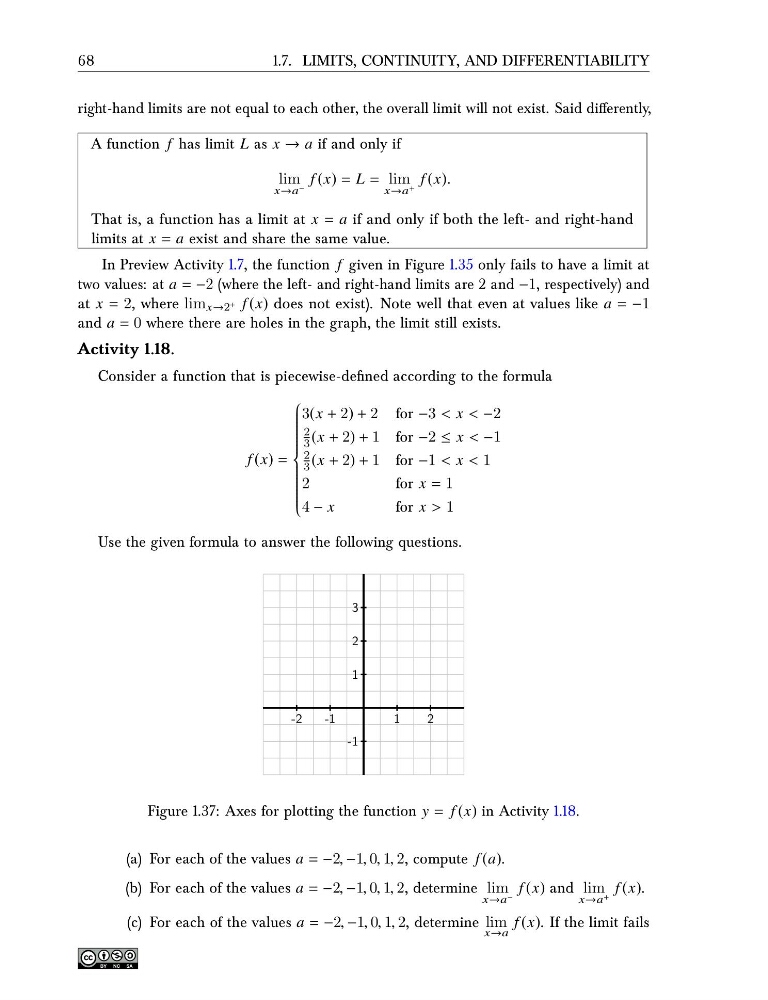
Figure 1.37: Axes for plotting the function y = f (x) in Activity 1.18.
(a) For each of the values a = −2, −1, 0, 1, 2, compute f (a).
(b) For each of the values a = −2, −1, 0, 1, 2, determine lim
x→a −
f (x) and lim
x→a +
f (x).
(c) For each of the values a = −2, −1, 0, 1, 2, determine lim
x→a
f (x). If the limit fails
1.7. LIMITS, CONTINUITY, AND DIFFERENTIABILITY
right-hand limits are not equal to each other, the overall limit will not exist. Said differently,
A function f has limit L as x → a if and only if
lim
x→a −
f (x) = L = lim
x→a +
f (x).
That is, a function has a limit at x = a if and only if both the left- and right-hand
limits at x = a exist and share the same value.
In Preview Activity 1.7, the function f given in Figure 1.35 only fails to have a limit at
two values: at a = −2 (where the left- and right-hand limits are 2 and −1, respectively) and
at x = 2, where lim x→2 + f (x) does not exist). Note well that even at values like a = −1
and a = 0 where there are holes in the graph, the limit still exists.
Activity 1.18.
Consider a function that is piecewise-defined according to the formula
f (x) =
3(x + 2) + 2 for −3 < x < −2
2
3 (x + 2) + 1 for −2 ≤ x < −1
2
3 (x + 2) + 1 for −1 < x < 1
2
for x = 1
4 − x
for x > 1
Use the given formula to answer the following questions.
-2
-1
1
2
-1
1
2
3
Figure 1.37: Axes for plotting the function y = f (x) in Activity 1.18.
(a) For each of the values a = −2, −1, 0, 1, 2, compute f (a).
(b) For each of the values a = −2, −1, 0, 1, 2, determine lim
x→a −
f (x) and lim
x→a +
f (x).
(c) For each of the values a = −2, −1, 0, 1, 2, determine lim
x→a
f (x). If the limit fails