

60
1.6. THE SECOND DERIVATIVE
• on an interval where a is positive, v is
.
• on an interval where a is negative, v is
.
• on an interval where a is zero, v is
.
• on an interval where a is positive, s is
.
• on an interval where a is negative, s is
.
• on an interval where a is zero, s is
.
⊳
The context of position, velocity, and acceleration is an excellent one in which to
understand how a function, its first derivative, and its second derivative are related to one
another. In Activity 1.15, we can replace s, v, and a with an arbitrary function f and its
derivatives f ′ and f ′′ , and essentially all the same observations hold. In particular, note
that f ′ is increasing if and only if f is concave up, and similarly f ′ is increasing if and
only if f ′′ is positive. Likewise, f ′ is decreasing if and only if f is concave down, and f ′
is decreasing if and only if f ′′ is negative.
Activity 1.16.
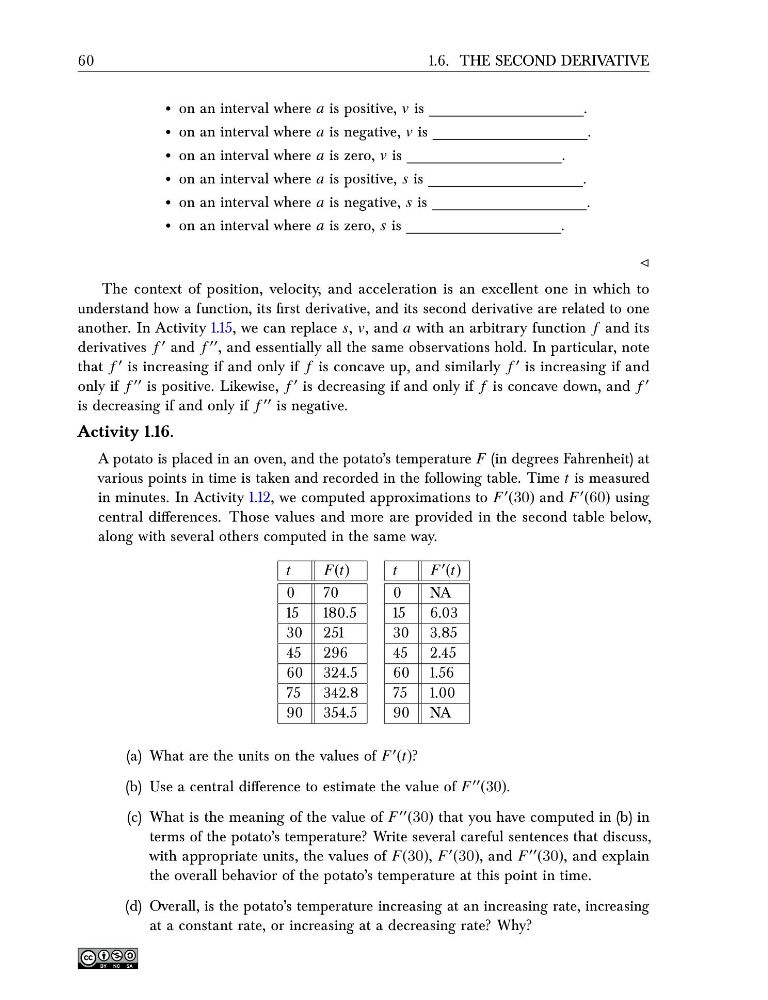
A potato is placed in an oven, and the potato’s temperature F (in degrees Fahrenheit) at
various points in time is taken and recorded in the following table. Time t is measured
in minutes. In Activity 1.12, we computed approximations to F ′ (30) and F ′ (60) using
central differences. Those values and more are provided in the second table below,
along with several others computed in the same way.
t
F(t)
0
70
15
180.5
30 251
45 296
60 324.5
75 342.8
90 354.5
t
F ′ (t)
0
NA
15
6.03
30 3.85
45 2.45
60 1.56
75 1.00
90 NA
(a) What are the units on the values of F ′ (t)?
(b) Use a central difference to estimate the value of F ′′ (30).
(c) What is the meaning of the value of F ′′ (30) that you have computed in (b) in
terms of the potato’s temperature? Write several careful sentences that discuss,
with appropriate units, the values of F(30), F ′ (30), and F ′′ (30), and explain
the overall behavior of the potato’s temperature at this point in time.
(d) Overall, is the potato’s temperature increasing at an increasing rate, increasing
at a constant rate, or increasing at a decreasing rate? Why?
1.6. THE SECOND DERIVATIVE
• on an interval where a is positive, v is
.
• on an interval where a is negative, v is
.
• on an interval where a is zero, v is
.
• on an interval where a is positive, s is
.
• on an interval where a is negative, s is
.
• on an interval where a is zero, s is
.
⊳
The context of position, velocity, and acceleration is an excellent one in which to
understand how a function, its first derivative, and its second derivative are related to one
another. In Activity 1.15, we can replace s, v, and a with an arbitrary function f and its
derivatives f ′ and f ′′ , and essentially all the same observations hold. In particular, note
that f ′ is increasing if and only if f is concave up, and similarly f ′ is increasing if and
only if f ′′ is positive. Likewise, f ′ is decreasing if and only if f is concave down, and f ′
is decreasing if and only if f ′′ is negative.
Activity 1.16.
A potato is placed in an oven, and the potato’s temperature F (in degrees Fahrenheit) at
various points in time is taken and recorded in the following table. Time t is measured
in minutes. In Activity 1.12, we computed approximations to F ′ (30) and F ′ (60) using
central differences. Those values and more are provided in the second table below,
along with several others computed in the same way.
t
F(t)
0
70
15
180.5
30 251
45 296
60 324.5
75 342.8
90 354.5
t
F ′ (t)
0
NA
15
6.03
30 3.85
45 2.45
60 1.56
75 1.00
90 NA
(a) What are the units on the values of F ′ (t)?
(b) Use a central difference to estimate the value of F ′′ (30).
(c) What is the meaning of the value of F ′′ (30) that you have computed in (b) in
terms of the potato’s temperature? Write several careful sentences that discuss,
with appropriate units, the values of F(30), F ′ (30), and F ′′ (30), and explain
the overall behavior of the potato’s temperature at this point in time.
(d) Overall, is the potato’s temperature increasing at an increasing rate, increasing
at a constant rate, or increasing at a decreasing rate? Why?