

1.6. THE SECOND DERIVATIVE
59
Preview Activity 1.6.
Activity 1.15.
The position of a car driving along a straight road at time t in minutes is given by
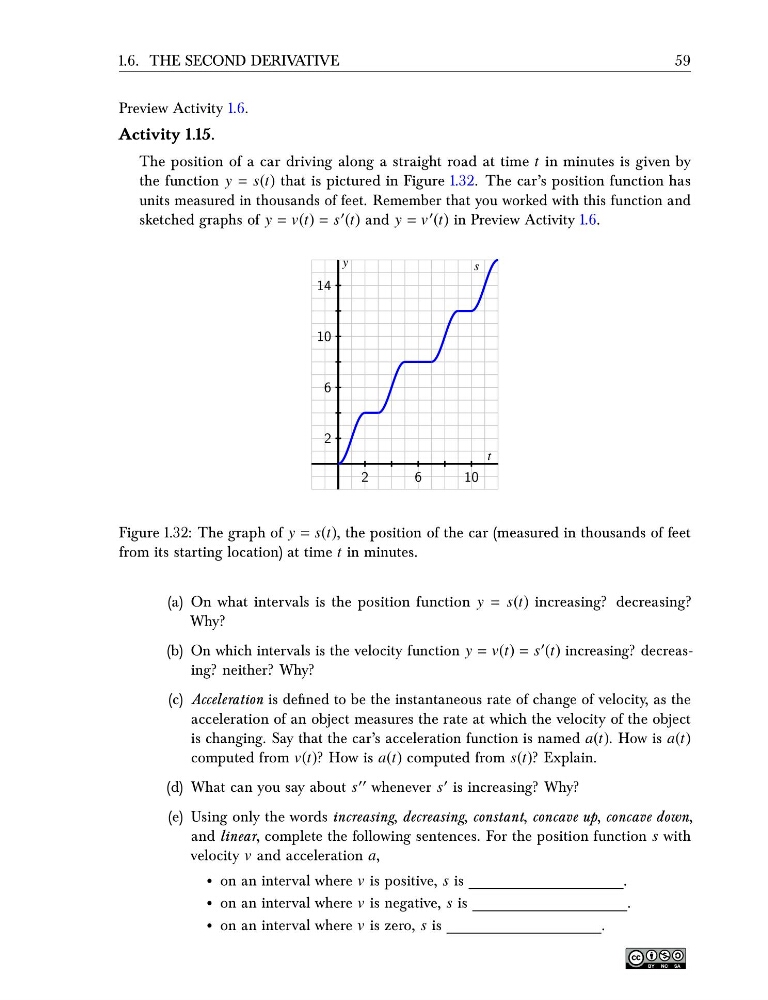
the function y = s(t) that is pictured in Figure 1.32. The car’s position function has
units measured in thousands of feet. Remember that you worked with this function and
sketched graphs of y = v(t) = s ′ (t) and y = v ′ (t) in Preview Activity 1.6.
2
6
10
2
6
10
14
t
y
s
Figure 1.32: The graph of y = s(t), the position of the car (measured in thousands of feet
from its starting location) at time t in minutes.
(a) On what intervals is the position function y = s(t) increasing? decreasing?
Why?
(b) On which intervals is the velocity function y = v(t) = s ′ (t) increasing? decreasing? neither? Why?
(c) Acceleration is defined to be the instantaneous rate of change of velocity, as the
acceleration of an object measures the rate at which the velocity of the object
is changing. Say that the car’s acceleration function is named a(t). How is a(t)
computed from v(t)? How is a(t) computed from s(t)? Explain.
(d) What can you say about s ′′ whenever s ′ is increasing? Why?
(e) Using only the words increasing, decreasing, constant, concave up, concave down,
and linear, complete the following sentences. For the position function s with
velocity v and acceleration a,
• on an interval where v is positive, s is
.
• on an interval where v is negative, s is
.
• on an interval where v is zero, s is
.
59
Preview Activity 1.6.
Activity 1.15.
The position of a car driving along a straight road at time t in minutes is given by
the function y = s(t) that is pictured in Figure 1.32. The car’s position function has
units measured in thousands of feet. Remember that you worked with this function and
sketched graphs of y = v(t) = s ′ (t) and y = v ′ (t) in Preview Activity 1.6.
2
6
10
2
6
10
14
t
y
s
Figure 1.32: The graph of y = s(t), the position of the car (measured in thousands of feet
from its starting location) at time t in minutes.
(a) On what intervals is the position function y = s(t) increasing? decreasing?
Why?
(b) On which intervals is the velocity function y = v(t) = s ′ (t) increasing? decreasing? neither? Why?
(c) Acceleration is defined to be the instantaneous rate of change of velocity, as the
acceleration of an object measures the rate at which the velocity of the object
is changing. Say that the car’s acceleration function is named a(t). How is a(t)
computed from v(t)? How is a(t) computed from s(t)? Explain.
(d) What can you say about s ′′ whenever s ′ is increasing? Why?
(e) Using only the words increasing, decreasing, constant, concave up, concave down,
and linear, complete the following sentences. For the position function s with
velocity v and acceleration a,
• on an interval where v is positive, s is
.
• on an interval where v is negative, s is
.
• on an interval where v is zero, s is
.