

1.6. THE SECOND DERIVATIVE
55
Here we connect these terms more formally to a function’s behavior on an interval of input
values.
Definition 1.5. Given a function f (x) defined on the interval (a, b), we say that f is
increasing on (a, b) provided that for all x, y in the interval (a, b), if x < y, then f (x) < f (y).
Similarly, we say that f is decreasing on (a, b) provided that for all x, y in the interval (a, b),
if x < y, then f (x) > f (y).
Simply put, an increasing function is one that is rising as we move from left to right
along the graph, and a decreasing function is one that falls as the value of the input
increases. For a function that has a derivative, we can use the sign of the derivative to
determine whether or not the function is increasing or decreasing.
Let f be a function that is differentiable on an interval (a, b). We say that f is
increasing on (a, b) if and only if f ′ (x) > 0 for every x such that a < x < b; similarly,
f is decreasing on (a, b) if and only if f ′ (x) < 0. If f ′ (a) = 0, then we say f is neither
increasing nor decreasing at x = a.
-2
2
-2
2
A
B
y = f (x)
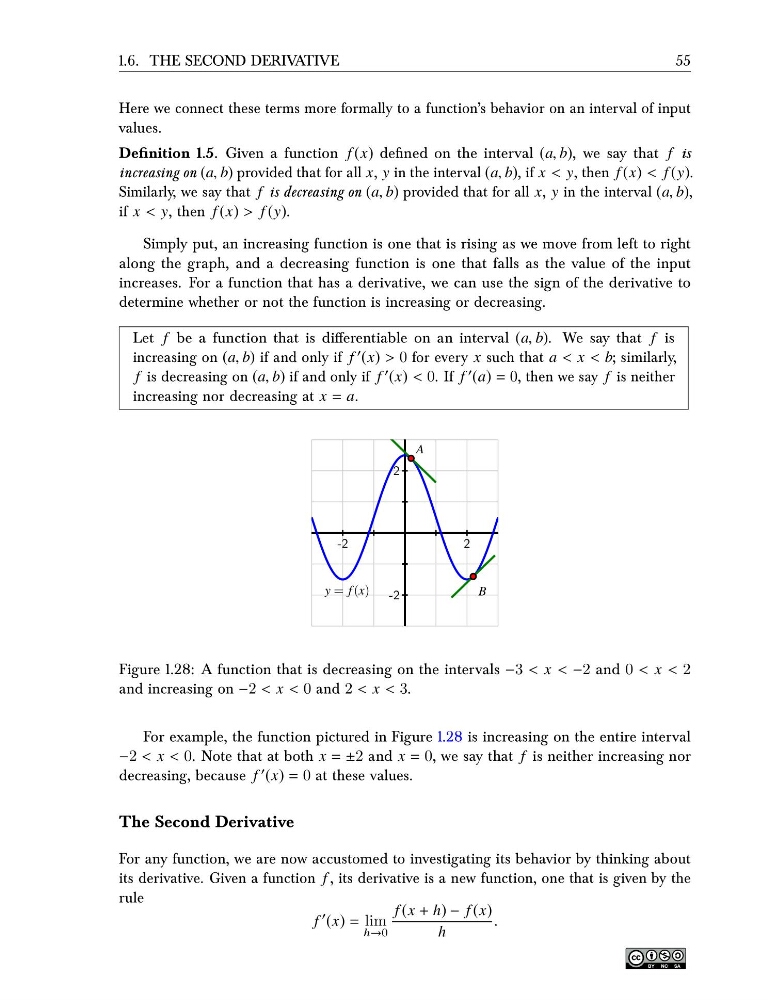
Figure 1.28: A function that is decreasing on the intervals −3 < x < −2 and 0 < x < 2
and increasing on −2 < x < 0 and 2 < x < 3.
For example, the function pictured in Figure 1.28 is increasing on the entire interval
−2 < x < 0. Note that at both x = ±2 and x = 0, we say that f is neither increasing nor
decreasing, because f ′ (x) = 0 at these values.
The Second Derivative
For any function, we are now accustomed to investigating its behavior by thinking about
its derivative. Given a function f , its derivative is a new function, one that is given by the
rule
f
′ (x) = lim
h→0
f (x + h) − f (x)
h
.
55
Here we connect these terms more formally to a function’s behavior on an interval of input
values.
Definition 1.5. Given a function f (x) defined on the interval (a, b), we say that f is
increasing on (a, b) provided that for all x, y in the interval (a, b), if x < y, then f (x) < f (y).
Similarly, we say that f is decreasing on (a, b) provided that for all x, y in the interval (a, b),
if x < y, then f (x) > f (y).
Simply put, an increasing function is one that is rising as we move from left to right
along the graph, and a decreasing function is one that falls as the value of the input
increases. For a function that has a derivative, we can use the sign of the derivative to
determine whether or not the function is increasing or decreasing.
Let f be a function that is differentiable on an interval (a, b). We say that f is
increasing on (a, b) if and only if f ′ (x) > 0 for every x such that a < x < b; similarly,
f is decreasing on (a, b) if and only if f ′ (x) < 0. If f ′ (a) = 0, then we say f is neither
increasing nor decreasing at x = a.
-2
2
-2
2
A
B
y = f (x)
Figure 1.28: A function that is decreasing on the intervals −3 < x < −2 and 0 < x < 2
and increasing on −2 < x < 0 and 2 < x < 3.
For example, the function pictured in Figure 1.28 is increasing on the entire interval
−2 < x < 0. Note that at both x = ±2 and x = 0, we say that f is neither increasing nor
decreasing, because f ′ (x) = 0 at these values.
The Second Derivative
For any function, we are now accustomed to investigating its behavior by thinking about
its derivative. Given a function f , its derivative is a new function, one that is given by the
rule
f
′ (x) = lim
h→0
f (x + h) − f (x)
h
.