

1.5. INTERPRETING, ESTIMATING, AND USING THE DERIVATIVE
47
given by
f
′ (a) ≈
f (a + h) − f (a − h)
2h
,
and this quantity measures the slope of the secant line to y = f (x) through the points
(a − h, f (a − h)) and (a + h, f (a + h)). Anytime we have symmetric data surrounding a
point at which we desire to estimate the derivative, the central difference is an ideal choice
for so doing.
The following activities will further explore the meaning of the derivative in several
different contexts while also viewing the derivative from graphical, numerical, and algebraic
perspectives.
Activity 1.12.
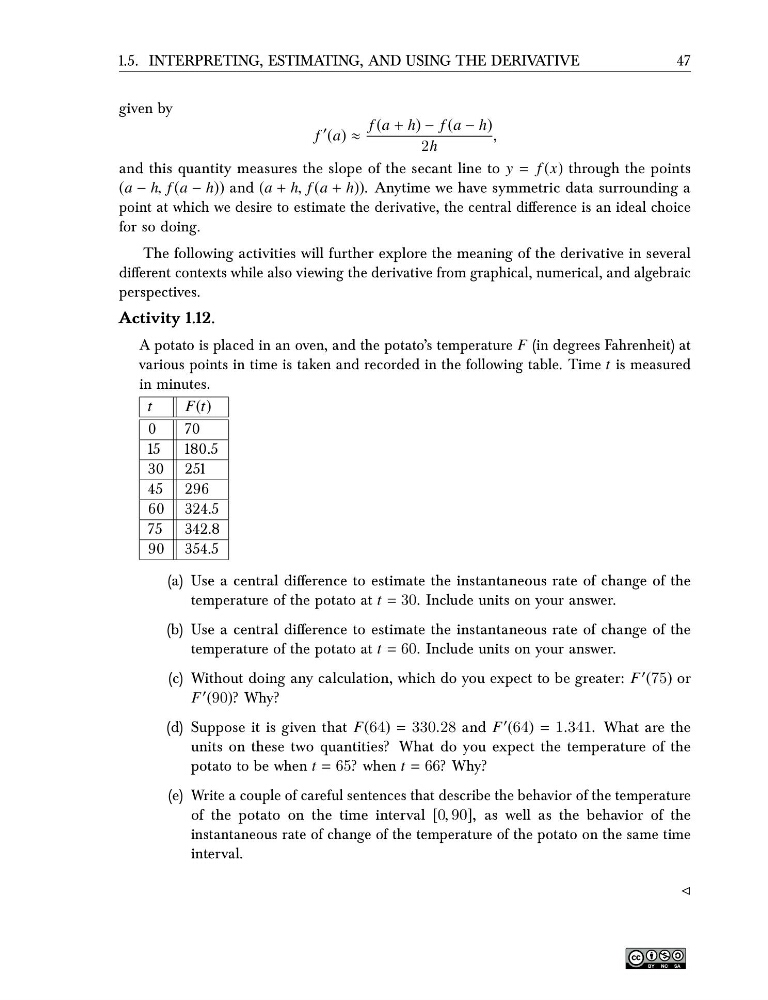
A potato is placed in an oven, and the potato’s temperature F (in degrees Fahrenheit) at
various points in time is taken and recorded in the following table. Time t is measured
in minutes.
t
F(t)
0
70
15
180.5
30 251
45 296
60 324.5
75 342.8
90 354.5
(a) Use a central difference to estimate the instantaneous rate of change of the
temperature of the potato at t = 30. Include units on your answer.
(b) Use a central difference to estimate the instantaneous rate of change of the
temperature of the potato at t = 60. Include units on your answer.
(c) Without doing any calculation, which do you expect to be greater: F ′ (75) or
F ′ (90)? Why?
(d) Suppose it is given that F(64) = 330.28 and F ′ (64) = 1.341. What are the
units on these two quantities? What do you expect the temperature of the
potato to be when t = 65? when t = 66? Why?
(e) Write a couple of careful sentences that describe the behavior of the temperature
of the potato on the time interval [0, 90], as well as the behavior of the
instantaneous rate of change of the temperature of the potato on the same time
interval.
⊳
47
given by
f
′ (a) ≈
f (a + h) − f (a − h)
2h
,
and this quantity measures the slope of the secant line to y = f (x) through the points
(a − h, f (a − h)) and (a + h, f (a + h)). Anytime we have symmetric data surrounding a
point at which we desire to estimate the derivative, the central difference is an ideal choice
for so doing.
The following activities will further explore the meaning of the derivative in several
different contexts while also viewing the derivative from graphical, numerical, and algebraic
perspectives.
Activity 1.12.
A potato is placed in an oven, and the potato’s temperature F (in degrees Fahrenheit) at
various points in time is taken and recorded in the following table. Time t is measured
in minutes.
t
F(t)
0
70
15
180.5
30 251
45 296
60 324.5
75 342.8
90 354.5
(a) Use a central difference to estimate the instantaneous rate of change of the
temperature of the potato at t = 30. Include units on your answer.
(b) Use a central difference to estimate the instantaneous rate of change of the
temperature of the potato at t = 60. Include units on your answer.
(c) Without doing any calculation, which do you expect to be greater: F ′ (75) or
F ′ (90)? Why?
(d) Suppose it is given that F(64) = 330.28 and F ′ (64) = 1.341. What are the
units on these two quantities? What do you expect the temperature of the
potato to be when t = 65? when t = 66? Why?
(e) Write a couple of careful sentences that describe the behavior of the temperature
of the potato on the time interval [0, 90], as well as the behavior of the
instantaneous rate of change of the temperature of the potato on the same time
interval.
⊳