

490
8.4. ALTERNATING SERIES
• S 4 = S 3 − a 4 and so S 4 < S 3 . But a 4 < a 3 , so S 2 < S 4 . Thus,
0 < S 2 < S 4 < S 3 < S 1 .
• S 5 = S 4 + a 5 and so S 4 < S 5 . But a 5 < a 4 , so S 5 < S 3 . Thus,
0 < S 2 < S 4 < S 5 < S 3 < S 1 .
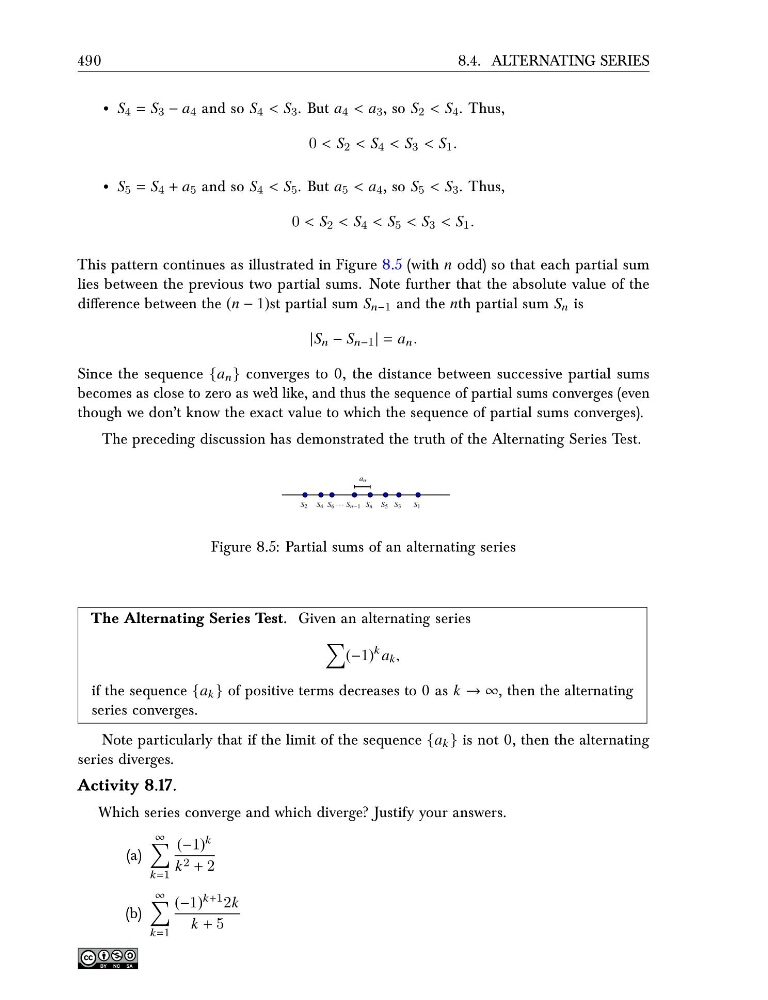
This pattern continues as illustrated in Figure 8.5 (with n odd) so that each partial sum
lies between the previous two partial sums. Note further that the absolute value of the
difference between the (n − 1)st partial sum S n−1 and the nth partial sum S n is
|S n − S n−1 | = a n .
Since the sequence {a n } converges to 0, the distance between successive partial sums
becomes as close to zero as we’ d like, and thus the sequence of partial sums converges (even
though we don’t know the exact value to which the sequence of partial sums converges).
The preceding discussion has demonstrated the truth of the Alternating Series Test.
an
S1
S2
S3
S4
S5
S6 . . . Sn−1 Sn
Figure 8.5: Partial sums of an alternating series
The Alternating Series Test. Given an alternating series
(−1)
k a k ,
if the sequence {a k } of positive terms decreases to 0 as k → ∞, then the alternating
series converges.
Note particularly that if the limit of the sequence {a k } is not 0, then the alternating
series diverges.
Activity 8.17.
Which series converge and which diverge? Justify your answers.
(a)
∞
k=1
(−1) k
k 2 + 2
(b)
∞
k=1
(−1) k+1 2k
k + 5
8.4. ALTERNATING SERIES
• S 4 = S 3 − a 4 and so S 4 < S 3 . But a 4 < a 3 , so S 2 < S 4 . Thus,
0 < S 2 < S 4 < S 3 < S 1 .
• S 5 = S 4 + a 5 and so S 4 < S 5 . But a 5 < a 4 , so S 5 < S 3 . Thus,
0 < S 2 < S 4 < S 5 < S 3 < S 1 .
This pattern continues as illustrated in Figure 8.5 (with n odd) so that each partial sum
lies between the previous two partial sums. Note further that the absolute value of the
difference between the (n − 1)st partial sum S n−1 and the nth partial sum S n is
|S n − S n−1 | = a n .
Since the sequence {a n } converges to 0, the distance between successive partial sums
becomes as close to zero as we’ d like, and thus the sequence of partial sums converges (even
though we don’t know the exact value to which the sequence of partial sums converges).
The preceding discussion has demonstrated the truth of the Alternating Series Test.
an
S1
S2
S3
S4
S5
S6 . . . Sn−1 Sn
Figure 8.5: Partial sums of an alternating series
The Alternating Series Test. Given an alternating series
(−1)
k a k ,
if the sequence {a k } of positive terms decreases to 0 as k → ∞, then the alternating
series converges.
Note particularly that if the limit of the sequence {a k } is not 0, then the alternating
series diverges.
Activity 8.17.
Which series converge and which diverge? Justify your answers.
(a)
∞
k=1
(−1) k
k 2 + 2
(b)
∞
k=1
(−1) k+1 2k
k + 5