

8.4. ALTERNATING SERIES
489
1
k=1
(−1)
k+1 1
k
=
6
k=1
(−1)
k+1 1
k
=
2
k=1
(−1)
k+1 1
k
=
7
k=1
(−1)
k+1 1
k
=
3
k=1
(−1)
k+1 1
k
=
8
k=1
(−1)
k+1 1
k
=
4
k=1
(−1)
k+1 1
k
=
9
k=1
(−1)
k+1 1
k
=
5
k=1
(−1)
k+1 1
k
=
10
k=1
(−1)
k+1 1
k
=
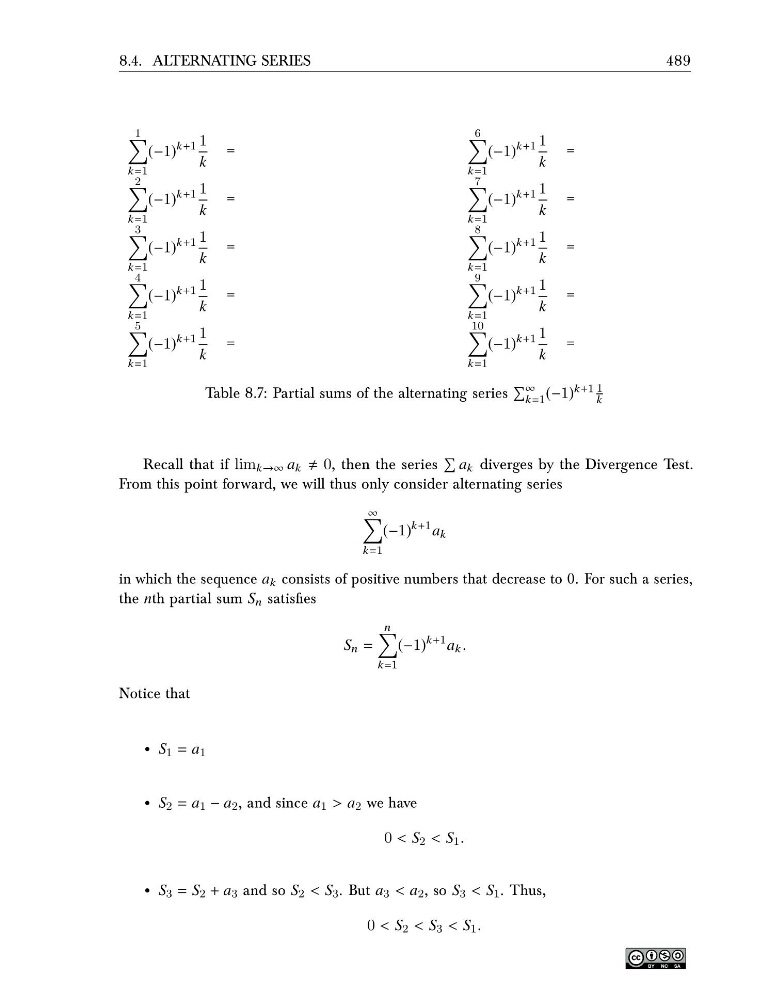
Table 8.7: Partial sums of the alternating series
∞
k=1 (−1) k+1 1
k
Recall that if lim k→∞ a k 0, then the series
a k diverges by the Divergence Test.
From this point forward, we will thus only consider alternating series
∞
k=1
(−1)
k+1 a k
in which the sequence a k consists of positive numbers that decrease to 0. For such a series,
the nth partial sum S n satisfies
S n =
n
k=1
(−1)
k+1 a k .
Notice that
• S 1 = a 1
• S 2 = a 1 − a 2 , and since a 1 > a 2 we have
0 < S 2 < S 1 .
• S 3 = S 2 + a 3 and so S 2 < S 3 . But a 3 < a 2 , so S 3 < S 1 . Thus,
0 < S 2 < S 3 < S 1 .
489
1
k=1
(−1)
k+1 1
k
=
6
k=1
(−1)
k+1 1
k
=
2
k=1
(−1)
k+1 1
k
=
7
k=1
(−1)
k+1 1
k
=
3
k=1
(−1)
k+1 1
k
=
8
k=1
(−1)
k+1 1
k
=
4
k=1
(−1)
k+1 1
k
=
9
k=1
(−1)
k+1 1
k
=
5
k=1
(−1)
k+1 1
k
=
10
k=1
(−1)
k+1 1
k
=
Table 8.7: Partial sums of the alternating series
∞
k=1 (−1) k+1 1
k
Recall that if lim k→∞ a k 0, then the series
a k diverges by the Divergence Test.
From this point forward, we will thus only consider alternating series
∞
k=1
(−1)
k+1 a k
in which the sequence a k consists of positive numbers that decrease to 0. For such a series,
the nth partial sum S n satisfies
S n =
n
k=1
(−1)
k+1 a k .
Notice that
• S 1 = a 1
• S 2 = a 1 − a 2 , and since a 1 > a 2 we have
0 < S 2 < S 1 .
• S 3 = S 2 + a 3 and so S 2 < S 3 . But a 3 < a 2 , so S 3 < S 1 . Thus,
0 < S 2 < S 3 < S 1 .