

476
8.3. SERIES OF REAL NUMBERS
1
2
3
4
5
6
7
8
9
10
0.00
0.25
0.50
0.75
1.00
k
a k
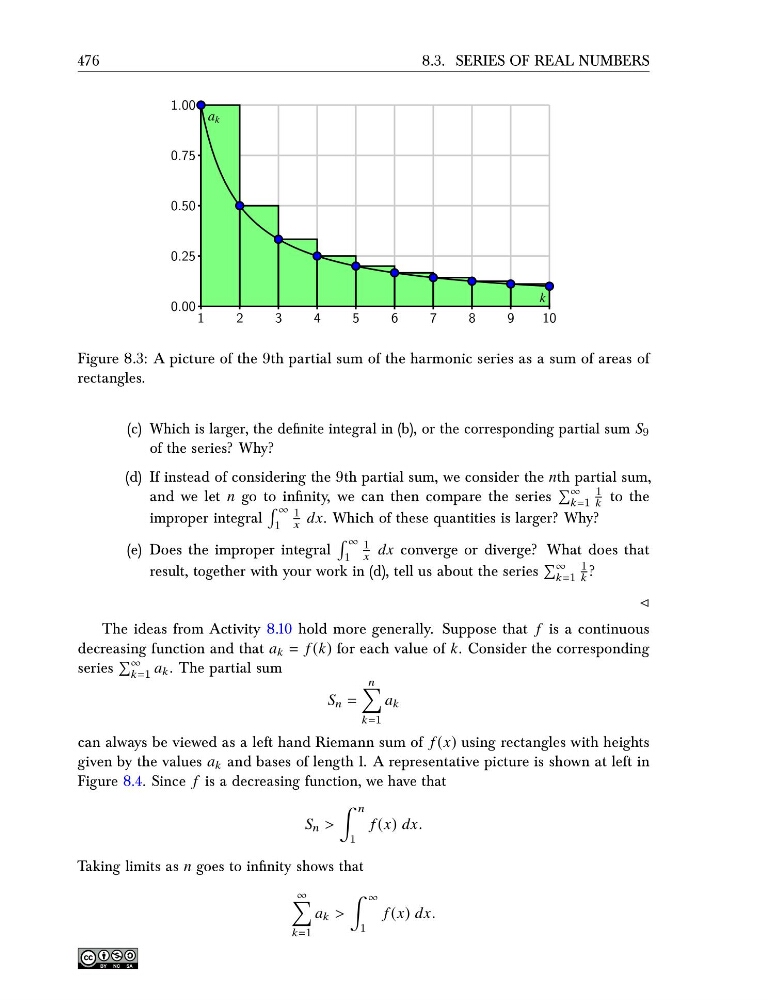
Figure 8.3: A picture of the 9th partial sum of the harmonic series as a sum of areas of
rectangles.
(c) Which is larger, the definite integral in (b), or the corresponding partial sum S 9
of the series? Why?
(d) If instead of considering the 9th partial sum, we consider the nth partial sum,
and we let n go to infinity, we can then compare the series
∞
k=1
1
k to the
improper integral
∞
1
1
x dx. Which of these quantities is larger? Why?
(e) Does the improper integral
∞
1
1
x dx converge or diverge? What does that
result, together with your work in (d), tell us about the series
∞
k=1
1
k ?
⊳
The ideas from Activity 8.10 hold more generally. Suppose that f is a continuous
decreasing function and that a k = f (k) for each value of k. Consider the corresponding
series
∞
k=1 a k . The partial sum
S n =
n
k=1
a k
can always be viewed as a left hand Riemann sum of f (x) using rectangles with heights
given by the values a k and bases of length 1. A representative picture is shown at left in
Figure 8.4. Since f is a decreasing function, we have that
S n >
n
1
f (x) dx.
Taking limits as n goes to infinity shows that
∞
k=1
a k >
∞
1
f (x) dx.
8.3. SERIES OF REAL NUMBERS
1
2
3
4
5
6
7
8
9
10
0.00
0.25
0.50
0.75
1.00
k
a k
Figure 8.3: A picture of the 9th partial sum of the harmonic series as a sum of areas of
rectangles.
(c) Which is larger, the definite integral in (b), or the corresponding partial sum S 9
of the series? Why?
(d) If instead of considering the 9th partial sum, we consider the nth partial sum,
and we let n go to infinity, we can then compare the series
∞
k=1
1
k to the
improper integral
∞
1
1
x dx. Which of these quantities is larger? Why?
(e) Does the improper integral
∞
1
1
x dx converge or diverge? What does that
result, together with your work in (d), tell us about the series
∞
k=1
1
k ?
⊳
The ideas from Activity 8.10 hold more generally. Suppose that f is a continuous
decreasing function and that a k = f (k) for each value of k. Consider the corresponding
series
∞
k=1 a k . The partial sum
S n =
n
k=1
a k
can always be viewed as a left hand Riemann sum of f (x) using rectangles with heights
given by the values a k and bases of length 1. A representative picture is shown at left in
Figure 8.4. Since f is a decreasing function, we have that
S n >
n
1
f (x) dx.
Taking limits as n goes to infinity shows that
∞
k=1
a k >
∞
1
f (x) dx.