

8.3. SERIES OF REAL NUMBERS
475
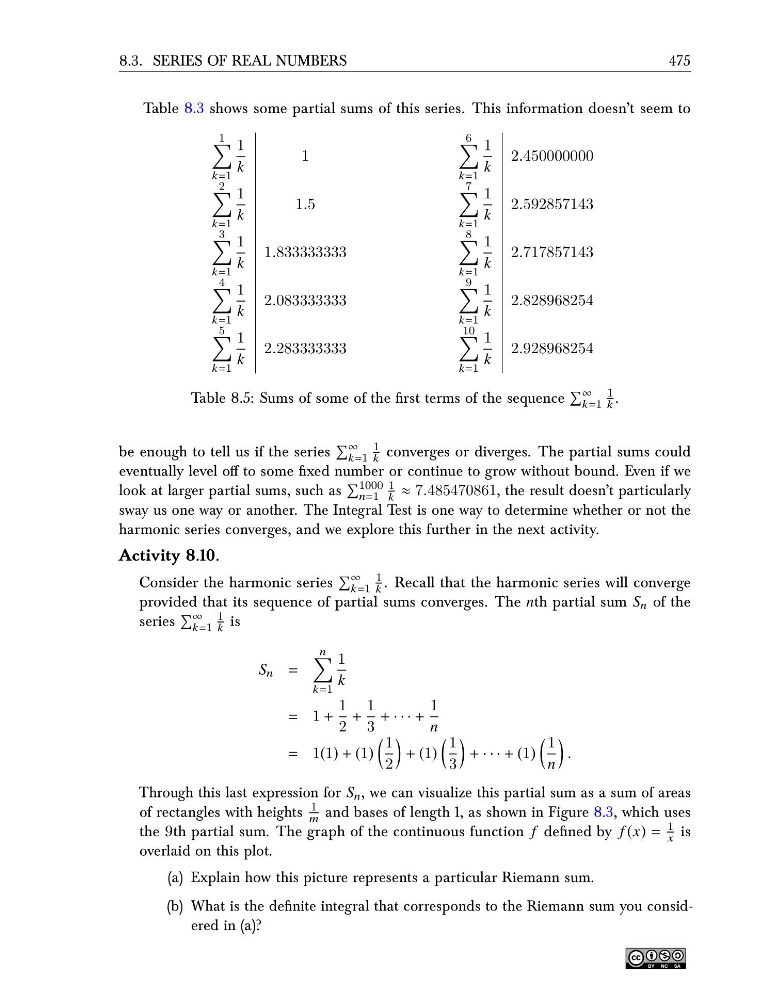
Table 8.3 shows some partial sums of this series. This information doesn’t seem to
1
k=1
1
k
1
6
k=1
1
k
2.450000000
2
k=1
1
k
1.5
7
k=1
1
k
2.592857143
3
k=1
1
k
1.833333333
8
k=1
1
k
2.717857143
4
k=1
1
k
2.083333333
9
k=1
1
k
2.828968254
5
k=1
1
k
2.283333333
10
k=1
1
k
2.928968254
Table 8.5: Sums of some of the first terms of the sequence
∞
k=1
1
k .
be enough to tell us if the series
∞
k=1
1
k converges or diverges. The partial sums could
eventually level off to some fixed number or continue to grow without bound. Even if we
look at larger partial sums, such as
1000
n=1
1
k ≈ 7.485470861, the result doesn’t particularly
sway us one way or another. The Integral Test is one way to determine whether or not the
harmonic series converges, and we explore this further in the next activity.
Activity 8.10.
Consider the harmonic series
∞
k=1
1
k . Recall that the harmonic series will converge
provided that its sequence of partial sums converges. The nth partial sum S n of the
series
∞
k=1
1
k is
S n =
n
k=1
1
k
= 1 +
1
2
+
1
3
+ · · · +
1
n
= 1(1) + (1)
1
2
+ (1)
1
3
+ · · · + (1)
1
n
.
Through this last expression for S n , we can visualize this partial sum as a sum of areas
of rectangles with heights
1
m and bases of length 1, as shown in Figure 8.3, which uses
the 9th partial sum. The graph of the continuous function f defined by f (x) =
1
x is
overlaid on this plot.
(a) Explain how this picture represents a particular Riemann sum.
(b) What is the definite integral that corresponds to the Riemann sum you considered in (a)?
475
Table 8.3 shows some partial sums of this series. This information doesn’t seem to
1
k=1
1
k
1
6
k=1
1
k
2.450000000
2
k=1
1
k
1.5
7
k=1
1
k
2.592857143
3
k=1
1
k
1.833333333
8
k=1
1
k
2.717857143
4
k=1
1
k
2.083333333
9
k=1
1
k
2.828968254
5
k=1
1
k
2.283333333
10
k=1
1
k
2.928968254
Table 8.5: Sums of some of the first terms of the sequence
∞
k=1
1
k .
be enough to tell us if the series
∞
k=1
1
k converges or diverges. The partial sums could
eventually level off to some fixed number or continue to grow without bound. Even if we
look at larger partial sums, such as
1000
n=1
1
k ≈ 7.485470861, the result doesn’t particularly
sway us one way or another. The Integral Test is one way to determine whether or not the
harmonic series converges, and we explore this further in the next activity.
Activity 8.10.
Consider the harmonic series
∞
k=1
1
k . Recall that the harmonic series will converge
provided that its sequence of partial sums converges. The nth partial sum S n of the
series
∞
k=1
1
k is
S n =
n
k=1
1
k
= 1 +
1
2
+
1
3
+ · · · +
1
n
= 1(1) + (1)
1
2
+ (1)
1
3
+ · · · + (1)
1
n
.
Through this last expression for S n , we can visualize this partial sum as a sum of areas
of rectangles with heights
1
m and bases of length 1, as shown in Figure 8.3, which uses
the 9th partial sum. The graph of the continuous function f defined by f (x) =
1
x is
overlaid on this plot.
(a) Explain how this picture represents a particular Riemann sum.
(b) What is the definite integral that corresponds to the Riemann sum you considered in (a)?