

28
1.3. THE DERIVATIVE OF A FUNCTION AT A POINT
Activity 1.7.
Consider the function f whose formula is f (x) = 3 − 2x.
(a) What familiar type of function is f ? What can you say about the slope of f at
every value of x?
(b) Compute the average rate of change of f on the intervals [1, 4], [3, 7], and
[5, 5 + h]; simplify each result as much as possible. What do you notice about
these quantities?
(c) Use the limit definition of the derivative to compute the exact instantaneous
rate of change of f with respect to x at the value a = 1. That is, compute f ′ (1)
using the limit definition. Show your work. Is your result surprising?
(d) Without doing any additional computations, what are the values of f ′ (2), f ′ (π),
and f ′ (−
√
2)? Why?
⊳
Activity 1.8.
A water balloon is tossed vertically in the air from a window. The balloon’s height in
feet at time t in seconds after being launched is given by s(t) = −16t 2 + 16t + 32. Use
this function to respond to each of the following questions.
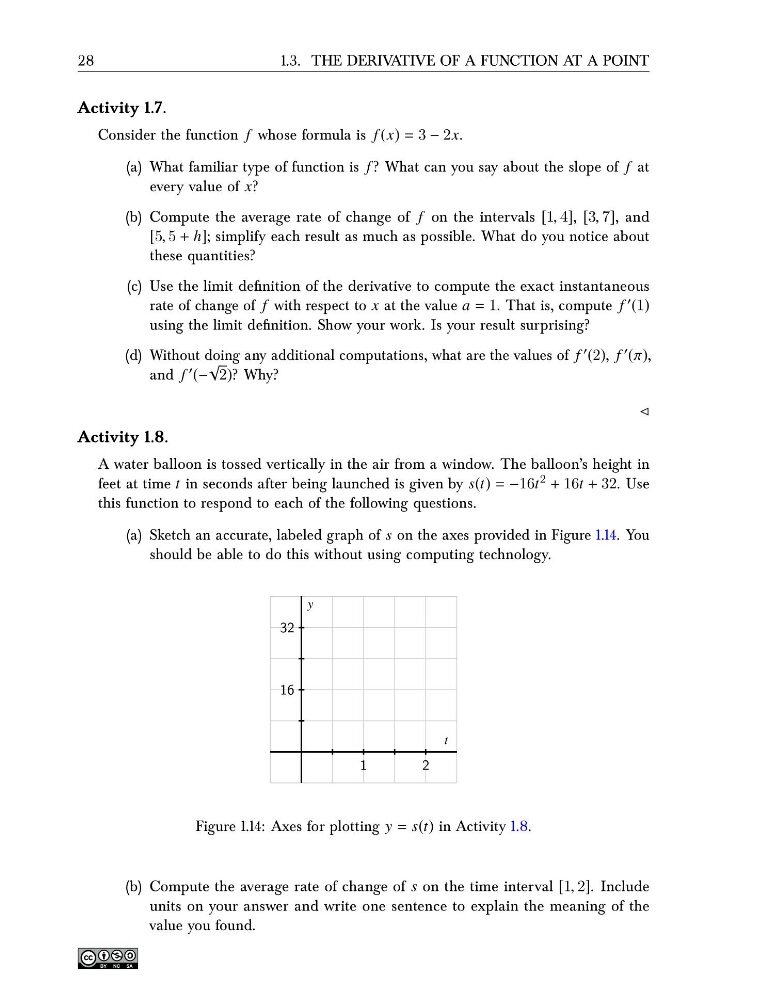
(a) Sketch an accurate, labeled graph of s on the axes provided in Figure 1.14. You
should be able to do this without using computing technology.
1
2
16
32
t
y
Figure 1.14: Axes for plotting y = s(t) in Activity 1.8.
(b) Compute the average rate of change of s on the time interval [1, 2]. Include
units on your answer and write one sentence to explain the meaning of the
value you found.
1.3. THE DERIVATIVE OF A FUNCTION AT A POINT
Activity 1.7.
Consider the function f whose formula is f (x) = 3 − 2x.
(a) What familiar type of function is f ? What can you say about the slope of f at
every value of x?
(b) Compute the average rate of change of f on the intervals [1, 4], [3, 7], and
[5, 5 + h]; simplify each result as much as possible. What do you notice about
these quantities?
(c) Use the limit definition of the derivative to compute the exact instantaneous
rate of change of f with respect to x at the value a = 1. That is, compute f ′ (1)
using the limit definition. Show your work. Is your result surprising?
(d) Without doing any additional computations, what are the values of f ′ (2), f ′ (π),
and f ′ (−
√
2)? Why?
⊳
Activity 1.8.
A water balloon is tossed vertically in the air from a window. The balloon’s height in
feet at time t in seconds after being launched is given by s(t) = −16t 2 + 16t + 32. Use
this function to respond to each of the following questions.
(a) Sketch an accurate, labeled graph of s on the axes provided in Figure 1.14. You
should be able to do this without using computing technology.
1
2
16
32
t
y
Figure 1.14: Axes for plotting y = s(t) in Activity 1.8.
(b) Compute the average rate of change of s on the time interval [1, 2]. Include
units on your answer and write one sentence to explain the meaning of the
value you found.