

406
7.2. QUALITATIVE BEHAVIOR OF SOLUTIONS TO DES
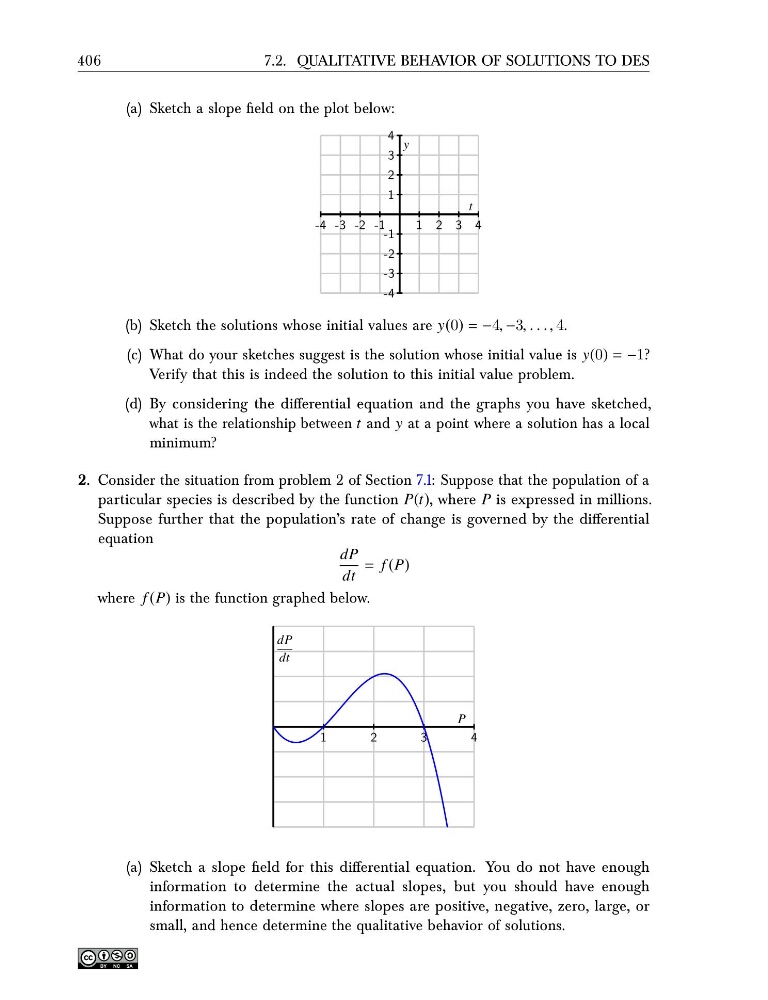
(a) Sketch a slope field on the plot below:
-4 -3 -2 -1
1 2 3 4
-4
-3
-2
-1
1
2
3
4
t
y
(b) Sketch the solutions whose initial values are y(0) = −4, −3, . . . , 4.
(c) What do your sketches suggest is the solution whose initial value is y(0) = −1?
Verify that this is indeed the solution to this initial value problem.
(d) By considering the differential equation and the graphs you have sketched,
what is the relationship between t and y at a point where a solution has a local
minimum?
2. Consider the situation from problem 2 of Section 7.1: Suppose that the population of a
particular species is described by the function P(t), where P is expressed in millions.
Suppose further that the population’s rate of change is governed by the differential
equation
dP
dt
= f (P)
where f (P) is the function graphed below.
1
2
3
4
P
dP
dt
(a) Sketch a slope field for this differential equation. You do not have enough
information to determine the actual slopes, but you should have enough
information to determine where slopes are positive, negative, zero, large, or
small, and hence determine the qualitative behavior of solutions.
7.2. QUALITATIVE BEHAVIOR OF SOLUTIONS TO DES
(a) Sketch a slope field on the plot below:
-4 -3 -2 -1
1 2 3 4
-4
-3
-2
-1
1
2
3
4
t
y
(b) Sketch the solutions whose initial values are y(0) = −4, −3, . . . , 4.
(c) What do your sketches suggest is the solution whose initial value is y(0) = −1?
Verify that this is indeed the solution to this initial value problem.
(d) By considering the differential equation and the graphs you have sketched,
what is the relationship between t and y at a point where a solution has a local
minimum?
2. Consider the situation from problem 2 of Section 7.1: Suppose that the population of a
particular species is described by the function P(t), where P is expressed in millions.
Suppose further that the population’s rate of change is governed by the differential
equation
dP
dt
= f (P)
where f (P) is the function graphed below.
1
2
3
4
P
dP
dt
(a) Sketch a slope field for this differential equation. You do not have enough
information to determine the actual slopes, but you should have enough
information to determine where slopes are positive, negative, zero, large, or
small, and hence determine the qualitative behavior of solutions.