

396
7.1. AN INTRODUCTION TO DIFFERENTIAL EQUATIONS
(f) What do you think is the temperature of the room? Explain your thinking.
(g) Verify that T(t) = 75 + 30e −t/15 is the solution to the differential equation with
initial value T(0) = 105. What happens to this solution after a long time?
2. Suppose that the population of a particular species is described by the function P(t),
where P is expressed in millions. Suppose further that the population’s rate of change
is governed by the differential equation
dP
dt
= f (P)
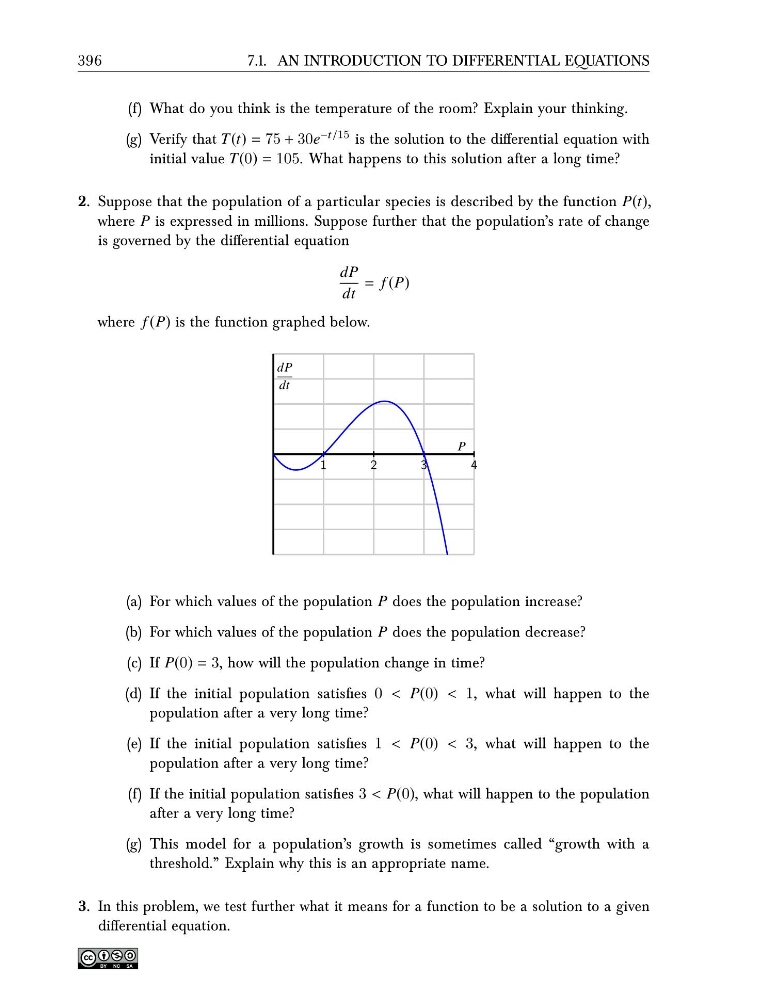
where f (P) is the function graphed below.
1
2
3
4
P
dP
dt
(a) For which values of the population P does the population increase?
(b) For which values of the population P does the population decrease?
(c) If P(0) = 3, how will the population change in time?
(d) If the initial population satisfies 0 < P(0) < 1, what will happen to the
population after a very long time?
(e) If the initial population satisfies 1 < P(0) < 3, what will happen to the
population after a very long time?
(f) If the initial population satisfies 3 < P(0), what will happen to the population
after a very long time?
(g) This model for a population’s growth is sometimes called “growth with a
threshold.” Explain why this is an appropriate name.
3. In this problem, we test further what it means for a function to be a solution to a given
differential equation.
7.1. AN INTRODUCTION TO DIFFERENTIAL EQUATIONS
(f) What do you think is the temperature of the room? Explain your thinking.
(g) Verify that T(t) = 75 + 30e −t/15 is the solution to the differential equation with
initial value T(0) = 105. What happens to this solution after a long time?
2. Suppose that the population of a particular species is described by the function P(t),
where P is expressed in millions. Suppose further that the population’s rate of change
is governed by the differential equation
dP
dt
= f (P)
where f (P) is the function graphed below.
1
2
3
4
P
dP
dt
(a) For which values of the population P does the population increase?
(b) For which values of the population P does the population decrease?
(c) If P(0) = 3, how will the population change in time?
(d) If the initial population satisfies 0 < P(0) < 1, what will happen to the
population after a very long time?
(e) If the initial population satisfies 1 < P(0) < 3, what will happen to the
population after a very long time?
(f) If the initial population satisfies 3 < P(0), what will happen to the population
after a very long time?
(g) This model for a population’s growth is sometimes called “growth with a
threshold.” Explain why this is an appropriate name.
3. In this problem, we test further what it means for a function to be a solution to a given
differential equation.