

7.1. AN INTRODUCTION TO DIFFERENTIAL EQUATIONS
395
Summary
In this section, we encountered the following important ideas:
• A differential equation is simply an equation that describes the derivative(s) of an
unknown function.
• Physical principles, as well as some everyday situations, often describe how a quantity
changes, which lead to differential equations.
• A solution to a differential equation is a function whose derivatives satisfy the equation’s
description. Differential equations typically have infinitely many solutions, parametrized
by the initial values.
Exercises
1. Suppose that T(t) represents the temperature of a cup of coffee set out in a room, where
T is expressed in degrees Fahrenheit and t in minutes. A physical principle known as
Newton’s Law of Cooling tells us that
dT
dt
= −
1
15
T + 5.
(a) Supposes that T(0) = 105. What does the differential equation give us for the
value of
dT
dt
| T =105 ? Explain in a complete sentence the meaning of these two
facts.
(b) Is T increasing or decreasing at t = 0?
(c) What is the approximate temperature at t = 1?
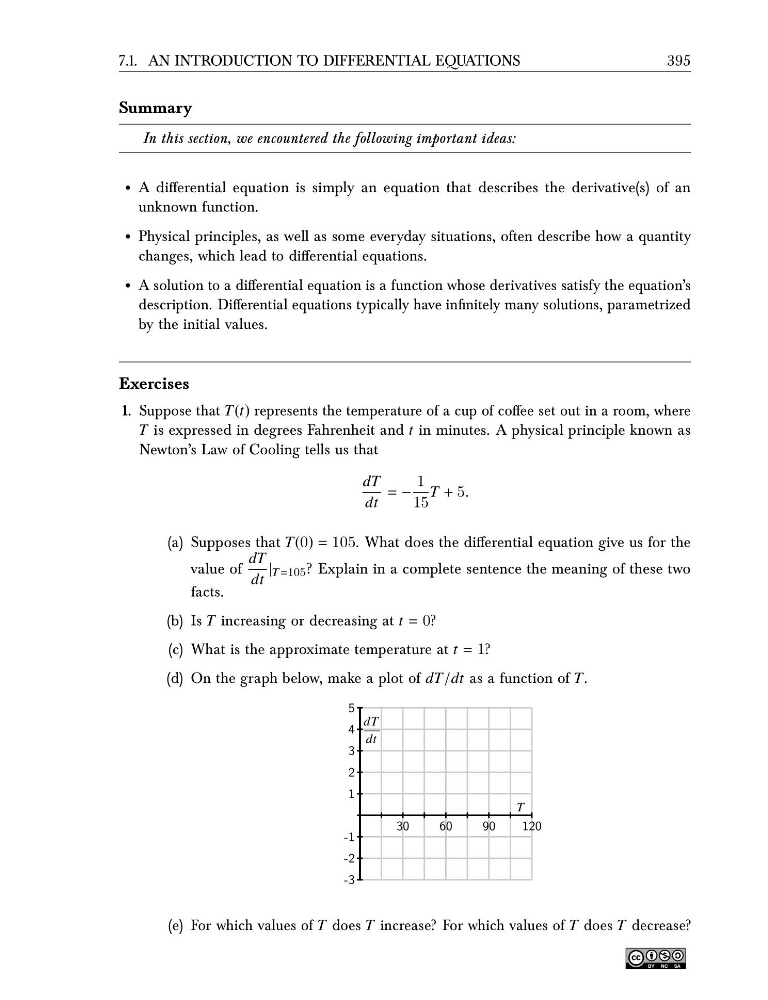
(d) On the graph below, make a plot of dT/dt as a function of T.
30
60
90
120
-3
-2
-1
1
2
3
4
5
T
dT
dt
(e) For which values of T does T increase? For which values of T does T decrease?
395
Summary
In this section, we encountered the following important ideas:
• A differential equation is simply an equation that describes the derivative(s) of an
unknown function.
• Physical principles, as well as some everyday situations, often describe how a quantity
changes, which lead to differential equations.
• A solution to a differential equation is a function whose derivatives satisfy the equation’s
description. Differential equations typically have infinitely many solutions, parametrized
by the initial values.
Exercises
1. Suppose that T(t) represents the temperature of a cup of coffee set out in a room, where
T is expressed in degrees Fahrenheit and t in minutes. A physical principle known as
Newton’s Law of Cooling tells us that
dT
dt
= −
1
15
T + 5.
(a) Supposes that T(0) = 105. What does the differential equation give us for the
value of
dT
dt
| T =105 ? Explain in a complete sentence the meaning of these two
facts.
(b) Is T increasing or decreasing at t = 0?
(c) What is the approximate temperature at t = 1?
(d) On the graph below, make a plot of dT/dt as a function of T.
30
60
90
120
-3
-2
-1
1
2
3
4
5
T
dT
dt
(e) For which values of T does T increase? For which values of T does T decrease?