

370
6.4. PHYSICS APPLICATIONS: WORK, FORCE, AND PRESSURE
crock, hence relieving the water buildup beneath the foundation. One of the questions
we’ d like to answer is: how much work does a sump pump accomplish?
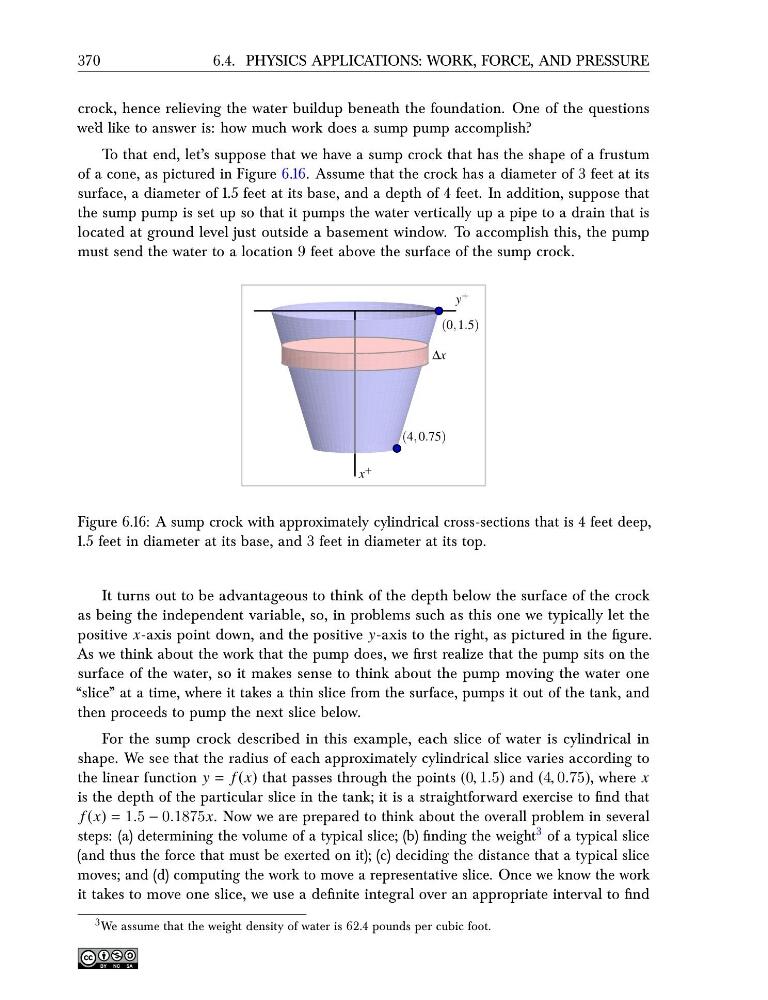
To that end, let’s suppose that we have a sump crock that has the shape of a frustum
of a cone, as pictured in Figure 6.16. Assume that the crock has a diameter of 3 feet at its
surface, a diameter of 1.5 feet at its base, and a depth of 4 feet. In addition, suppose that
the sump pump is set up so that it pumps the water vertically up a pipe to a drain that is
located at ground level just outside a basement window. To accomplish this, the pump
must send the water to a location 9 feet above the surface of the sump crock.
∆x
x +
y +
(0, 1.5)
(4, 0.75)
Figure 6.16: A sump crock with approximately cylindrical cross-sections that is 4 feet deep,
1.5 feet in diameter at its base, and 3 feet in diameter at its top.
It turns out to be advantageous to think of the depth below the surface of the crock
as being the independent variable, so, in problems such as this one we typically let the
positive x-axis point down, and the positive y-axis to the right, as pictured in the figure.
As we think about the work that the pump does, we first realize that the pump sits on the
surface of the water, so it makes sense to think about the pump moving the water one
“slice” at a time, where it takes a thin slice from the surface, pumps it out of the tank, and
then proceeds to pump the next slice below.
For the sump crock described in this example, each slice of water is cylindrical in
shape. We see that the radius of each approximately cylindrical slice varies according to
the linear function y = f (x) that passes through the points (0, 1.5) and (4, 0.75), where x
is the depth of the particular slice in the tank; it is a straightforward exercise to find that
f (x) = 1.5 − 0.1875x. Now we are prepared to think about the overall problem in several
steps: (a) determining the volume of a typical slice; (b) finding the weight 3 of a typical slice
(and thus the force that must be exerted on it); (c) deciding the distance that a typical slice
moves; and (d) computing the work to move a representative slice. Once we know the work
it takes to move one slice, we use a definite integral over an appropriate interval to find
3 We assume that the weight density of water is 62.4 pounds per cubic foot.
6.4. PHYSICS APPLICATIONS: WORK, FORCE, AND PRESSURE
crock, hence relieving the water buildup beneath the foundation. One of the questions
we’ d like to answer is: how much work does a sump pump accomplish?
To that end, let’s suppose that we have a sump crock that has the shape of a frustum
of a cone, as pictured in Figure 6.16. Assume that the crock has a diameter of 3 feet at its
surface, a diameter of 1.5 feet at its base, and a depth of 4 feet. In addition, suppose that
the sump pump is set up so that it pumps the water vertically up a pipe to a drain that is
located at ground level just outside a basement window. To accomplish this, the pump
must send the water to a location 9 feet above the surface of the sump crock.
∆x
x +
y +
(0, 1.5)
(4, 0.75)
Figure 6.16: A sump crock with approximately cylindrical cross-sections that is 4 feet deep,
1.5 feet in diameter at its base, and 3 feet in diameter at its top.
It turns out to be advantageous to think of the depth below the surface of the crock
as being the independent variable, so, in problems such as this one we typically let the
positive x-axis point down, and the positive y-axis to the right, as pictured in the figure.
As we think about the work that the pump does, we first realize that the pump sits on the
surface of the water, so it makes sense to think about the pump moving the water one
“slice” at a time, where it takes a thin slice from the surface, pumps it out of the tank, and
then proceeds to pump the next slice below.
For the sump crock described in this example, each slice of water is cylindrical in
shape. We see that the radius of each approximately cylindrical slice varies according to
the linear function y = f (x) that passes through the points (0, 1.5) and (4, 0.75), where x
is the depth of the particular slice in the tank; it is a straightforward exercise to find that
f (x) = 1.5 − 0.1875x. Now we are prepared to think about the overall problem in several
steps: (a) determining the volume of a typical slice; (b) finding the weight 3 of a typical slice
(and thus the force that must be exerted on it); (c) deciding the distance that a typical slice
moves; and (d) computing the work to move a representative slice. Once we know the work
it takes to move one slice, we use a definite integral over an appropriate interval to find
3 We assume that the weight density of water is 62.4 pounds per cubic foot.