

6.4. PHYSICS APPLICATIONS: WORK, FORCE, AND PRESSURE
369
natural length. That is, the force to compress (or extend) a spring x units
from its natural length is F(x) = k x for some constant k (which is called the
spring constant.) For springs, we choose to measure the force in pounds and the
distance the spring is compressed in feet.
Suppose that a force of 5 pounds extends a particular spring 4 inches (1/3 foot)
beyond its natural length.
i. Use the given fact that F(1/3) = 5 to find the spring constant k.
ii. Find the work done to extend the spring from its natural length to 1 foot
beyond its natural length.
iii. Find the work required to extend the spring from 1 foot beyond its natural
length to 1.5 feet beyond its natural length.
⊳
Work: Pumping Liquid from a Tank
In certain geographic locations where the water table is high, residential homes with
basements have a peculiar feature: in the basement, one finds a large hole in the floor,
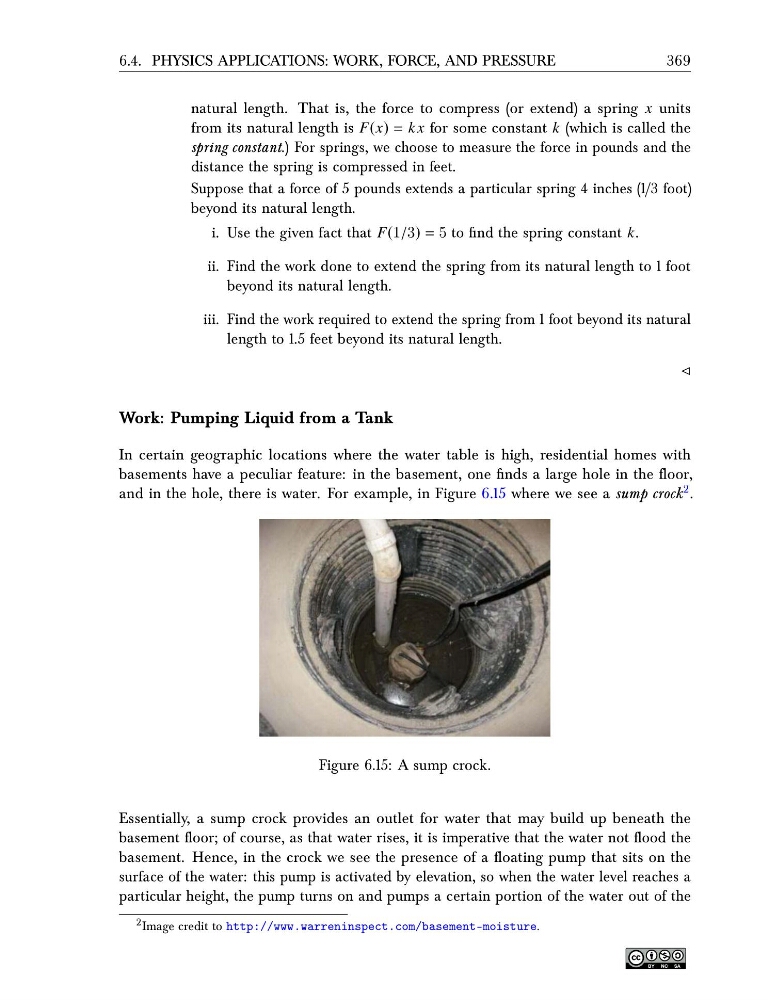
and in the hole, there is water. For example, in Figure 6.15 where we see a sump crock 2 .
Figure 6.15: A sump crock.
Essentially, a sump crock provides an outlet for water that may build up beneath the
basement floor; of course, as that water rises, it is imperative that the water not flood the
basement. Hence, in the crock we see the presence of a floating pump that sits on the
surface of the water: this pump is activated by elevation, so when the water level reaches a
particular height, the pump turns on and pumps a certain portion of the water out of the
2 Image credit to http://www.warreninspect.com/basement-moisture.
369
natural length. That is, the force to compress (or extend) a spring x units
from its natural length is F(x) = k x for some constant k (which is called the
spring constant.) For springs, we choose to measure the force in pounds and the
distance the spring is compressed in feet.
Suppose that a force of 5 pounds extends a particular spring 4 inches (1/3 foot)
beyond its natural length.
i. Use the given fact that F(1/3) = 5 to find the spring constant k.
ii. Find the work done to extend the spring from its natural length to 1 foot
beyond its natural length.
iii. Find the work required to extend the spring from 1 foot beyond its natural
length to 1.5 feet beyond its natural length.
⊳
Work: Pumping Liquid from a Tank
In certain geographic locations where the water table is high, residential homes with
basements have a peculiar feature: in the basement, one finds a large hole in the floor,
and in the hole, there is water. For example, in Figure 6.15 where we see a sump crock 2 .
Figure 6.15: A sump crock.
Essentially, a sump crock provides an outlet for water that may build up beneath the
basement floor; of course, as that water rises, it is imperative that the water not flood the
basement. Hence, in the crock we see the presence of a floating pump that sits on the
surface of the water: this pump is activated by elevation, so when the water level reaches a
particular height, the pump turns on and pumps a certain portion of the water out of the
2 Image credit to http://www.warreninspect.com/basement-moisture.