

6.3. DENSITY, MASS, AND CENTER OF MASS
357
x
∆x
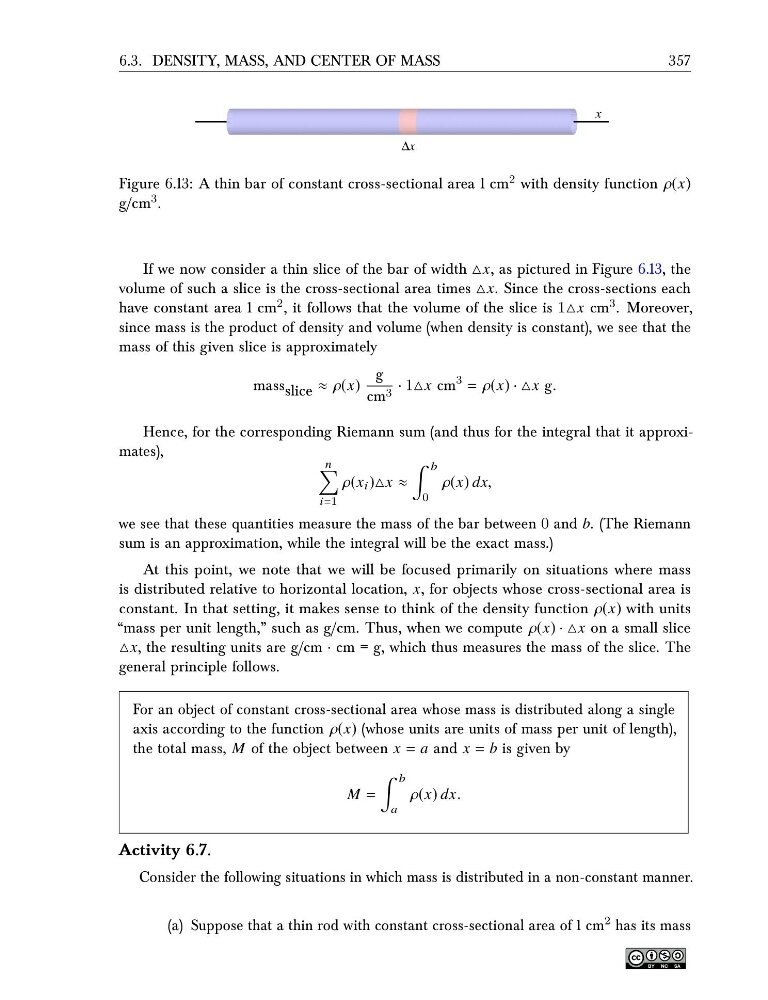
Figure 6.13: A thin bar of constant cross-sectional area 1 cm 2 with density function ρ(x)
g/cm 3 .
If we now consider a thin slice of the bar of width △x, as pictured in Figure 6.13, the
volume of such a slice is the cross-sectional area times △x. Since the cross-sections each
have constant area 1 cm 2 , it follows that the volume of the slice is 1△x cm 3 . Moreover,
since mass is the product of density and volume (when density is constant), we see that the
mass of this given slice is approximately
mass slice ≈ ρ(x)
g
cm 3 · 1△x cm
3 = ρ(x) · △x g.
Hence, for the corresponding Riemann sum (and thus for the integral that it approximates),
n
i=1
ρ(x i )△x ≈
b
0
ρ(x) dx,
we see that these quantities measure the mass of the bar between 0 and b. (The Riemann
sum is an approximation, while the integral will be the exact mass.)
At this point, we note that we will be focused primarily on situations where mass
is distributed relative to horizontal location, x, for objects whose cross-sectional area is
constant. In that setting, it makes sense to think of the density function ρ(x) with units
“mass per unit length,” such as g/cm. Thus, when we compute ρ(x) · △x on a small slice
△x, the resulting units are g/cm · cm = g, which thus measures the mass of the slice. The
general principle follows.
For an object of constant cross-sectional area whose mass is distributed along a single
axis according to the function ρ(x) (whose units are units of mass per unit of length),
the total mass, M of the object between x = a and x = b is given by
M =
b
a
ρ(x) dx.
Activity 6.7.
Consider the following situations in which mass is distributed in a non-constant manner.
(a) Suppose that a thin rod with constant cross-sectional area of 1 cm 2 has its mass
357
x
∆x
Figure 6.13: A thin bar of constant cross-sectional area 1 cm 2 with density function ρ(x)
g/cm 3 .
If we now consider a thin slice of the bar of width △x, as pictured in Figure 6.13, the
volume of such a slice is the cross-sectional area times △x. Since the cross-sections each
have constant area 1 cm 2 , it follows that the volume of the slice is 1△x cm 3 . Moreover,
since mass is the product of density and volume (when density is constant), we see that the
mass of this given slice is approximately
mass slice ≈ ρ(x)
g
cm 3 · 1△x cm
3 = ρ(x) · △x g.
Hence, for the corresponding Riemann sum (and thus for the integral that it approximates),
n
i=1
ρ(x i )△x ≈
b
0
ρ(x) dx,
we see that these quantities measure the mass of the bar between 0 and b. (The Riemann
sum is an approximation, while the integral will be the exact mass.)
At this point, we note that we will be focused primarily on situations where mass
is distributed relative to horizontal location, x, for objects whose cross-sectional area is
constant. In that setting, it makes sense to think of the density function ρ(x) with units
“mass per unit length,” such as g/cm. Thus, when we compute ρ(x) · △x on a small slice
△x, the resulting units are g/cm · cm = g, which thus measures the mass of the slice. The
general principle follows.
For an object of constant cross-sectional area whose mass is distributed along a single
axis according to the function ρ(x) (whose units are units of mass per unit of length),
the total mass, M of the object between x = a and x = b is given by
M =
b
a
ρ(x) dx.
Activity 6.7.
Consider the following situations in which mass is distributed in a non-constant manner.
(a) Suppose that a thin rod with constant cross-sectional area of 1 cm 2 has its mass