

6.1. USING DEFINITE INTEGRALS TO FIND AREA AND LENGTH
339
the region whose area is being found, (iii) draw and label a representative slice, and (iv)
state the area of the representative slice. Then, state a definite integral whose value is
the exact area of the region, and evaluate the integral to find the numeric value of the
region’s area. Note well: At the step where you draw a representative slice, you need
to make a choice about whether to slice vertically or horizontally.
(a) The finite region bounded by x = y 2 and x = 6 − 2y 2 .
(b) The finite region bounded by x = 1 − y 2 and x = 2 − 2y 2 .
(c) The area bounded by the x-axis, y = x 2 , and y = 2 − x.
(d) The finite regions between the curves x = y 2 − 2y and y = x.
⊳
Finding the length of a curve
In addition to being able to use definite integrals to find the areas of certain geometric
regions, we can also use the definite integral to find the length of a portion of a curve. We
use the same fundamental principle: we take a curve whose length we cannot easily find,
and slice it up into small pieces whose lengths we can easily approximate. In particular, we
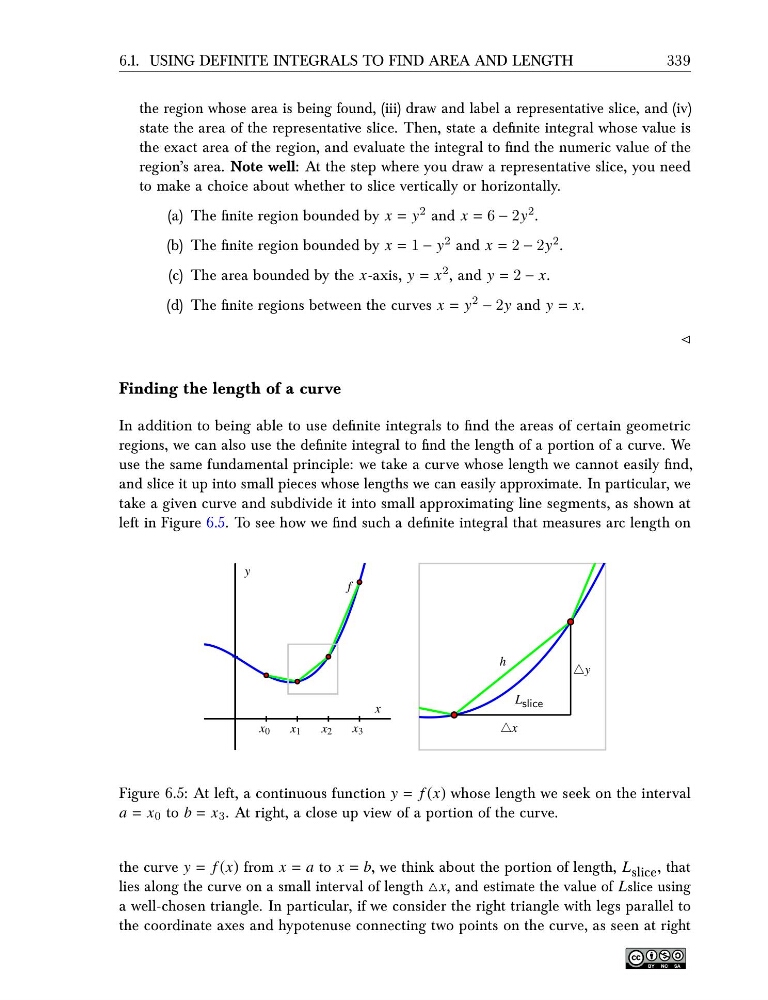
take a given curve and subdivide it into small approximating line segments, as shown at
left in Figure 6.5. To see how we find such a definite integral that measures arc length on
x
y
f
x 0
x 1
x 2
x 3
△x
△y
h
L slice
Figure 6.5: At left, a continuous function y = f (x) whose length we seek on the interval
a = x 0 to b = x 3 . At right, a close up view of a portion of the curve.
the curve y = f (x) from x = a to x = b, we think about the portion of length, L slice , that
lies along the curve on a small interval of length △x, and estimate the value of Lslice using
a well-chosen triangle. In particular, if we consider the right triangle with legs parallel to
the coordinate axes and hypotenuse connecting two points on the curve, as seen at right
339
the region whose area is being found, (iii) draw and label a representative slice, and (iv)
state the area of the representative slice. Then, state a definite integral whose value is
the exact area of the region, and evaluate the integral to find the numeric value of the
region’s area. Note well: At the step where you draw a representative slice, you need
to make a choice about whether to slice vertically or horizontally.
(a) The finite region bounded by x = y 2 and x = 6 − 2y 2 .
(b) The finite region bounded by x = 1 − y 2 and x = 2 − 2y 2 .
(c) The area bounded by the x-axis, y = x 2 , and y = 2 − x.
(d) The finite regions between the curves x = y 2 − 2y and y = x.
⊳
Finding the length of a curve
In addition to being able to use definite integrals to find the areas of certain geometric
regions, we can also use the definite integral to find the length of a portion of a curve. We
use the same fundamental principle: we take a curve whose length we cannot easily find,
and slice it up into small pieces whose lengths we can easily approximate. In particular, we
take a given curve and subdivide it into small approximating line segments, as shown at
left in Figure 6.5. To see how we find such a definite integral that measures arc length on
x
y
f
x 0
x 1
x 2
x 3
△x
△y
h
L slice
Figure 6.5: At left, a continuous function y = f (x) whose length we seek on the interval
a = x 0 to b = x 3 . At right, a close up view of a portion of the curve.
the curve y = f (x) from x = a to x = b, we think about the portion of length, L slice , that
lies along the curve on a small interval of length △x, and estimate the value of Lslice using
a well-chosen triangle. In particular, if we consider the right triangle with legs parallel to
the coordinate axes and hypotenuse connecting two points on the curve, as seen at right