

338
6.1. USING DEFINITE INTEGRALS TO FIND AREA AND LENGTH
1
2
3
-1
1
2
x = y 2 − 1
y = x − 1
1
2
3
-1
1
2
x = y 2 − 1
y = x − 1
1
2
3
-1
1
2
x = y 2 − 1
x = y + 1
△y
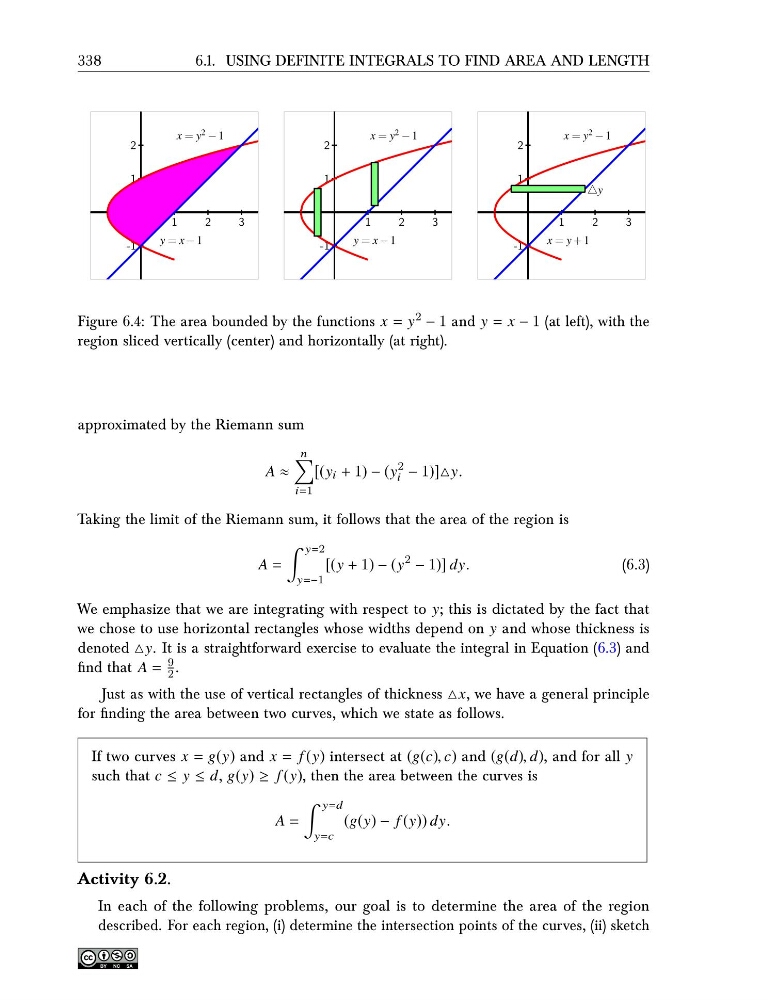
Figure 6.4: The area bounded by the functions x = y 2 − 1 and y = x − 1 (at left), with the
region sliced vertically (center) and horizontally (at right).
approximated by the Riemann sum
A ≈
n
i=1
[(y i + 1) − (y
2
i − 1)]△y.
Taking the limit of the Riemann sum, it follows that the area of the region is
A =
y=2
y=−1
[(y + 1) − (y
2 − 1)] dy.
(6.3)
We emphasize that we are integrating with respect to y; this is dictated by the fact that
we chose to use horizontal rectangles whose widths depend on y and whose thickness is
denoted △y. It is a straightforward exercise to evaluate the integral in Equation (6.3) and
find that A =
9
2 .
Just as with the use of vertical rectangles of thickness △x, we have a general principle
for finding the area between two curves, which we state as follows.
If two curves x = g(y) and x = f (y) intersect at (g(c), c) and (g(d), d), and for all y
such that c ≤ y ≤ d, g(y) ≥ f (y), then the area between the curves is
A =
y=d
y=c
(g(y) − f (y)) dy.
Activity 6.2.
In each of the following problems, our goal is to determine the area of the region
described. For each region, (i) determine the intersection points of the curves, (ii) sketch
6.1. USING DEFINITE INTEGRALS TO FIND AREA AND LENGTH
1
2
3
-1
1
2
x = y 2 − 1
y = x − 1
1
2
3
-1
1
2
x = y 2 − 1
y = x − 1
1
2
3
-1
1
2
x = y 2 − 1
x = y + 1
△y
Figure 6.4: The area bounded by the functions x = y 2 − 1 and y = x − 1 (at left), with the
region sliced vertically (center) and horizontally (at right).
approximated by the Riemann sum
A ≈
n
i=1
[(y i + 1) − (y
2
i − 1)]△y.
Taking the limit of the Riemann sum, it follows that the area of the region is
A =
y=2
y=−1
[(y + 1) − (y
2 − 1)] dy.
(6.3)
We emphasize that we are integrating with respect to y; this is dictated by the fact that
we chose to use horizontal rectangles whose widths depend on y and whose thickness is
denoted △y. It is a straightforward exercise to evaluate the integral in Equation (6.3) and
find that A =
9
2 .
Just as with the use of vertical rectangles of thickness △x, we have a general principle
for finding the area between two curves, which we state as follows.
If two curves x = g(y) and x = f (y) intersect at (g(c), c) and (g(d), d), and for all y
such that c ≤ y ≤ d, g(y) ≥ f (y), then the area between the curves is
A =
y=d
y=c
(g(y) − f (y)) dy.
Activity 6.2.
In each of the following problems, our goal is to determine the area of the region
described. For each region, (i) determine the intersection points of the curves, (ii) sketch