

328
5.6. NUMERICAL INTEGRATION
(c) Estimate the total distance traveled on [0, 1.8] by computing L 3 , R 3 , and T 3 .
Which of these under-estimates the true distance traveled?
(d) Estimate the total distance traveled on [0, 1.8] by computing M 3 . Is this an
over- or under-estimate? Why?
(e) Using your results from (c) and (d), improve your estimate further by using
Simpson’s Rule.
(f) What is your best estimate of the average velocity of the car on [0, 1.8]? Why?
What are the units on this quantity?
0.3 0.6 0.9 1.2 1.5 1.8
v
t
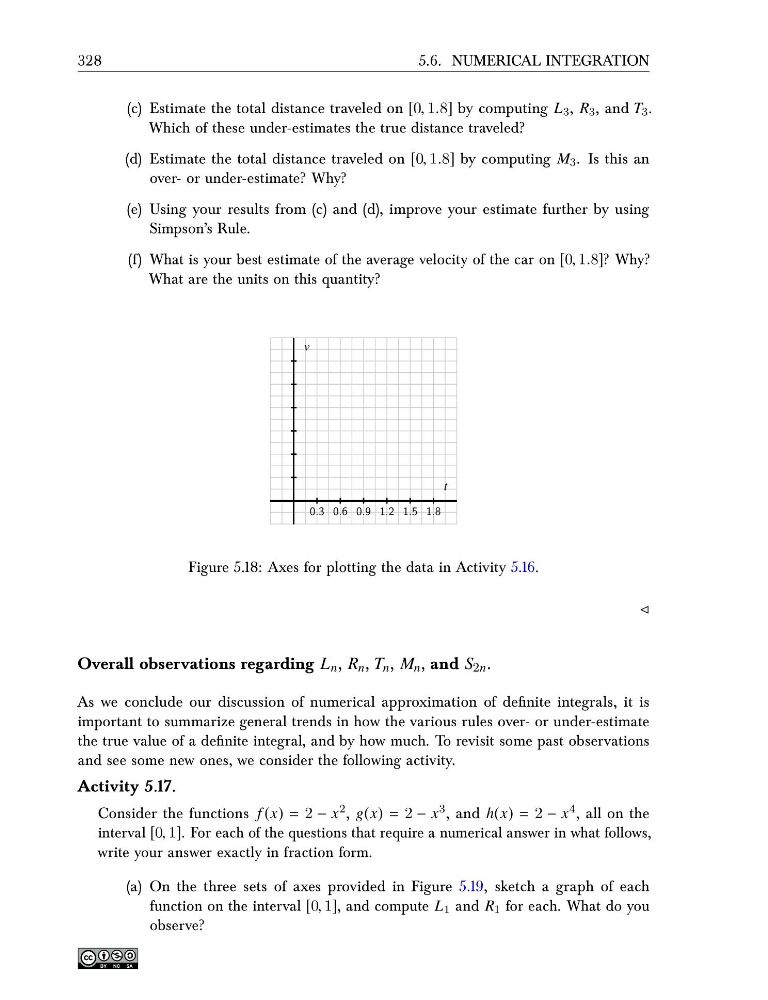
Figure 5.18: Axes for plotting the data in Activity 5.16.
⊳
Overall observations regarding L n , R n , T n , M n , and S 2n .
As we conclude our discussion of numerical approximation of definite integrals, it is
important to summarize general trends in how the various rules over- or under-estimate
the true value of a definite integral, and by how much. To revisit some past observations
and see some new ones, we consider the following activity.
Activity 5.17.
Consider the functions f (x) = 2 − x 2 , g(x) = 2 − x 3 , and h(x) = 2 − x 4 , all on the
interval [0, 1]. For each of the questions that require a numerical answer in what follows,
write your answer exactly in fraction form.
(a) On the three sets of axes provided in Figure 5.19, sketch a graph of each
function on the interval [0, 1], and compute L 1 and R 1 for each. What do you
observe?
5.6. NUMERICAL INTEGRATION
(c) Estimate the total distance traveled on [0, 1.8] by computing L 3 , R 3 , and T 3 .
Which of these under-estimates the true distance traveled?
(d) Estimate the total distance traveled on [0, 1.8] by computing M 3 . Is this an
over- or under-estimate? Why?
(e) Using your results from (c) and (d), improve your estimate further by using
Simpson’s Rule.
(f) What is your best estimate of the average velocity of the car on [0, 1.8]? Why?
What are the units on this quantity?
0.3 0.6 0.9 1.2 1.5 1.8
v
t
Figure 5.18: Axes for plotting the data in Activity 5.16.
⊳
Overall observations regarding L n , R n , T n , M n , and S 2n .
As we conclude our discussion of numerical approximation of definite integrals, it is
important to summarize general trends in how the various rules over- or under-estimate
the true value of a definite integral, and by how much. To revisit some past observations
and see some new ones, we consider the following activity.
Activity 5.17.
Consider the functions f (x) = 2 − x 2 , g(x) = 2 − x 3 , and h(x) = 2 − x 4 , all on the
interval [0, 1]. For each of the questions that require a numerical answer in what follows,
write your answer exactly in fraction form.
(a) On the three sets of axes provided in Figure 5.19, sketch a graph of each
function on the interval [0, 1], and compute L 1 and R 1 for each. What do you
observe?