

5.3. INTEGRATION BY SUBSTITUTION
289
Because an algebraic formula for an antiderivative of f enables us to evaluate the definite
integral
b
a
f (x) dx exactly, we see that we have a natural interest in being able to find such
algebraic antiderivatives. Note that we emphasize algebraic antiderivatives, as opposed to
any antiderivative, since we know by the Second Fundamental Theorem of Calculus that
G(x) =
x
a
f (t) dt is indeed an antiderivative of the given function f , but one that still
involves a definite integral. One of our main goals in this section and the one following
is to develop understanding, in select circumstances, of how to “undo” the process of
differentiation in order to find an algebraic antiderivative for a given function.
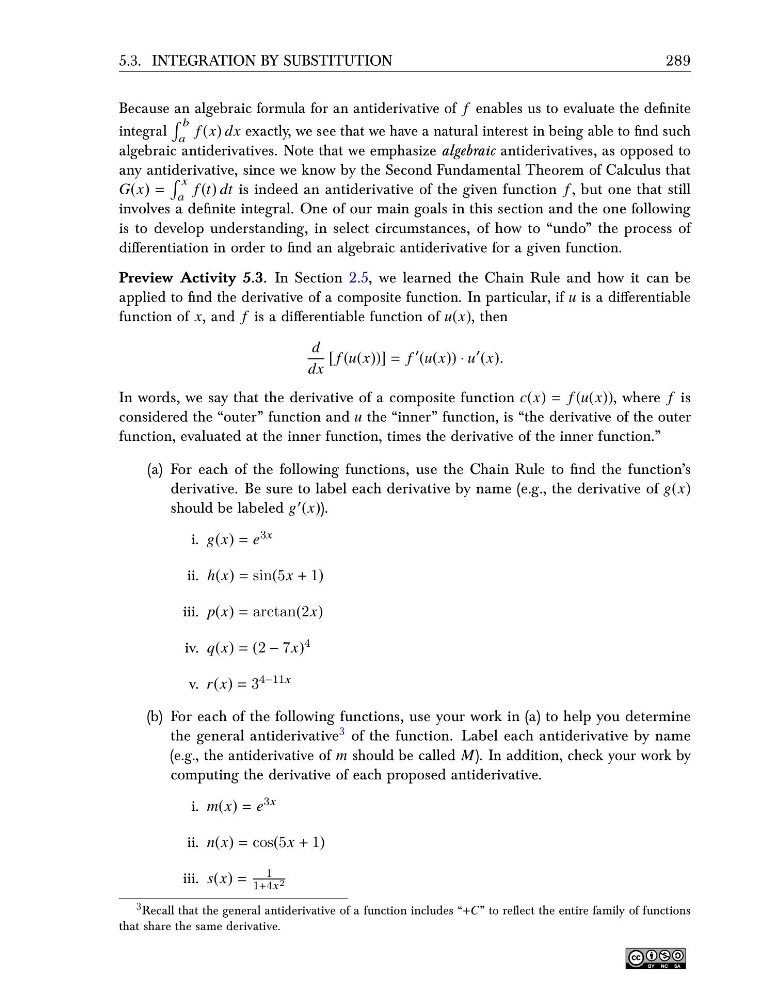
Preview Activity 5.3. In Section 2.5, we learned the Chain Rule and how it can be
applied to find the derivative of a composite function. In particular, if u is a differentiable
function of x, and f is a differentiable function of u(x), then
d
dx
[ f (u(x))] = f
′ (u(x)) · u
′ (x).
In words, we say that the derivative of a composite function c(x) = f (u(x)), where f is
considered the “outer” function and u the “inner” function, is “the derivative of the outer
function, evaluated at the inner function, times the derivative of the inner function.”
(a) For each of the following functions, use the Chain Rule to find the function’s
derivative. Be sure to label each derivative by name (e.g., the derivative of g(x)
should be labeled g ′ (x)).
i. g(x) = e 3x
ii. h(x) = sin(5x + 1)
iii. p(x) = arctan(2x)
iv. q(x) = (2 − 7x) 4
v. r(x) = 3 4−11x
(b) For each of the following functions, use your work in (a) to help you determine
the general antiderivative 3 of the function. Label each antiderivative by name
(e.g., the antiderivative of m should be called M). In addition, check your work by
computing the derivative of each proposed antiderivative.
i. m(x) = e 3x
ii. n(x) = cos(5x + 1)
iii. s(x) =
1
1+4x 2
3 Recall that the general antiderivative of a function includes “+C” to reflect the entire family of functions
that share the same derivative.
289
Because an algebraic formula for an antiderivative of f enables us to evaluate the definite
integral
b
a
f (x) dx exactly, we see that we have a natural interest in being able to find such
algebraic antiderivatives. Note that we emphasize algebraic antiderivatives, as opposed to
any antiderivative, since we know by the Second Fundamental Theorem of Calculus that
G(x) =
x
a
f (t) dt is indeed an antiderivative of the given function f , but one that still
involves a definite integral. One of our main goals in this section and the one following
is to develop understanding, in select circumstances, of how to “undo” the process of
differentiation in order to find an algebraic antiderivative for a given function.
Preview Activity 5.3. In Section 2.5, we learned the Chain Rule and how it can be
applied to find the derivative of a composite function. In particular, if u is a differentiable
function of x, and f is a differentiable function of u(x), then
d
dx
[ f (u(x))] = f
′ (u(x)) · u
′ (x).
In words, we say that the derivative of a composite function c(x) = f (u(x)), where f is
considered the “outer” function and u the “inner” function, is “the derivative of the outer
function, evaluated at the inner function, times the derivative of the inner function.”
(a) For each of the following functions, use the Chain Rule to find the function’s
derivative. Be sure to label each derivative by name (e.g., the derivative of g(x)
should be labeled g ′ (x)).
i. g(x) = e 3x
ii. h(x) = sin(5x + 1)
iii. p(x) = arctan(2x)
iv. q(x) = (2 − 7x) 4
v. r(x) = 3 4−11x
(b) For each of the following functions, use your work in (a) to help you determine
the general antiderivative 3 of the function. Label each antiderivative by name
(e.g., the antiderivative of m should be called M). In addition, check your work by
computing the derivative of each proposed antiderivative.
i. m(x) = e 3x
ii. n(x) = cos(5x + 1)
iii. s(x) =
1
1+4x 2
3 Recall that the general antiderivative of a function includes “+C” to reflect the entire family of functions
that share the same derivative.