

288
5.3. INTEGRATION BY SUBSTITUTION
5.3 Integration by Substitution
Motivating Questions
In this section, we strive to understand the ideas generated by the following important
questions:
• How can we begin to find algebraic formulas for antiderivatives of more complicated algebraic functions?
• What is an indefinite integral and how is its notation used in discussing antiderivatives?
• How does the technique of u-substitution work to help us evaluate certain indefinite
integrals, and how does this process rely on identifying function-derivative pairs?
Introduction
In Section 4.4, we learned the key role that antiderivatives play in the process of evaluating
definite integrals exactly. In particular, the Fundamental Theorem of Calculus tells us that
if F is any antiderivative of f , then
b
a
f (x) dx = F(b) − F(a).
Furthermore, we realized that each elementary derivative rule developed in Chapter 2
leads to a corresponding elementary antiderivative, as summarized in Table 4.1. Thus, if
we wish to evaluate an integral such as
1
0
x
3 −
√
x + 5
x
dx,
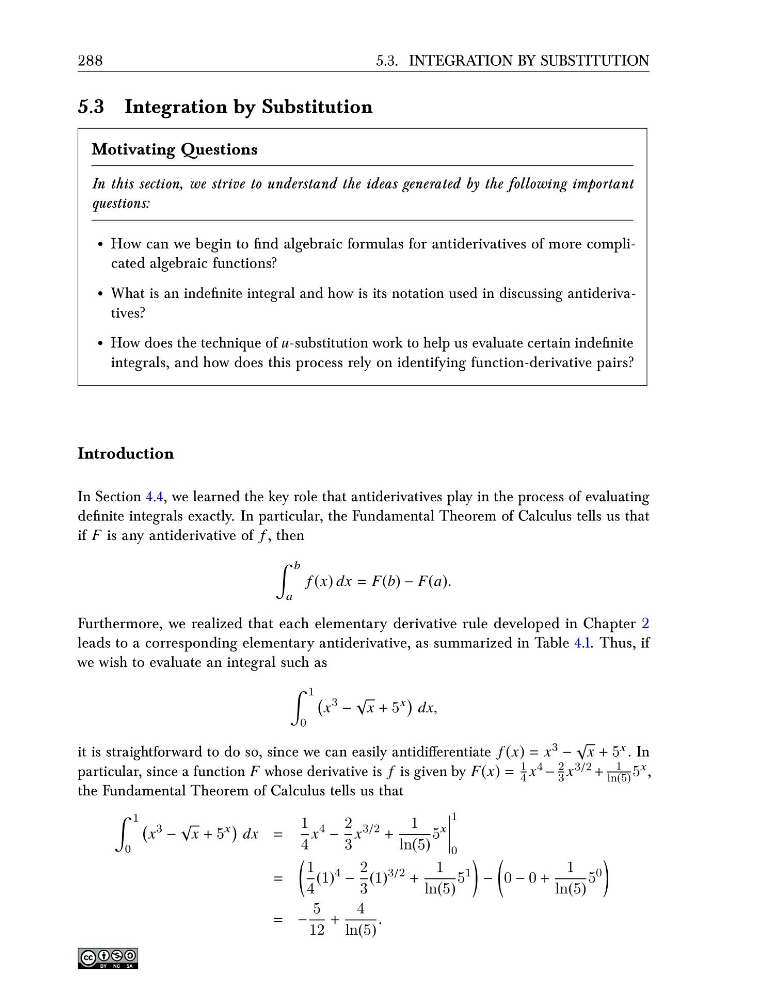
it is straightforward to do so, since we can easily antidifferentiate f (x) = x 3 −
√
x + 5 x . In
particular, since a function F whose derivative is f is given by F(x) =
1
4 x 4 −
2
3 x 3/2 +
1
ln(5) 5 x ,
the Fundamental Theorem of Calculus tells us that
1
0
x
3 −
√
x + 5
x
dx =
1
4
x
4 −
2
3
x
3/2 +
1
ln(5)
5
x
1
0
=
1
4
(1)
4 −
2
3
(1)
3/2 +
1
ln(5)
5
1
−
0 − 0 +
1
ln(5)
5
0
= −
5
12
+
4
ln(5)
.
5.3. INTEGRATION BY SUBSTITUTION
5.3 Integration by Substitution
Motivating Questions
In this section, we strive to understand the ideas generated by the following important
questions:
• How can we begin to find algebraic formulas for antiderivatives of more complicated algebraic functions?
• What is an indefinite integral and how is its notation used in discussing antiderivatives?
• How does the technique of u-substitution work to help us evaluate certain indefinite
integrals, and how does this process rely on identifying function-derivative pairs?
Introduction
In Section 4.4, we learned the key role that antiderivatives play in the process of evaluating
definite integrals exactly. In particular, the Fundamental Theorem of Calculus tells us that
if F is any antiderivative of f , then
b
a
f (x) dx = F(b) − F(a).
Furthermore, we realized that each elementary derivative rule developed in Chapter 2
leads to a corresponding elementary antiderivative, as summarized in Table 4.1. Thus, if
we wish to evaluate an integral such as
1
0
x
3 −
√
x + 5
x
dx,
it is straightforward to do so, since we can easily antidifferentiate f (x) = x 3 −
√
x + 5 x . In
particular, since a function F whose derivative is f is given by F(x) =
1
4 x 4 −
2
3 x 3/2 +
1
ln(5) 5 x ,
the Fundamental Theorem of Calculus tells us that
1
0
x
3 −
√
x + 5
x
dx =
1
4
x
4 −
2
3
x
3/2 +
1
ln(5)
5
x
1
0
=
1
4
(1)
4 −
2
3
(1)
3/2 +
1
ln(5)
5
1
−
0 − 0 +
1
ln(5)
5
0
= −
5
12
+
4
ln(5)
.