

268
5.1. CONSTRUCTING ACCURATE GRAPHS OF ANTIDERIVATIVES
Fundamental Theorem of Calculus that
F(2) = F(1) +
2
1
x
2 dx
= 2 +
1
3
x
3
2
1
= 2 +
8
3
−
1
3
=
13
3
.
In this way, we see that if we are given a function f for which we can find the exact
net-signed area bounded by f on a given interval, along with one value of a corresponding
antiderivative F, we can find any other value of F that we seek, and in this way construct a
completely accurate graph of F. We have two main options for finding the exact net-signed
area: using the Fundamental Theorem of Calculus (which requires us to find an algebraic
formula for an antiderivative of the given function f ), or, in the case where f has nice
geometric properties, finding net-signed areas through the use of known area formulas.
Activity 5.1.
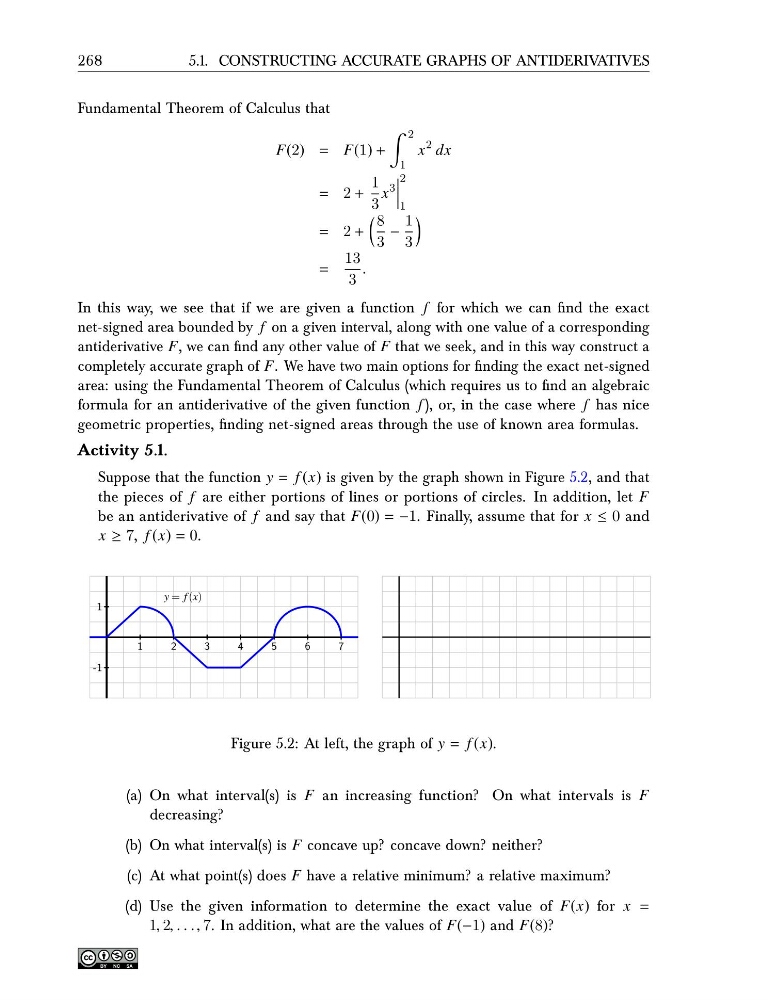
Suppose that the function y = f (x) is given by the graph shown in Figure 5.2, and that
the pieces of f are either portions of lines or portions of circles. In addition, let F
be an antiderivative of f and say that F(0) = −1. Finally, assume that for x ≤ 0 and
x ≥ 7, f (x) = 0.
1
2
3
4
5
6
7
-1
1
y = f (x)
Figure 5.2: At left, the graph of y = f (x).
(a) On what interval(s) is F an increasing function? On what intervals is F
decreasing?
(b) On what interval(s) is F concave up? concave down? neither?
(c) At what point(s) does F have a relative minimum? a relative maximum?
(d) Use the given information to determine the exact value of F(x) for x =
1, 2, . . . , 7. In addition, what are the values of F(−1) and F(8)?
5.1. CONSTRUCTING ACCURATE GRAPHS OF ANTIDERIVATIVES
Fundamental Theorem of Calculus that
F(2) = F(1) +
2
1
x
2 dx
= 2 +
1
3
x
3
2
1
= 2 +
8
3
−
1
3
=
13
3
.
In this way, we see that if we are given a function f for which we can find the exact
net-signed area bounded by f on a given interval, along with one value of a corresponding
antiderivative F, we can find any other value of F that we seek, and in this way construct a
completely accurate graph of F. We have two main options for finding the exact net-signed
area: using the Fundamental Theorem of Calculus (which requires us to find an algebraic
formula for an antiderivative of the given function f ), or, in the case where f has nice
geometric properties, finding net-signed areas through the use of known area formulas.
Activity 5.1.
Suppose that the function y = f (x) is given by the graph shown in Figure 5.2, and that
the pieces of f are either portions of lines or portions of circles. In addition, let F
be an antiderivative of f and say that F(0) = −1. Finally, assume that for x ≤ 0 and
x ≥ 7, f (x) = 0.
1
2
3
4
5
6
7
-1
1
y = f (x)
Figure 5.2: At left, the graph of y = f (x).
(a) On what interval(s) is F an increasing function? On what intervals is F
decreasing?
(b) On what interval(s) is F concave up? concave down? neither?
(c) At what point(s) does F have a relative minimum? a relative maximum?
(d) Use the given information to determine the exact value of F(x) for x =
1, 2, . . . , 7. In addition, what are the values of F(−1) and F(8)?