

260
4.4. THE FUNDAMENTAL THEOREM OF CALCULUS
2 4 6 8 10 12
2
4
6
8
10
12
gal/day
days
y = r(t)
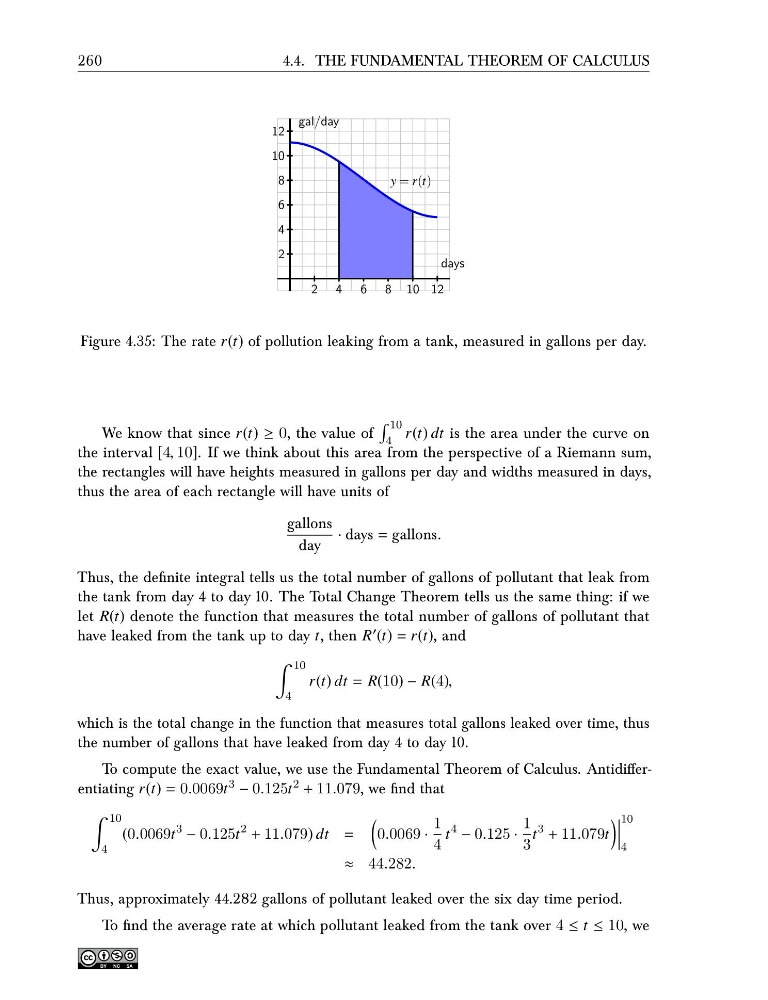
Figure 4.35: The rate r(t) of pollution leaking from a tank, measured in gallons per day.
We know that since r(t) ≥ 0, the value of
10
4
r(t) dt is the area under the curve on
the interval [4, 10]. If we think about this area from the perspective of a Riemann sum,
the rectangles will have heights measured in gallons per day and widths measured in days,
thus the area of each rectangle will have units of
gallons
day
· days = gallons.
Thus, the definite integral tells us the total number of gallons of pollutant that leak from
the tank from day 4 to day 10. The Total Change Theorem tells us the same thing: if we
let R(t) denote the function that measures the total number of gallons of pollutant that
have leaked from the tank up to day t, then R ′ (t) = r(t), and
10
4
r(t) dt = R(10) − R(4),
which is the total change in the function that measures total gallons leaked over time, thus
the number of gallons that have leaked from day 4 to day 10.
To compute the exact value, we use the Fundamental Theorem of Calculus. Antidifferentiating r(t) = 0.0069t 3 − 0.125t 2 + 11.079, we find that
10
4
(0.0069t
3 − 0.125t
2 + 11.079) dt =
0.0069 ·
1
4
t
4 − 0.125 ·
1
3
t
3 + 11.079t
10
4
≈ 44.282.
Thus, approximately 44.282 gallons of pollutant leaked over the six day time period.
To find the average rate at which pollutant leaked from the tank over 4 ≤ t ≤ 10, we
4.4. THE FUNDAMENTAL THEOREM OF CALCULUS
2 4 6 8 10 12
2
4
6
8
10
12
gal/day
days
y = r(t)
Figure 4.35: The rate r(t) of pollution leaking from a tank, measured in gallons per day.
We know that since r(t) ≥ 0, the value of
10
4
r(t) dt is the area under the curve on
the interval [4, 10]. If we think about this area from the perspective of a Riemann sum,
the rectangles will have heights measured in gallons per day and widths measured in days,
thus the area of each rectangle will have units of
gallons
day
· days = gallons.
Thus, the definite integral tells us the total number of gallons of pollutant that leak from
the tank from day 4 to day 10. The Total Change Theorem tells us the same thing: if we
let R(t) denote the function that measures the total number of gallons of pollutant that
have leaked from the tank up to day t, then R ′ (t) = r(t), and
10
4
r(t) dt = R(10) − R(4),
which is the total change in the function that measures total gallons leaked over time, thus
the number of gallons that have leaked from day 4 to day 10.
To compute the exact value, we use the Fundamental Theorem of Calculus. Antidifferentiating r(t) = 0.0069t 3 − 0.125t 2 + 11.079, we find that
10
4
(0.0069t
3 − 0.125t
2 + 11.079) dt =
0.0069 ·
1
4
t
4 − 0.125 ·
1
3
t
3 + 11.079t
10
4
≈ 44.282.
Thus, approximately 44.282 gallons of pollutant leaked over the six day time period.
To find the average rate at which pollutant leaked from the tank over 4 ≤ t ≤ 10, we