

4.4. THE FUNDAMENTAL THEOREM OF CALCULUS
259
and were seeking f ′ ; if now instead we think about knowing f ′ and seeking information
about f , we can instead say the following:
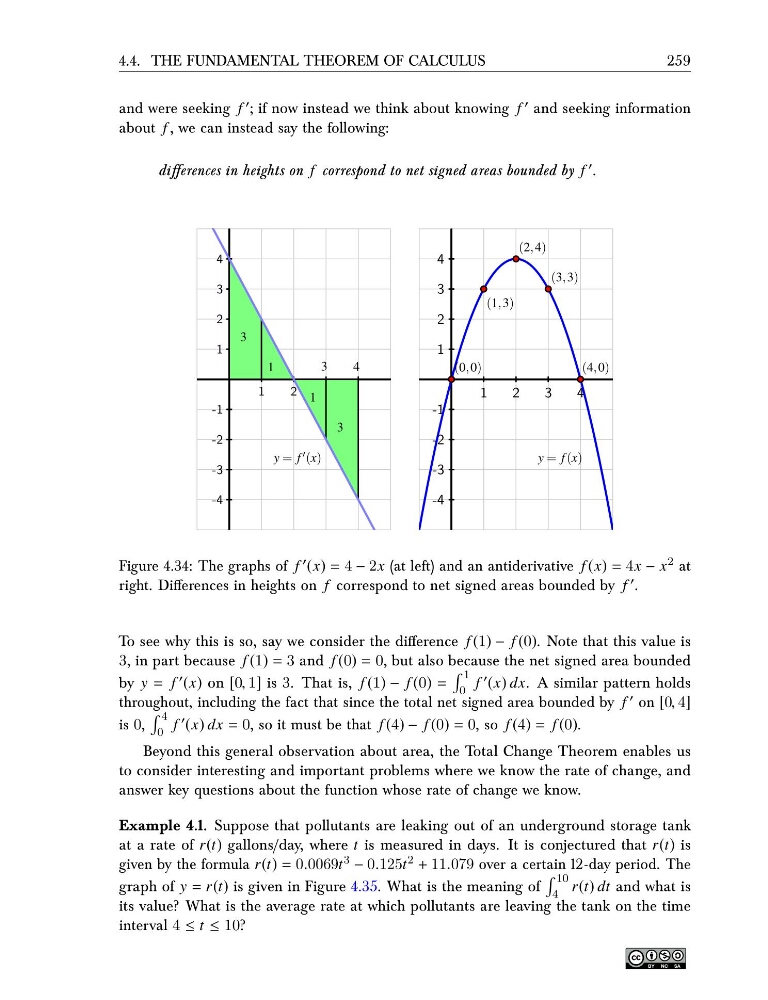
differences in heights on f correspond to net signed areas bounded by f ′ .
1
2
-4
-3
-2
-1
1
2
3
4
y = f ′ (x)
3
4
3
1
1
3
1
2
3
4
-4
-3
-2
-1
1
2
3
4
y = f (x)
(0, 0)
(1, 3)
(2, 4)
(3, 3)
(4, 0)
Figure 4.34: The graphs of f ′ (x) = 4 − 2x (at left) and an antiderivative f (x) = 4x − x 2 at
right. Differences in heights on f correspond to net signed areas bounded by f ′ .
To see why this is so, say we consider the difference f (1) − f (0). Note that this value is
3, in part because f (1) = 3 and f (0) = 0, but also because the net signed area bounded
by y = f ′ (x) on [0, 1] is 3. That is, f (1) − f (0) =
1
0
f ′ (x) dx. A similar pattern holds
throughout, including the fact that since the total net signed area bounded by f ′ on [0, 4]
is 0,
4
0
f ′ (x) dx = 0, so it must be that f (4) − f (0) = 0, so f (4) = f (0).
Beyond this general observation about area, the Total Change Theorem enables us
to consider interesting and important problems where we know the rate of change, and
answer key questions about the function whose rate of change we know.
Example 4.1. Suppose that pollutants are leaking out of an underground storage tank
at a rate of r(t) gallons/day, where t is measured in days. It is conjectured that r(t) is
given by the formula r(t) = 0.0069t 3 − 0.125t 2 + 11.079 over a certain 12-day period. The
graph of y = r(t) is given in Figure 4.35. What is the meaning of
10
4
r(t) dt and what is
its value? What is the average rate at which pollutants are leaving the tank on the time
interval 4 ≤ t ≤ 10?
259
and were seeking f ′ ; if now instead we think about knowing f ′ and seeking information
about f , we can instead say the following:
differences in heights on f correspond to net signed areas bounded by f ′ .
1
2
-4
-3
-2
-1
1
2
3
4
y = f ′ (x)
3
4
3
1
1
3
1
2
3
4
-4
-3
-2
-1
1
2
3
4
y = f (x)
(0, 0)
(1, 3)
(2, 4)
(3, 3)
(4, 0)
Figure 4.34: The graphs of f ′ (x) = 4 − 2x (at left) and an antiderivative f (x) = 4x − x 2 at
right. Differences in heights on f correspond to net signed areas bounded by f ′ .
To see why this is so, say we consider the difference f (1) − f (0). Note that this value is
3, in part because f (1) = 3 and f (0) = 0, but also because the net signed area bounded
by y = f ′ (x) on [0, 1] is 3. That is, f (1) − f (0) =
1
0
f ′ (x) dx. A similar pattern holds
throughout, including the fact that since the total net signed area bounded by f ′ on [0, 4]
is 0,
4
0
f ′ (x) dx = 0, so it must be that f (4) − f (0) = 0, so f (4) = f (0).
Beyond this general observation about area, the Total Change Theorem enables us
to consider interesting and important problems where we know the rate of change, and
answer key questions about the function whose rate of change we know.
Example 4.1. Suppose that pollutants are leaking out of an underground storage tank
at a rate of r(t) gallons/day, where t is measured in days. It is conjectured that r(t) is
given by the formula r(t) = 0.0069t 3 − 0.125t 2 + 11.079 over a certain 12-day period. The
graph of y = r(t) is given in Figure 4.35. What is the meaning of
10
4
r(t) dt and what is
its value? What is the average rate at which pollutants are leaving the tank on the time
interval 4 ≤ t ≤ 10?