

236
4.3. THE DEFINITE INTEGRAL
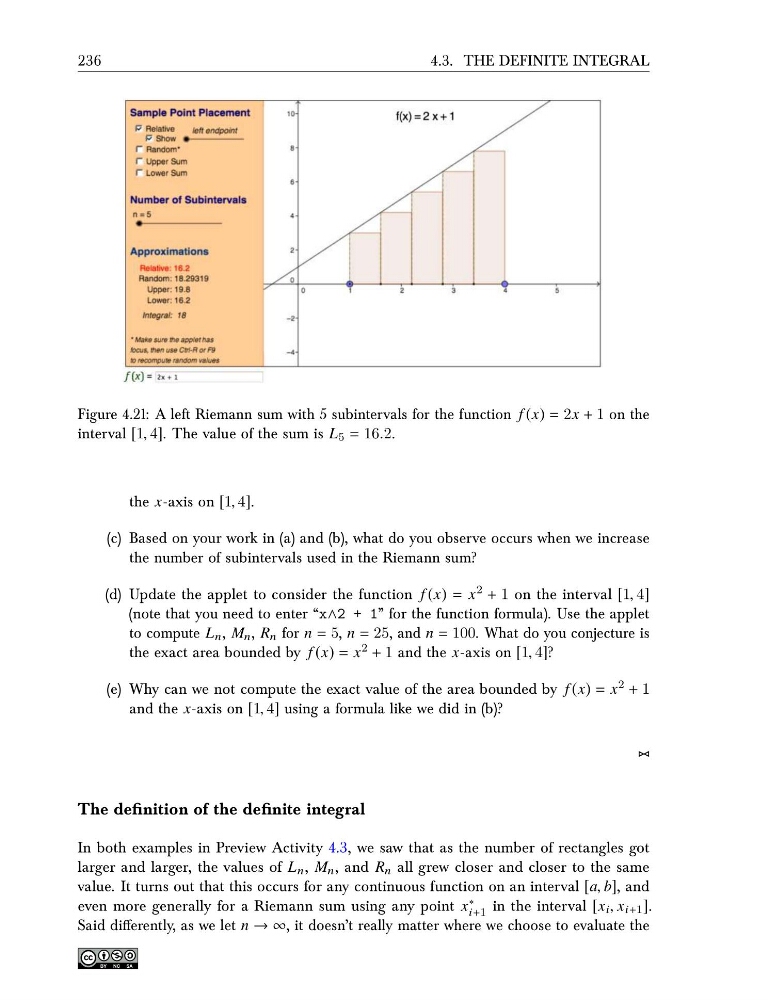
Figure 4.21: A left Riemann sum with 5 subintervals for the function f (x) = 2x + 1 on the
interval [1, 4]. The value of the sum is L 5 = 16.2.
the x-axis on [1, 4].
(c) Based on your work in (a) and (b), what do you observe occurs when we increase
the number of subintervals used in the Riemann sum?
(d) Update the applet to consider the function f (x) = x 2 + 1 on the interval [1, 4]
(note that you need to enter “x∧2 + 1” for the function formula). Use the applet
to compute L n , M n , R n for n = 5, n = 25, and n = 100. What do you conjecture is
the exact area bounded by f (x) = x 2 + 1 and the x-axis on [1, 4]?
(e) Why can we not compute the exact value of the area bounded by f (x) = x 2 + 1
and the x-axis on [1, 4] using a formula like we did in (b)?
⊲⊳
The definition of the definite integral
In both examples in Preview Activity 4.3, we saw that as the number of rectangles got
larger and larger, the values of L n , M n , and R n all grew closer and closer to the same
value. It turns out that this occurs for any continuous function on an interval [a, b], and
even more generally for a Riemann sum using any point x ∗
i+1 in the interval [x i , x i+1 ].
Said differently, as we let n → ∞, it doesn’t really matter where we choose to evaluate the
4.3. THE DEFINITE INTEGRAL
Figure 4.21: A left Riemann sum with 5 subintervals for the function f (x) = 2x + 1 on the
interval [1, 4]. The value of the sum is L 5 = 16.2.
the x-axis on [1, 4].
(c) Based on your work in (a) and (b), what do you observe occurs when we increase
the number of subintervals used in the Riemann sum?
(d) Update the applet to consider the function f (x) = x 2 + 1 on the interval [1, 4]
(note that you need to enter “x∧2 + 1” for the function formula). Use the applet
to compute L n , M n , R n for n = 5, n = 25, and n = 100. What do you conjecture is
the exact area bounded by f (x) = x 2 + 1 and the x-axis on [1, 4]?
(e) Why can we not compute the exact value of the area bounded by f (x) = x 2 + 1
and the x-axis on [1, 4] using a formula like we did in (b)?
⊲⊳
The definition of the definite integral
In both examples in Preview Activity 4.3, we saw that as the number of rectangles got
larger and larger, the values of L n , M n , and R n all grew closer and closer to the same
value. It turns out that this occurs for any continuous function on an interval [a, b], and
even more generally for a Riemann sum using any point x ∗
i+1 in the interval [x i , x i+1 ].
Said differently, as we let n → ∞, it doesn’t really matter where we choose to evaluate the