

4.3. THE DEFINITE INTEGRAL
235
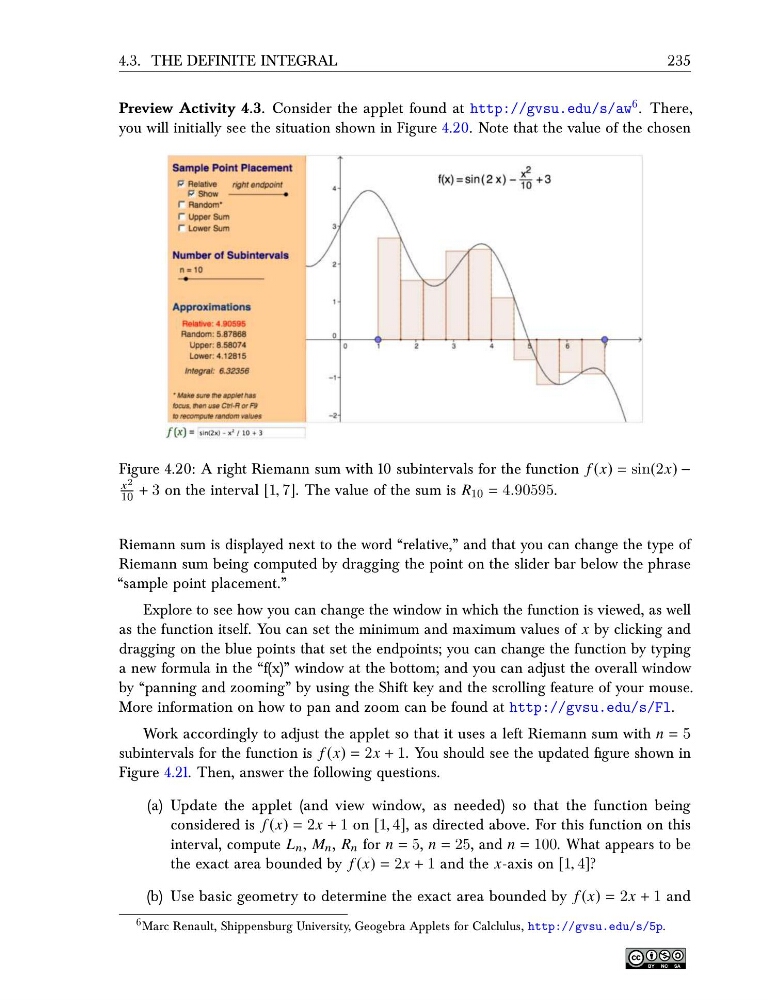
Preview Activity 4.3. Consider the applet found at http://gvsu.edu/s/aw 6 . There,
you will initially see the situation shown in Figure 4.20. Note that the value of the chosen
Figure 4.20: A right Riemann sum with 10 subintervals for the function f (x) = sin(2x) −
x 2
10 + 3 on the interval [1, 7]. The value of the sum is R 10 = 4.90595.
Riemann sum is displayed next to the word “relative,” and that you can change the type of
Riemann sum being computed by dragging the point on the slider bar below the phrase
“sample point placement.”
Explore to see how you can change the window in which the function is viewed, as well
as the function itself. You can set the minimum and maximum values of x by clicking and
dragging on the blue points that set the endpoints; you can change the function by typing
a new formula in the “f(x)” window at the bottom; and you can adjust the overall window
by “panning and zooming” by using the Shift key and the scrolling feature of your mouse.
More information on how to pan and zoom can be found at http://gvsu.edu/s/Fl.
Work accordingly to adjust the applet so that it uses a left Riemann sum with n = 5
subintervals for the function is f (x) = 2x + 1. You should see the updated figure shown in
Figure 4.21. Then, answer the following questions.
(a) Update the applet (and view window, as needed) so that the function being
considered is f (x) = 2x + 1 on [1, 4], as directed above. For this function on this
interval, compute L n , M n , R n for n = 5, n = 25, and n = 100. What appears to be
the exact area bounded by f (x) = 2x + 1 and the x-axis on [1, 4]?
(b) Use basic geometry to determine the exact area bounded by f (x) = 2x + 1 and
6 Marc Renault, Shippensburg University, Geogebra Applets for Calclulus, http://gvsu.edu/s/5p.
235
Preview Activity 4.3. Consider the applet found at http://gvsu.edu/s/aw 6 . There,
you will initially see the situation shown in Figure 4.20. Note that the value of the chosen
Figure 4.20: A right Riemann sum with 10 subintervals for the function f (x) = sin(2x) −
x 2
10 + 3 on the interval [1, 7]. The value of the sum is R 10 = 4.90595.
Riemann sum is displayed next to the word “relative,” and that you can change the type of
Riemann sum being computed by dragging the point on the slider bar below the phrase
“sample point placement.”
Explore to see how you can change the window in which the function is viewed, as well
as the function itself. You can set the minimum and maximum values of x by clicking and
dragging on the blue points that set the endpoints; you can change the function by typing
a new formula in the “f(x)” window at the bottom; and you can adjust the overall window
by “panning and zooming” by using the Shift key and the scrolling feature of your mouse.
More information on how to pan and zoom can be found at http://gvsu.edu/s/Fl.
Work accordingly to adjust the applet so that it uses a left Riemann sum with n = 5
subintervals for the function is f (x) = 2x + 1. You should see the updated figure shown in
Figure 4.21. Then, answer the following questions.
(a) Update the applet (and view window, as needed) so that the function being
considered is f (x) = 2x + 1 on [1, 4], as directed above. For this function on this
interval, compute L n , M n , R n for n = 5, n = 25, and n = 100. What appears to be
the exact area bounded by f (x) = 2x + 1 and the x-axis on [1, 4]?
(b) Use basic geometry to determine the exact area bounded by f (x) = 2x + 1 and
6 Marc Renault, Shippensburg University, Geogebra Applets for Calclulus, http://gvsu.edu/s/5p.