

4.1. DETERMINING DISTANCE TRAVELED FROM VELOCITY
219
setting of the problem?
(c) Find an antiderivative s of the function v. That is, find a function s such that
s ′ (t) = v(t).
(d) Compute the value of s(a) − s(0). What does this number represent in terms of
the physical setting of the problem?
(e) Compute s(5) − s(1). What does this number tell you about the rocket’s flight?
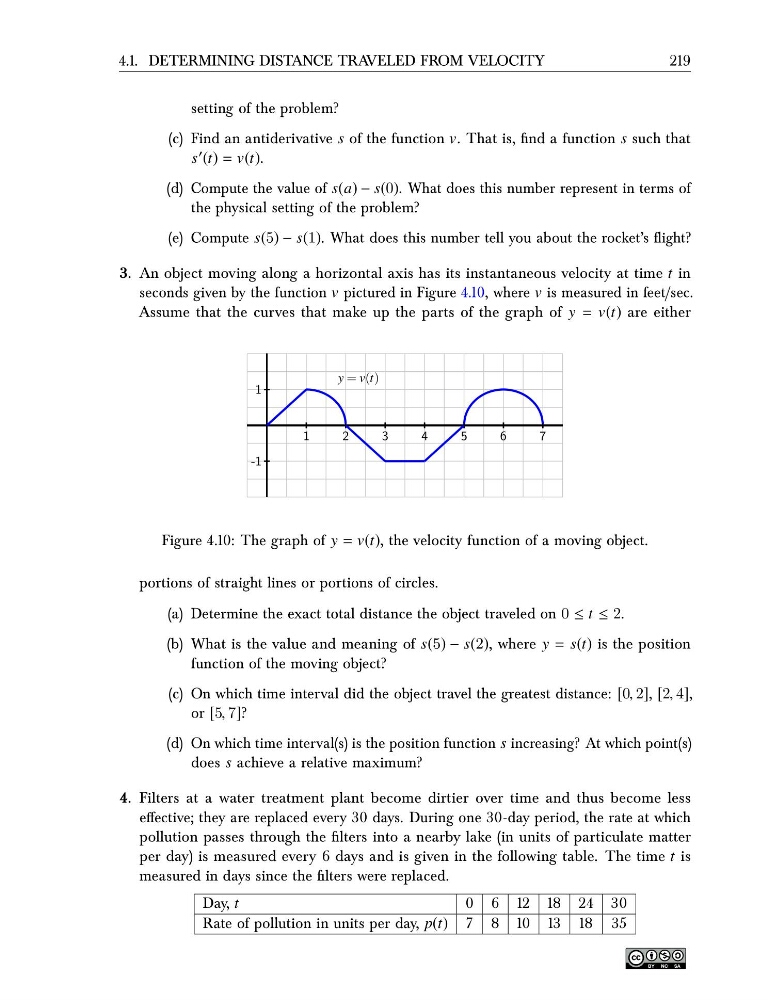
3. An object moving along a horizontal axis has its instantaneous velocity at time t in
seconds given by the function v pictured in Figure 4.10, where v is measured in feet/sec.
Assume that the curves that make up the parts of the graph of y = v(t) are either
1
2
3
4
5
6
7
-1
1
y = v(t)
Figure 4.10: The graph of y = v(t), the velocity function of a moving object.
portions of straight lines or portions of circles.
(a) Determine the exact total distance the object traveled on 0 ≤ t ≤ 2.
(b) What is the value and meaning of s(5) − s(2), where y = s(t) is the position
function of the moving object?
(c) On which time interval did the object travel the greatest distance: [0, 2], [2, 4],
or [5, 7]?
(d) On which time interval(s) is the position function s increasing? At which point(s)
does s achieve a relative maximum?
4. Filters at a water treatment plant become dirtier over time and thus become less
effective; they are replaced every 30 days. During one 30-day period, the rate at which
pollution passes through the filters into a nearby lake (in units of particulate matter
per day) is measured every 6 days and is given in the following table. The time t is
measured in days since the filters were replaced.
Day, t
0 6 12 18 24 30
Rate of pollution in units per day, p(t) 7 8 10 13 18 35
219
setting of the problem?
(c) Find an antiderivative s of the function v. That is, find a function s such that
s ′ (t) = v(t).
(d) Compute the value of s(a) − s(0). What does this number represent in terms of
the physical setting of the problem?
(e) Compute s(5) − s(1). What does this number tell you about the rocket’s flight?
3. An object moving along a horizontal axis has its instantaneous velocity at time t in
seconds given by the function v pictured in Figure 4.10, where v is measured in feet/sec.
Assume that the curves that make up the parts of the graph of y = v(t) are either
1
2
3
4
5
6
7
-1
1
y = v(t)
Figure 4.10: The graph of y = v(t), the velocity function of a moving object.
portions of straight lines or portions of circles.
(a) Determine the exact total distance the object traveled on 0 ≤ t ≤ 2.
(b) What is the value and meaning of s(5) − s(2), where y = s(t) is the position
function of the moving object?
(c) On which time interval did the object travel the greatest distance: [0, 2], [2, 4],
or [5, 7]?
(d) On which time interval(s) is the position function s increasing? At which point(s)
does s achieve a relative maximum?
4. Filters at a water treatment plant become dirtier over time and thus become less
effective; they are replaced every 30 days. During one 30-day period, the rate at which
pollution passes through the filters into a nearby lake (in units of particulate matter
per day) is measured every 6 days and is given in the following table. The time t is
measured in days since the filters were replaced.
Day, t
0 6 12 18 24 30
Rate of pollution in units per day, p(t) 7 8 10 13 18 35