

218
4.1. DETERMINING DISTANCE TRAVELED FROM VELOCITY
Exercises
1. Along the eastern shore of Lake Michigan from Lake Macatawa (near Holland) to Grand
Haven, there is a bike bath that runs almost directly north-south. For the purposes of
this problem, assume the road is completely straight, and that the function s(t) tracks
the position of the biker along this path in miles north of Pigeon Lake, which lies
roughly halfway between the ends of the bike path.
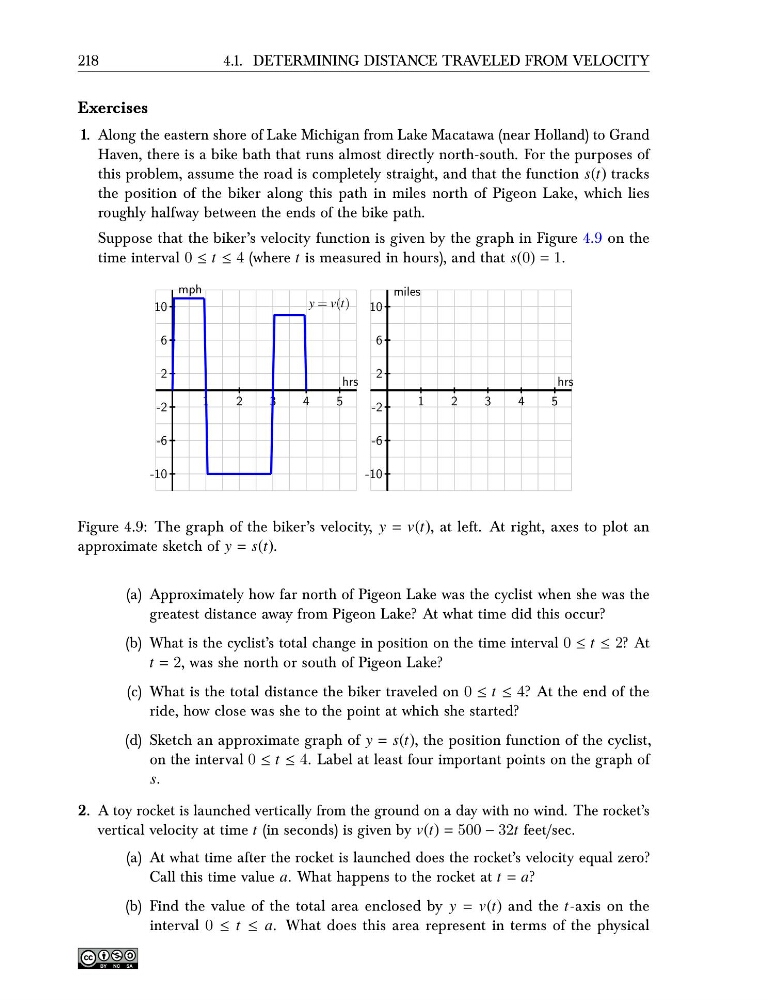
Suppose that the biker’s velocity function is given by the graph in Figure 4.9 on the
time interval 0 ≤ t ≤ 4 (where t is measured in hours), and that s(0) = 1.
1
2
3
4
5
-10
-6
-2
2
6
10
mph
hrs
y = v(t)
1
2
3
4
5
-10
-6
-2
2
6
10
miles
hrs
Figure 4.9: The graph of the biker’s velocity, y = v(t), at left. At right, axes to plot an
approximate sketch of y = s(t).
(a) Approximately how far north of Pigeon Lake was the cyclist when she was the
greatest distance away from Pigeon Lake? At what time did this occur?
(b) What is the cyclist’s total change in position on the time interval 0 ≤ t ≤ 2? At
t = 2, was she north or south of Pigeon Lake?
(c) What is the total distance the biker traveled on 0 ≤ t ≤ 4? At the end of the
ride, how close was she to the point at which she started?
(d) Sketch an approximate graph of y = s(t), the position function of the cyclist,
on the interval 0 ≤ t ≤ 4. Label at least four important points on the graph of
s.
2. A toy rocket is launched vertically from the ground on a day with no wind. The rocket’s
vertical velocity at time t (in seconds) is given by v(t) = 500 − 32t feet/sec.
(a) At what time after the rocket is launched does the rocket’s velocity equal zero?
Call this time value a. What happens to the rocket at t = a?
(b) Find the value of the total area enclosed by y = v(t) and the t-axis on the
interval 0 ≤ t ≤ a. What does this area represent in terms of the physical
4.1. DETERMINING DISTANCE TRAVELED FROM VELOCITY
Exercises
1. Along the eastern shore of Lake Michigan from Lake Macatawa (near Holland) to Grand
Haven, there is a bike bath that runs almost directly north-south. For the purposes of
this problem, assume the road is completely straight, and that the function s(t) tracks
the position of the biker along this path in miles north of Pigeon Lake, which lies
roughly halfway between the ends of the bike path.
Suppose that the biker’s velocity function is given by the graph in Figure 4.9 on the
time interval 0 ≤ t ≤ 4 (where t is measured in hours), and that s(0) = 1.
1
2
3
4
5
-10
-6
-2
2
6
10
mph
hrs
y = v(t)
1
2
3
4
5
-10
-6
-2
2
6
10
miles
hrs
Figure 4.9: The graph of the biker’s velocity, y = v(t), at left. At right, axes to plot an
approximate sketch of y = s(t).
(a) Approximately how far north of Pigeon Lake was the cyclist when she was the
greatest distance away from Pigeon Lake? At what time did this occur?
(b) What is the cyclist’s total change in position on the time interval 0 ≤ t ≤ 2? At
t = 2, was she north or south of Pigeon Lake?
(c) What is the total distance the biker traveled on 0 ≤ t ≤ 4? At the end of the
ride, how close was she to the point at which she started?
(d) Sketch an approximate graph of y = s(t), the position function of the cyclist,
on the interval 0 ≤ t ≤ 4. Label at least four important points on the graph of
s.
2. A toy rocket is launched vertically from the ground on a day with no wind. The rocket’s
vertical velocity at time t (in seconds) is given by v(t) = 500 − 32t feet/sec.
(a) At what time after the rocket is launched does the rocket’s velocity equal zero?
Call this time value a. What happens to the rocket at t = a?
(b) Find the value of the total area enclosed by y = v(t) and the t-axis on the
interval 0 ≤ t ≤ a. What does this area represent in terms of the physical