

208
4.1. DETERMINING DISTANCE TRAVELED FROM VELOCITY
the position function,
s
′ (t) = lim
h→0
s(t + h) − s(t)
h
.
Thus, given a differentiable position function, we are able to know the exact velocity of
the moving object at any point in time.
Moreover, from this foundational problem involving position and velocity we have
learned a great deal. Given a differentiable function f , we are now able to find its derivative
and use this derivative to determine the function’s instantaneous rate of change at any
point in the domain, as well as to find where the function is increasing or decreasing, is
concave up or concave down, and has relative extremes. The vast majority of the problems
and applications we have considered have involved the situation where a particular function
is known and we seek information that relies on knowing the function’s instantaneous rate
of change. That is, we have typically proceeded from a function f to its derivative, f ′ ,
and then used the meaning of the derivative to help us answer important questions.
In a much smaller number of situations so far, we have encountered the reverse
situation where we instead know the derivative, f ′ , and have tried to deduce information
about f . It is this particular problem that will be the focus of our attention in most of
Chapter 4: if we know the instantaneous rate of change of a function, are we able to
determine the function itself? To begin, we start with a more focused question: if we know
the instantaneous velocity of an object moving along a straight line path, can we determine
its corresponding position function?
Preview Activity 4.1. Suppose that a person is taking a walk along a long straight path
and walks at a constant rate of 3 miles per hour.
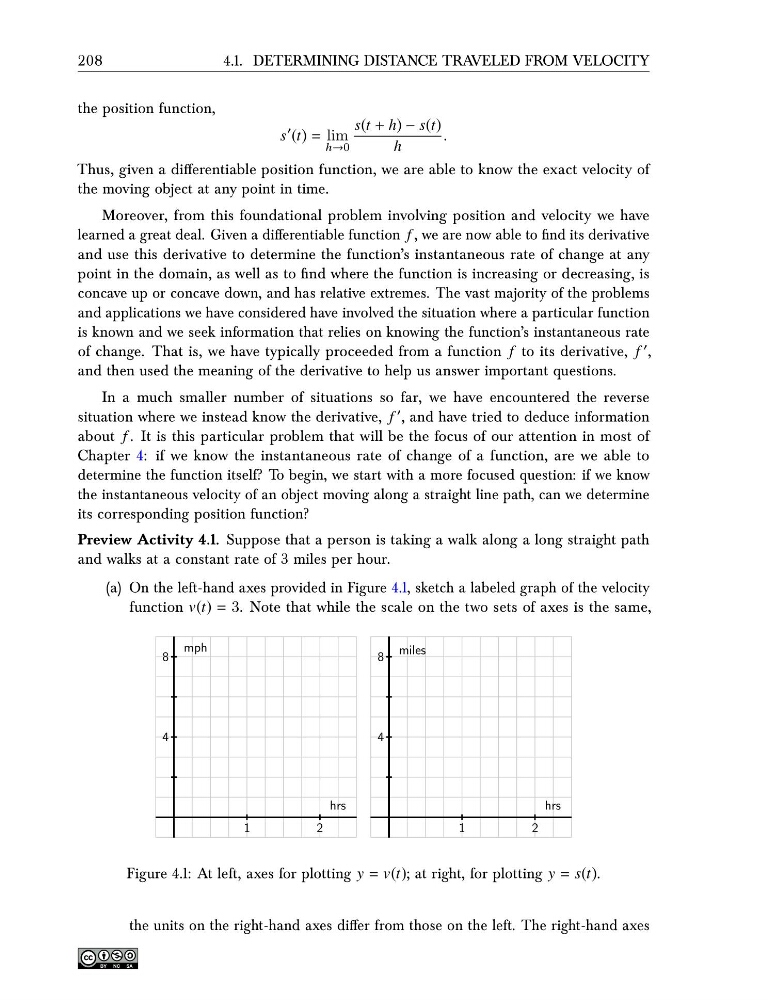
(a) On the left-hand axes provided in Figure 4.1, sketch a labeled graph of the velocity
function v(t) = 3. Note that while the scale on the two sets of axes is the same,
1
2
4
8
mph
hrs
1
2
4
8
miles
hrs
Figure 4.1: At left, axes for plotting y = v(t); at right, for plotting y = s(t).
the units on the right-hand axes differ from those on the left. The right-hand axes
4.1. DETERMINING DISTANCE TRAVELED FROM VELOCITY
the position function,
s
′ (t) = lim
h→0
s(t + h) − s(t)
h
.
Thus, given a differentiable position function, we are able to know the exact velocity of
the moving object at any point in time.
Moreover, from this foundational problem involving position and velocity we have
learned a great deal. Given a differentiable function f , we are now able to find its derivative
and use this derivative to determine the function’s instantaneous rate of change at any
point in the domain, as well as to find where the function is increasing or decreasing, is
concave up or concave down, and has relative extremes. The vast majority of the problems
and applications we have considered have involved the situation where a particular function
is known and we seek information that relies on knowing the function’s instantaneous rate
of change. That is, we have typically proceeded from a function f to its derivative, f ′ ,
and then used the meaning of the derivative to help us answer important questions.
In a much smaller number of situations so far, we have encountered the reverse
situation where we instead know the derivative, f ′ , and have tried to deduce information
about f . It is this particular problem that will be the focus of our attention in most of
Chapter 4: if we know the instantaneous rate of change of a function, are we able to
determine the function itself? To begin, we start with a more focused question: if we know
the instantaneous velocity of an object moving along a straight line path, can we determine
its corresponding position function?
Preview Activity 4.1. Suppose that a person is taking a walk along a long straight path
and walks at a constant rate of 3 miles per hour.
(a) On the left-hand axes provided in Figure 4.1, sketch a labeled graph of the velocity
function v(t) = 3. Note that while the scale on the two sets of axes is the same,
1
2
4
8
mph
hrs
1
2
4
8
miles
hrs
Figure 4.1: At left, axes for plotting y = v(t); at right, for plotting y = s(t).
the units on the right-hand axes differ from those on the left. The right-hand axes