

186
3.3. GLOBAL OPTIMIZATION
Moving towards applications
In Section 3.4, we will focus almost exclusively on applied optimization problems: problems
where we seek to find the absolute maximum or minimum value of a function that
represents some physical situation. We conclude this current section with an example
of one such problem because it highlights the role that a closed, bounded domain can
play in finding absolute extrema. In addition, these problems often involve considerable
preliminary work to develop the function which is to be optimized, and this example
demonstrates that process.
Example 3.4. A 20 cm piece of wire is cut into two pieces. One piece is used to form a
square and the other an equilateral triangle. How should the wire be cut to maximize the
total area enclosed by the square and triangle? to minimize the area?
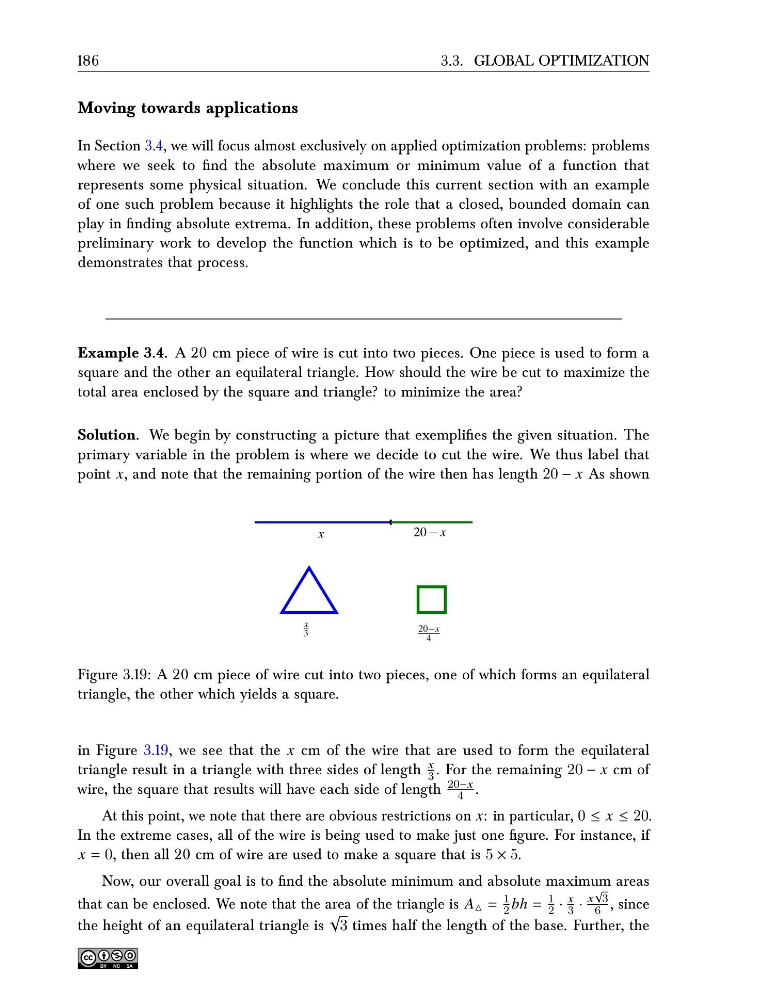
Solution. We begin by constructing a picture that exemplifies the given situation. The
primary variable in the problem is where we decide to cut the wire. We thus label that
point x, and note that the remaining portion of the wire then has length 20 − x As shown
x
20 − x
x
3
20−x
4
Figure 3.19: A 20 cm piece of wire cut into two pieces, one of which forms an equilateral
triangle, the other which yields a square.
in Figure 3.19, we see that the x cm of the wire that are used to form the equilateral
triangle result in a triangle with three sides of length
x
3 . For the remaining 20 − x cm of
wire, the square that results will have each side of length
20−x
4 .
At this point, we note that there are obvious restrictions on x: in particular, 0 ≤ x ≤ 20.
In the extreme cases, all of the wire is being used to make just one figure. For instance, if
x = 0, then all 20 cm of wire are used to make a square that is 5 × 5.
Now, our overall goal is to find the absolute minimum and absolute maximum areas
that can be enclosed. We note that the area of the triangle is A △ =
1
2 bh =
1
2 ·
x
3 ·
x
√
3
6 , since
the height of an equilateral triangle is
√
3 times half the length of the base. Further, the
3.3. GLOBAL OPTIMIZATION
Moving towards applications
In Section 3.4, we will focus almost exclusively on applied optimization problems: problems
where we seek to find the absolute maximum or minimum value of a function that
represents some physical situation. We conclude this current section with an example
of one such problem because it highlights the role that a closed, bounded domain can
play in finding absolute extrema. In addition, these problems often involve considerable
preliminary work to develop the function which is to be optimized, and this example
demonstrates that process.
Example 3.4. A 20 cm piece of wire is cut into two pieces. One piece is used to form a
square and the other an equilateral triangle. How should the wire be cut to maximize the
total area enclosed by the square and triangle? to minimize the area?
Solution. We begin by constructing a picture that exemplifies the given situation. The
primary variable in the problem is where we decide to cut the wire. We thus label that
point x, and note that the remaining portion of the wire then has length 20 − x As shown
x
20 − x
x
3
20−x
4
Figure 3.19: A 20 cm piece of wire cut into two pieces, one of which forms an equilateral
triangle, the other which yields a square.
in Figure 3.19, we see that the x cm of the wire that are used to form the equilateral
triangle result in a triangle with three sides of length
x
3 . For the remaining 20 − x cm of
wire, the square that results will have each side of length
20−x
4 .
At this point, we note that there are obvious restrictions on x: in particular, 0 ≤ x ≤ 20.
In the extreme cases, all of the wire is being used to make just one figure. For instance, if
x = 0, then all 20 cm of wire are used to make a square that is 5 × 5.
Now, our overall goal is to find the absolute minimum and absolute maximum areas
that can be enclosed. We note that the area of the triangle is A △ =
1
2 bh =
1
2 ·
x
3 ·
x
√
3
6 , since
the height of an equilateral triangle is
√
3 times half the length of the base. Further, the