

3.3. GLOBAL OPTIMIZATION
185
Activity 3.8.
Find the exact absolute maximum and minimum of each function on the stated interval.
(a) h(x) = xe −x , [0, 3]
(b) p(t) = sin(t) + cos(t), [−
π
2 ,
π
2 ]
(c) q(x) =
x 2
x−2 , [3, 7]
(d) f (x) = 4 − e −(x−2) 2 , (−∞, ∞)
(e) h(x) = xe −ax , [0,
2
a ] (a > 0)
(f) f (x) = b − e −(x−a) 2 , (−∞, ∞), a, b > 0
⊳
One of the big lessons in finding absolute extreme values is the realization that the
interval we choose has nearly the same impact on the problem as the function under
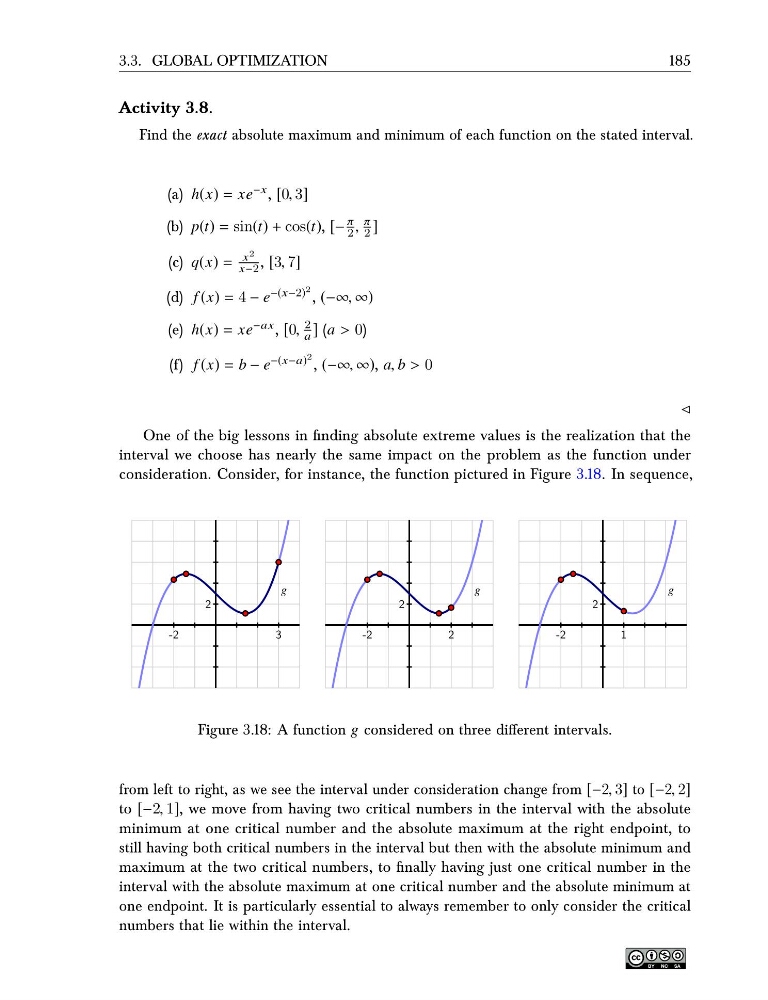
consideration. Consider, for instance, the function pictured in Figure 3.18. In sequence,
-2
3
2
g
-2
2
2
g
-2
1
2
g
Figure 3.18: A function g considered on three different intervals.
from left to right, as we see the interval under consideration change from [−2, 3] to [−2, 2]
to [−2, 1], we move from having two critical numbers in the interval with the absolute
minimum at one critical number and the absolute maximum at the right endpoint, to
still having both critical numbers in the interval but then with the absolute minimum and
maximum at the two critical numbers, to finally having just one critical number in the
interval with the absolute maximum at one critical number and the absolute minimum at
one endpoint. It is particularly essential to always remember to only consider the critical
numbers that lie within the interval.
185
Activity 3.8.
Find the exact absolute maximum and minimum of each function on the stated interval.
(a) h(x) = xe −x , [0, 3]
(b) p(t) = sin(t) + cos(t), [−
π
2 ,
π
2 ]
(c) q(x) =
x 2
x−2 , [3, 7]
(d) f (x) = 4 − e −(x−2) 2 , (−∞, ∞)
(e) h(x) = xe −ax , [0,
2
a ] (a > 0)
(f) f (x) = b − e −(x−a) 2 , (−∞, ∞), a, b > 0
⊳
One of the big lessons in finding absolute extreme values is the realization that the
interval we choose has nearly the same impact on the problem as the function under
consideration. Consider, for instance, the function pictured in Figure 3.18. In sequence,
-2
3
2
g
-2
2
2
g
-2
1
2
g
Figure 3.18: A function g considered on three different intervals.
from left to right, as we see the interval under consideration change from [−2, 3] to [−2, 2]
to [−2, 1], we move from having two critical numbers in the interval with the absolute
minimum at one critical number and the absolute maximum at the right endpoint, to
still having both critical numbers in the interval but then with the absolute minimum and
maximum at the two critical numbers, to finally having just one critical number in the
interval with the absolute maximum at one critical number and the absolute minimum at
one endpoint. It is particularly essential to always remember to only consider the critical
numbers that lie within the interval.