

3.2. USING DERIVATIVES TO DESCRIBE FAMILIES OF FUNCTIONS
175
c
c +
2π
b
d
d + a
f (t) = a sin(b(t − c)) + d
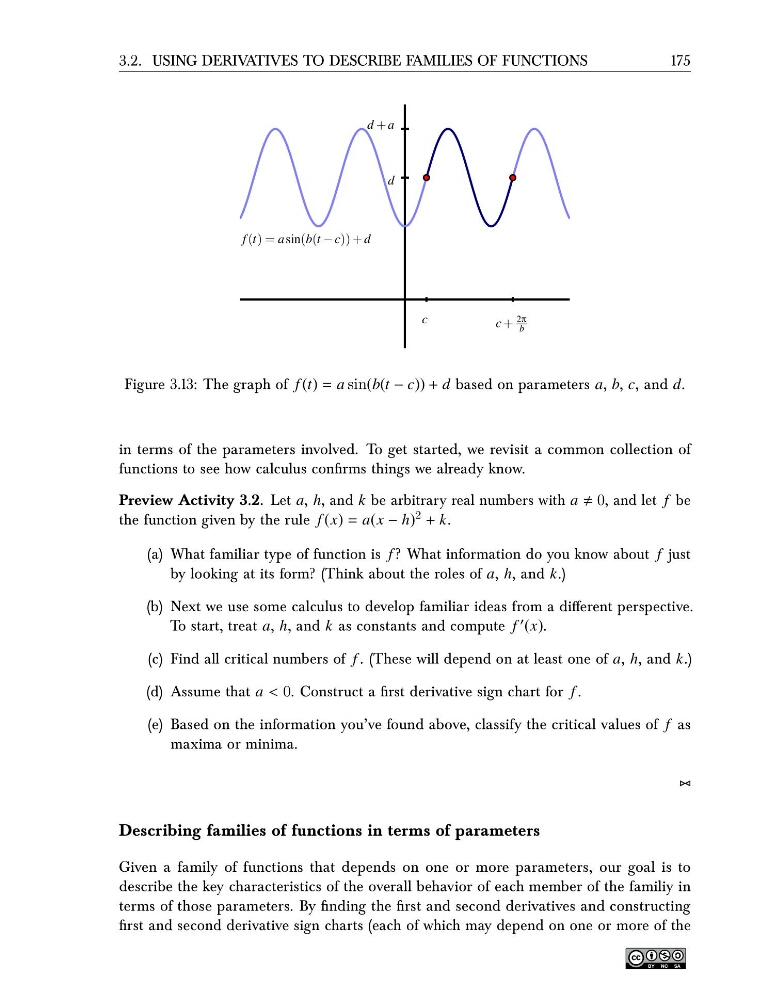
Figure 3.13: The graph of f (t) = a sin(b(t − c)) + d based on parameters a, b, c, and d.
in terms of the parameters involved. To get started, we revisit a common collection of
functions to see how calculus confirms things we already know.
Preview Activity 3.2. Let a, h, and k be arbitrary real numbers with a 0, and let f be
the function given by the rule f (x) = a(x − h) 2 + k.
(a) What familiar type of function is f ? What information do you know about f just
by looking at its form? (Think about the roles of a, h, and k.)
(b) Next we use some calculus to develop familiar ideas from a different perspective.
To start, treat a, h, and k as constants and compute f ′ (x).
(c) Find all critical numbers of f . (These will depend on at least one of a, h, and k.)
(d) Assume that a < 0. Construct a first derivative sign chart for f .
(e) Based on the information you’ve found above, classify the critical values of f as
maxima or minima.
⊲⊳
Describing families of functions in terms of parameters
Given a family of functions that depends on one or more parameters, our goal is to
describe the key characteristics of the overall behavior of each member of the familiy in
terms of those parameters. By finding the first and second derivatives and constructing
first and second derivative sign charts (each of which may depend on one or more of the
175
c
c +
2π
b
d
d + a
f (t) = a sin(b(t − c)) + d
Figure 3.13: The graph of f (t) = a sin(b(t − c)) + d based on parameters a, b, c, and d.
in terms of the parameters involved. To get started, we revisit a common collection of
functions to see how calculus confirms things we already know.
Preview Activity 3.2. Let a, h, and k be arbitrary real numbers with a 0, and let f be
the function given by the rule f (x) = a(x − h) 2 + k.
(a) What familiar type of function is f ? What information do you know about f just
by looking at its form? (Think about the roles of a, h, and k.)
(b) Next we use some calculus to develop familiar ideas from a different perspective.
To start, treat a, h, and k as constants and compute f ′ (x).
(c) Find all critical numbers of f . (These will depend on at least one of a, h, and k.)
(d) Assume that a < 0. Construct a first derivative sign chart for f .
(e) Based on the information you’ve found above, classify the critical values of f as
maxima or minima.
⊲⊳
Describing families of functions in terms of parameters
Given a family of functions that depends on one or more parameters, our goal is to
describe the key characteristics of the overall behavior of each member of the familiy in
terms of those parameters. By finding the first and second derivatives and constructing
first and second derivative sign charts (each of which may depend on one or more of the