

3.1. USING DERIVATIVES TO IDENTIFY EXTREME VALUES
173
h ′
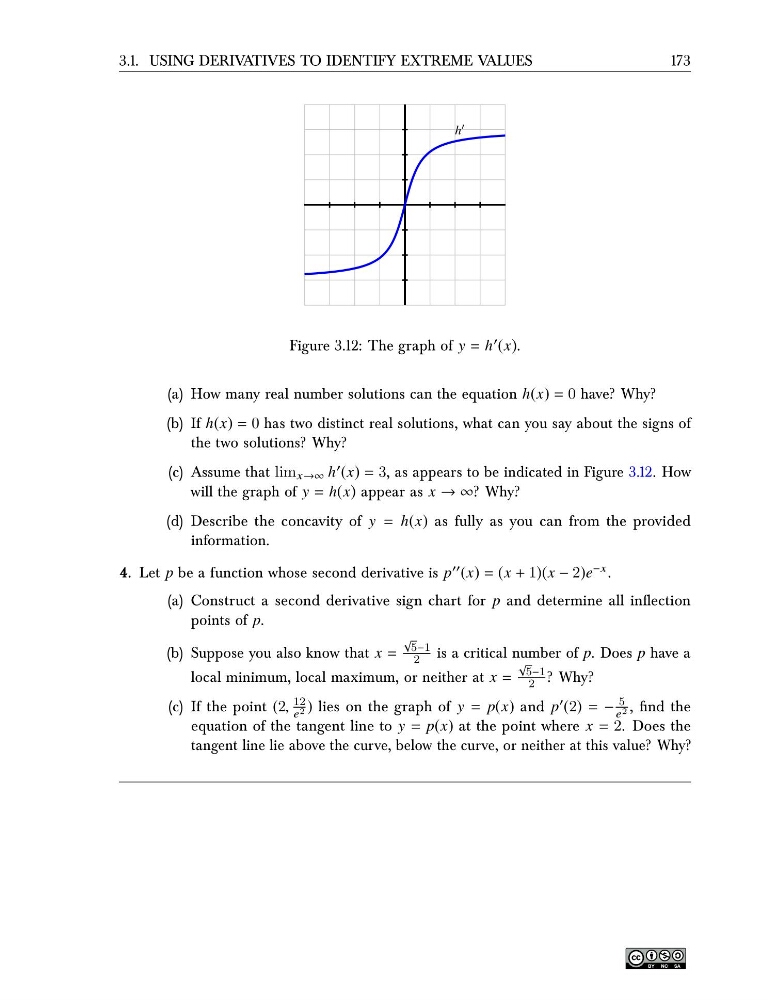
Figure 3.12: The graph of y = h ′ (x).
(a) How many real number solutions can the equation h(x) = 0 have? Why?
(b) If h(x) = 0 has two distinct real solutions, what can you say about the signs of
the two solutions? Why?
(c) Assume that lim x→∞ h ′ (x) = 3, as appears to be indicated in Figure 3.12. How
will the graph of y = h(x) appear as x → ∞? Why?
(d) Describe the concavity of y = h(x) as fully as you can from the provided
information.
4. Let p be a function whose second derivative is p ′′ (x) = (x + 1)(x − 2)e −x .
(a) Construct a second derivative sign chart for p and determine all inflection
points of p.
(b) Suppose you also know that x =
√
5−1
2 is a critical number of p. Does p have a
local minimum, local maximum, or neither at x =
√
5−1
2 ? Why?
(c) If the point (2,
12
e 2 ) lies on the graph of y = p(x) and p ′ (2) = −
5
e 2 , find the
equation of the tangent line to y = p(x) at the point where x = 2. Does the
tangent line lie above the curve, below the curve, or neither at this value? Why?
173
h ′
Figure 3.12: The graph of y = h ′ (x).
(a) How many real number solutions can the equation h(x) = 0 have? Why?
(b) If h(x) = 0 has two distinct real solutions, what can you say about the signs of
the two solutions? Why?
(c) Assume that lim x→∞ h ′ (x) = 3, as appears to be indicated in Figure 3.12. How
will the graph of y = h(x) appear as x → ∞? Why?
(d) Describe the concavity of y = h(x) as fully as you can from the provided
information.
4. Let p be a function whose second derivative is p ′′ (x) = (x + 1)(x − 2)e −x .
(a) Construct a second derivative sign chart for p and determine all inflection
points of p.
(b) Suppose you also know that x =
√
5−1
2 is a critical number of p. Does p have a
local minimum, local maximum, or neither at x =
√
5−1
2 ? Why?
(c) If the point (2,
12
e 2 ) lies on the graph of y = p(x) and p ′ (2) = −
5
e 2 , find the
equation of the tangent line to y = p(x) at the point where x = 2. Does the
tangent line lie above the curve, below the curve, or neither at this value? Why?