

3.1. USING DERIVATIVES TO IDENTIFY EXTREME VALUES
165
determine where f ′ (x) = 0. From the equation
e
−2x (3 − x)(x + 1)
2 = 0
and the zero product property, it follows that x = 3 and x = −1 are critical numbers of f .
(Note particularly that there is no value of x that makes e −2x = 0.)
Next, to apply the first derivative test, we’ d like to know the sign of f ′ (x) at inputs
near the critical numbers. Because the critical numbers are the only locations at which
f ′ can change sign, it follows that the sign of the derivative is the same on each of the
intervals created by the critical numbers: for instance, the sign of f ′ must be the same for
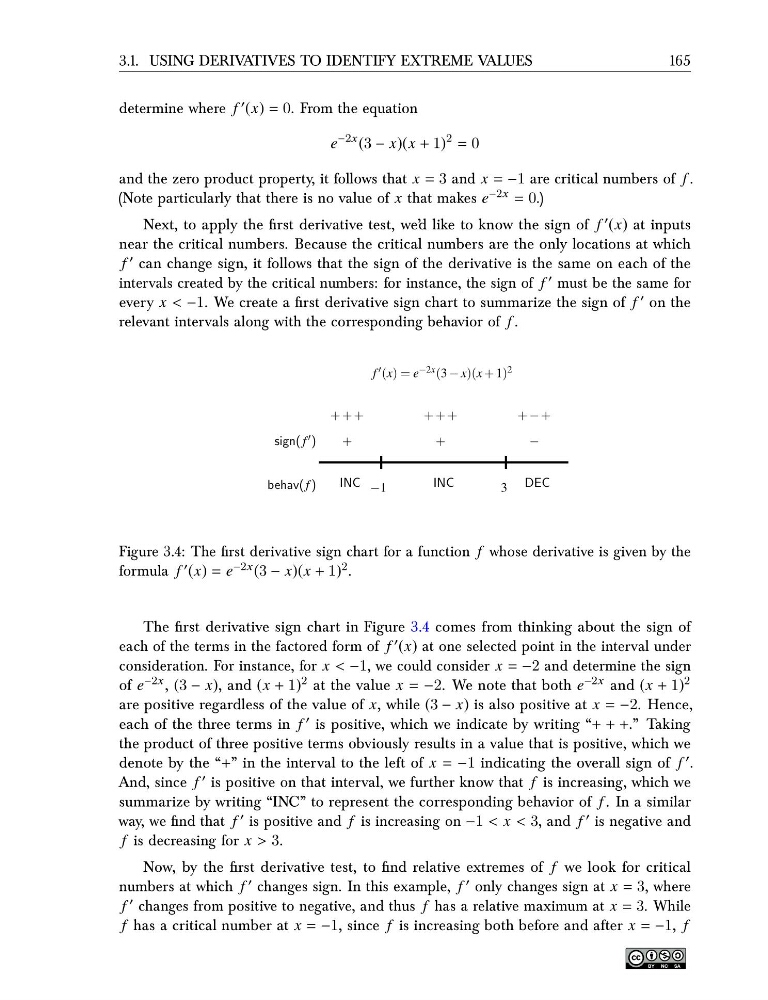
every x < −1. We create a first derivative sign chart to summarize the sign of f ′ on the
relevant intervals along with the corresponding behavior of f .
sign( f ′ )
behav( f )
+ + +
+
INC −1
+ + +
+
INC
3
+ − +
−
DEC
f ′ (x) = e −2x (3 − x)(x + 1) 2
Figure 3.4: The first derivative sign chart for a function f whose derivative is given by the
formula f ′ (x) = e −2x (3 − x)(x + 1) 2 .
The first derivative sign chart in Figure 3.4 comes from thinking about the sign of
each of the terms in the factored form of f ′ (x) at one selected point in the interval under
consideration. For instance, for x < −1, we could consider x = −2 and determine the sign
of e −2x , (3 − x), and (x + 1) 2 at the value x = −2. We note that both e −2x and (x + 1) 2
are positive regardless of the value of x, while (3 − x) is also positive at x = −2. Hence,
each of the three terms in f ′ is positive, which we indicate by writing “+ + +.” Taking
the product of three positive terms obviously results in a value that is positive, which we
denote by the “+” in the interval to the left of x = −1 indicating the overall sign of f ′ .
And, since f ′ is positive on that interval, we further know that f is increasing, which we
summarize by writing “INC” to represent the corresponding behavior of f . In a similar
way, we find that f ′ is positive and f is increasing on −1 < x < 3, and f ′ is negative and
f is decreasing for x > 3.
Now, by the first derivative test, to find relative extremes of f we look for critical
numbers at which f ′ changes sign. In this example, f ′ only changes sign at x = 3, where
f ′ changes from positive to negative, and thus f has a relative maximum at x = 3. While
f has a critical number at x = −1, since f is increasing both before and after x = −1, f
165
determine where f ′ (x) = 0. From the equation
e
−2x (3 − x)(x + 1)
2 = 0
and the zero product property, it follows that x = 3 and x = −1 are critical numbers of f .
(Note particularly that there is no value of x that makes e −2x = 0.)
Next, to apply the first derivative test, we’ d like to know the sign of f ′ (x) at inputs
near the critical numbers. Because the critical numbers are the only locations at which
f ′ can change sign, it follows that the sign of the derivative is the same on each of the
intervals created by the critical numbers: for instance, the sign of f ′ must be the same for
every x < −1. We create a first derivative sign chart to summarize the sign of f ′ on the
relevant intervals along with the corresponding behavior of f .
sign( f ′ )
behav( f )
+ + +
+
INC −1
+ + +
+
INC
3
+ − +
−
DEC
f ′ (x) = e −2x (3 − x)(x + 1) 2
Figure 3.4: The first derivative sign chart for a function f whose derivative is given by the
formula f ′ (x) = e −2x (3 − x)(x + 1) 2 .
The first derivative sign chart in Figure 3.4 comes from thinking about the sign of
each of the terms in the factored form of f ′ (x) at one selected point in the interval under
consideration. For instance, for x < −1, we could consider x = −2 and determine the sign
of e −2x , (3 − x), and (x + 1) 2 at the value x = −2. We note that both e −2x and (x + 1) 2
are positive regardless of the value of x, while (3 − x) is also positive at x = −2. Hence,
each of the three terms in f ′ is positive, which we indicate by writing “+ + +.” Taking
the product of three positive terms obviously results in a value that is positive, which we
denote by the “+” in the interval to the left of x = −1 indicating the overall sign of f ′ .
And, since f ′ is positive on that interval, we further know that f is increasing, which we
summarize by writing “INC” to represent the corresponding behavior of f . In a similar
way, we find that f ′ is positive and f is increasing on −1 < x < 3, and f ′ is negative and
f is decreasing for x > 3.
Now, by the first derivative test, to find relative extremes of f we look for critical
numbers at which f ′ changes sign. In this example, f ′ only changes sign at x = 3, where
f ′ changes from positive to negative, and thus f has a relative maximum at x = 3. While
f has a critical number at x = −1, since f is increasing both before and after x = −1, f