

164
3.1. USING DERIVATIVES TO IDENTIFY EXTREME VALUES
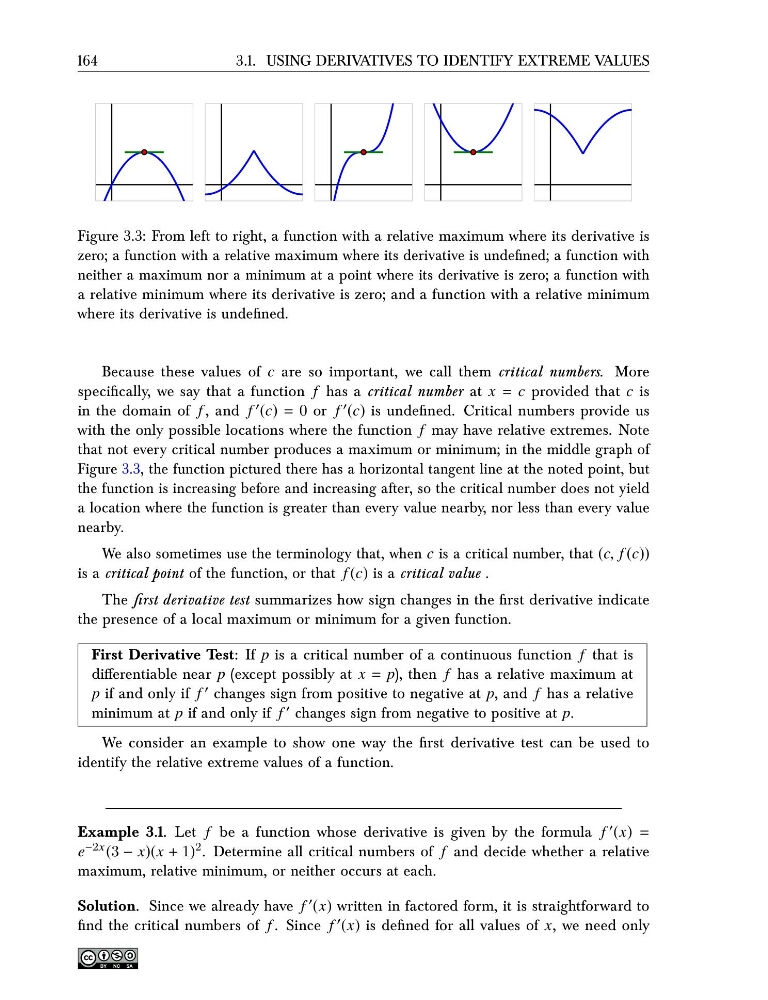
Figure 3.3: From left to right, a function with a relative maximum where its derivative is
zero; a function with a relative maximum where its derivative is undefined; a function with
neither a maximum nor a minimum at a point where its derivative is zero; a function with
a relative minimum where its derivative is zero; and a function with a relative minimum
where its derivative is undefined.
Because these values of c are so important, we call them critical numbers. More
specifically, we say that a function f has a critical number at x = c provided that c is
in the domain of f , and f ′ (c) = 0 or f ′ (c) is undefined. Critical numbers provide us
with the only possible locations where the function f may have relative extremes. Note
that not every critical number produces a maximum or minimum; in the middle graph of
Figure 3.3, the function pictured there has a horizontal tangent line at the noted point, but
the function is increasing before and increasing after, so the critical number does not yield
a location where the function is greater than every value nearby, nor less than every value
nearby.
We also sometimes use the terminology that, when c is a critical number, that (c, f (c))
is a critical point of the function, or that f (c) is a critical value .
The first derivative test summarizes how sign changes in the first derivative indicate
the presence of a local maximum or minimum for a given function.
First Derivative Test: If p is a critical number of a continuous function f that is
differentiable near p (except possibly at x = p), then f has a relative maximum at
p if and only if f ′ changes sign from positive to negative at p, and f has a relative
minimum at p if and only if f ′ changes sign from negative to positive at p.
We consider an example to show one way the first derivative test can be used to
identify the relative extreme values of a function.
Example 3.1. Let f be a function whose derivative is given by the formula f ′ (x) =
e −2x (3 − x)(x + 1) 2 . Determine all critical numbers of f and decide whether a relative
maximum, relative minimum, or neither occurs at each.
Solution. Since we already have f ′ (x) written in factored form, it is straightforward to
find the critical numbers of f . Since f ′ (x) is defined for all values of x, we need only
3.1. USING DERIVATIVES TO IDENTIFY EXTREME VALUES
Figure 3.3: From left to right, a function with a relative maximum where its derivative is
zero; a function with a relative maximum where its derivative is undefined; a function with
neither a maximum nor a minimum at a point where its derivative is zero; a function with
a relative minimum where its derivative is zero; and a function with a relative minimum
where its derivative is undefined.
Because these values of c are so important, we call them critical numbers. More
specifically, we say that a function f has a critical number at x = c provided that c is
in the domain of f , and f ′ (c) = 0 or f ′ (c) is undefined. Critical numbers provide us
with the only possible locations where the function f may have relative extremes. Note
that not every critical number produces a maximum or minimum; in the middle graph of
Figure 3.3, the function pictured there has a horizontal tangent line at the noted point, but
the function is increasing before and increasing after, so the critical number does not yield
a location where the function is greater than every value nearby, nor less than every value
nearby.
We also sometimes use the terminology that, when c is a critical number, that (c, f (c))
is a critical point of the function, or that f (c) is a critical value .
The first derivative test summarizes how sign changes in the first derivative indicate
the presence of a local maximum or minimum for a given function.
First Derivative Test: If p is a critical number of a continuous function f that is
differentiable near p (except possibly at x = p), then f has a relative maximum at
p if and only if f ′ changes sign from positive to negative at p, and f has a relative
minimum at p if and only if f ′ changes sign from negative to positive at p.
We consider an example to show one way the first derivative test can be used to
identify the relative extreme values of a function.
Example 3.1. Let f be a function whose derivative is given by the formula f ′ (x) =
e −2x (3 − x)(x + 1) 2 . Determine all critical numbers of f and decide whether a relative
maximum, relative minimum, or neither occurs at each.
Solution. Since we already have f ′ (x) written in factored form, it is straightforward to
find the critical numbers of f . Since f ′ (x) is defined for all values of x, we need only