

146
2.7. DERIVATIVES OF FUNCTIONS GIVEN IMPLICITLY
-3
3
-3
3
x
y
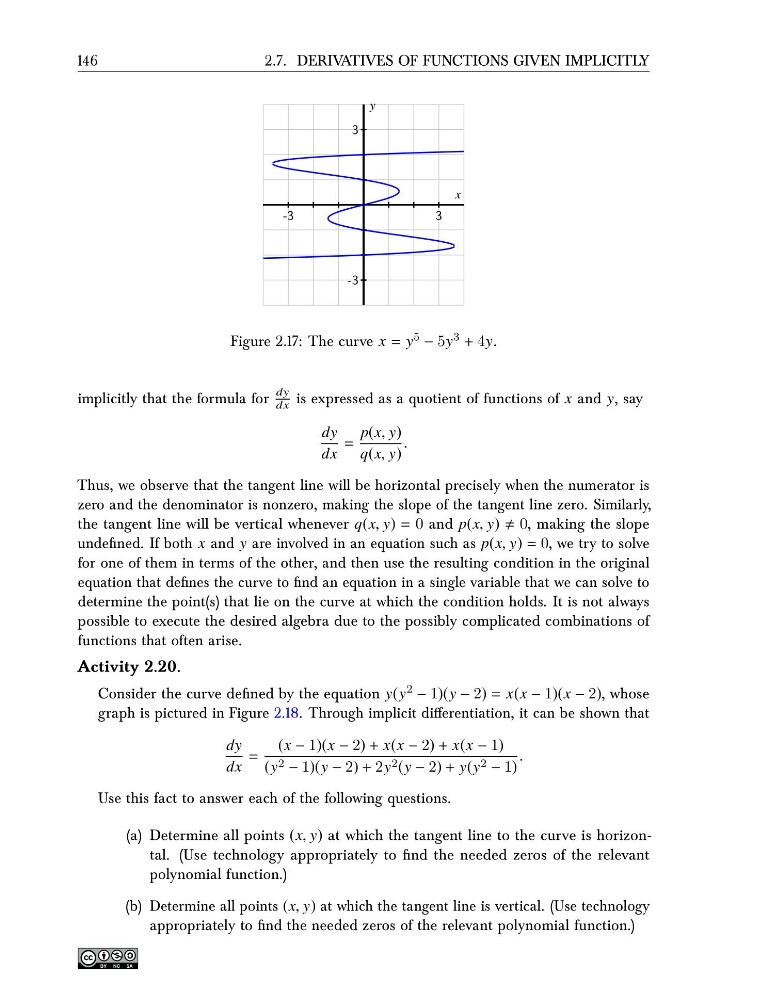
Figure 2.17: The curve x = y 5 − 5y 3 + 4y.
implicitly that the formula for
dy
dx is expressed as a quotient of functions of x and y, say
dy
dx
=
p(x, y)
q(x, y)
.
Thus, we observe that the tangent line will be horizontal precisely when the numerator is
zero and the denominator is nonzero, making the slope of the tangent line zero. Similarly,
the tangent line will be vertical whenever q(x, y) = 0 and p(x, y) 0, making the slope
undefined. If both x and y are involved in an equation such as p(x, y) = 0, we try to solve
for one of them in terms of the other, and then use the resulting condition in the original
equation that defines the curve to find an equation in a single variable that we can solve to
determine the point(s) that lie on the curve at which the condition holds. It is not always
possible to execute the desired algebra due to the possibly complicated combinations of
functions that often arise.
Activity 2.20.
Consider the curve defined by the equation y(y 2 − 1)(y − 2) = x(x − 1)(x − 2), whose
graph is pictured in Figure 2.18. Through implicit differentiation, it can be shown that
dy
dx
=
(x − 1)(x − 2) + x(x − 2) + x(x − 1)
(y 2 − 1)(y − 2) + 2y 2 (y − 2) + y(y 2 − 1)
.
Use this fact to answer each of the following questions.
(a) Determine all points (x, y) at which the tangent line to the curve is horizontal. (Use technology appropriately to find the needed zeros of the relevant
polynomial function.)
(b) Determine all points (x, y) at which the tangent line is vertical. (Use technology
appropriately to find the needed zeros of the relevant polynomial function.)
2.7. DERIVATIVES OF FUNCTIONS GIVEN IMPLICITLY
-3
3
-3
3
x
y
Figure 2.17: The curve x = y 5 − 5y 3 + 4y.
implicitly that the formula for
dy
dx is expressed as a quotient of functions of x and y, say
dy
dx
=
p(x, y)
q(x, y)
.
Thus, we observe that the tangent line will be horizontal precisely when the numerator is
zero and the denominator is nonzero, making the slope of the tangent line zero. Similarly,
the tangent line will be vertical whenever q(x, y) = 0 and p(x, y) 0, making the slope
undefined. If both x and y are involved in an equation such as p(x, y) = 0, we try to solve
for one of them in terms of the other, and then use the resulting condition in the original
equation that defines the curve to find an equation in a single variable that we can solve to
determine the point(s) that lie on the curve at which the condition holds. It is not always
possible to execute the desired algebra due to the possibly complicated combinations of
functions that often arise.
Activity 2.20.
Consider the curve defined by the equation y(y 2 − 1)(y − 2) = x(x − 1)(x − 2), whose
graph is pictured in Figure 2.18. Through implicit differentiation, it can be shown that
dy
dx
=
(x − 1)(x − 2) + x(x − 2) + x(x − 1)
(y 2 − 1)(y − 2) + 2y 2 (y − 2) + y(y 2 − 1)
.
Use this fact to answer each of the following questions.
(a) Determine all points (x, y) at which the tangent line to the curve is horizontal. (Use technology appropriately to find the needed zeros of the relevant
polynomial function.)
(b) Determine all points (x, y) at which the tangent line is vertical. (Use technology
appropriately to find the needed zeros of the relevant polynomial function.)