

2.2. THE SINE AND COSINE FUNCTIONS
97
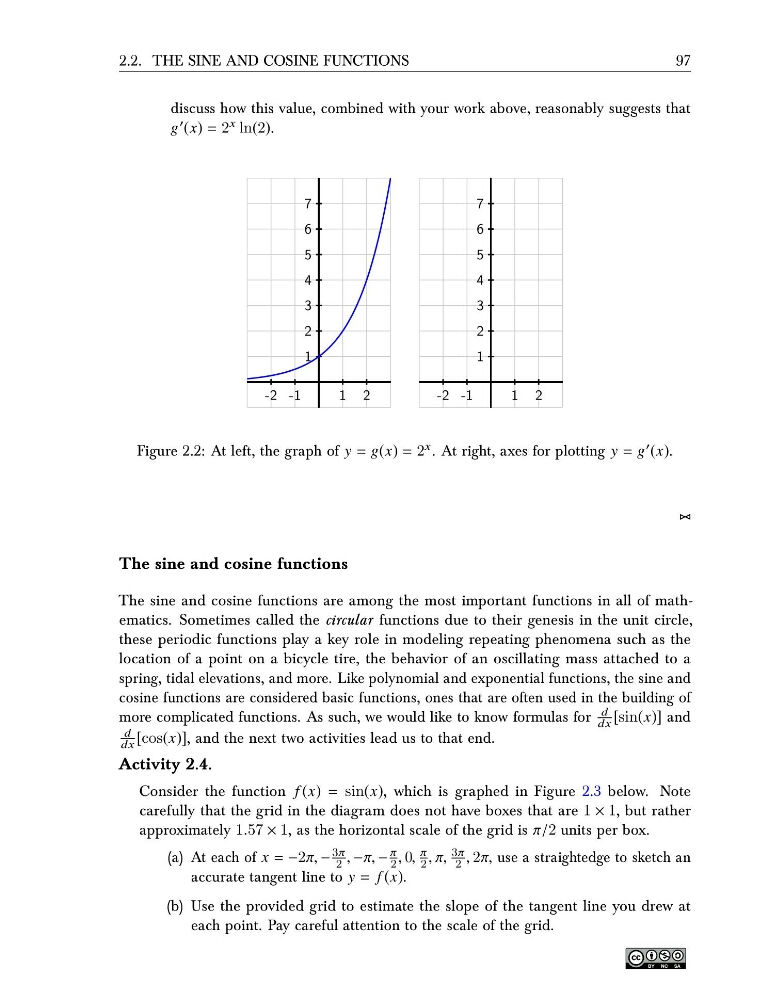
discuss how this value, combined with your work above, reasonably suggests that
g ′ (x) = 2 x ln(2).
-2 -1
1 2
1
2
3
4
5
6
7
-2 -1
1 2
1
2
3
4
5
6
7
Figure 2.2: At left, the graph of y = g(x) = 2 x . At right, axes for plotting y = g ′ (x).
⊲⊳
The sine and cosine functions
The sine and cosine functions are among the most important functions in all of mathematics. Sometimes called the circular functions due to their genesis in the unit circle,
these periodic functions play a key role in modeling repeating phenomena such as the
location of a point on a bicycle tire, the behavior of an oscillating mass attached to a
spring, tidal elevations, and more. Like polynomial and exponential functions, the sine and
cosine functions are considered basic functions, ones that are often used in the building of
more complicated functions. As such, we would like to know formulas for
d
dx [sin(x)] and
d
dx [cos(x)], and the next two activities lead us to that end.
Activity 2.4.
Consider the function f (x) = sin(x), which is graphed in Figure 2.3 below. Note
carefully that the grid in the diagram does not have boxes that are 1 × 1, but rather
approximately 1.57 × 1, as the horizontal scale of the grid is π/2 units per box.
(a) At each of x = −2π, −
3π
2 , −π, −
π
2 , 0,
π
2 , π,
3π
2 , 2π, use a straightedge to sketch an
accurate tangent line to y = f (x).
(b) Use the provided grid to estimate the slope of the tangent line you drew at
each point. Pay careful attention to the scale of the grid.
97
discuss how this value, combined with your work above, reasonably suggests that
g ′ (x) = 2 x ln(2).
-2 -1
1 2
1
2
3
4
5
6
7
-2 -1
1 2
1
2
3
4
5
6
7
Figure 2.2: At left, the graph of y = g(x) = 2 x . At right, axes for plotting y = g ′ (x).
⊲⊳
The sine and cosine functions
The sine and cosine functions are among the most important functions in all of mathematics. Sometimes called the circular functions due to their genesis in the unit circle,
these periodic functions play a key role in modeling repeating phenomena such as the
location of a point on a bicycle tire, the behavior of an oscillating mass attached to a
spring, tidal elevations, and more. Like polynomial and exponential functions, the sine and
cosine functions are considered basic functions, ones that are often used in the building of
more complicated functions. As such, we would like to know formulas for
d
dx [sin(x)] and
d
dx [cos(x)], and the next two activities lead us to that end.
Activity 2.4.
Consider the function f (x) = sin(x), which is graphed in Figure 2.3 below. Note
carefully that the grid in the diagram does not have boxes that are 1 × 1, but rather
approximately 1.57 × 1, as the horizontal scale of the grid is π/2 units per box.
(a) At each of x = −2π, −
3π
2 , −π, −
π
2 , 0,
π
2 , π,
3π
2 , 2π, use a straightedge to sketch an
accurate tangent line to y = f (x).
(b) Use the provided grid to estimate the slope of the tangent line you drew at
each point. Pay careful attention to the scale of the grid.