

2.1. ELEMENTARY DERIVATIVE RULES
95
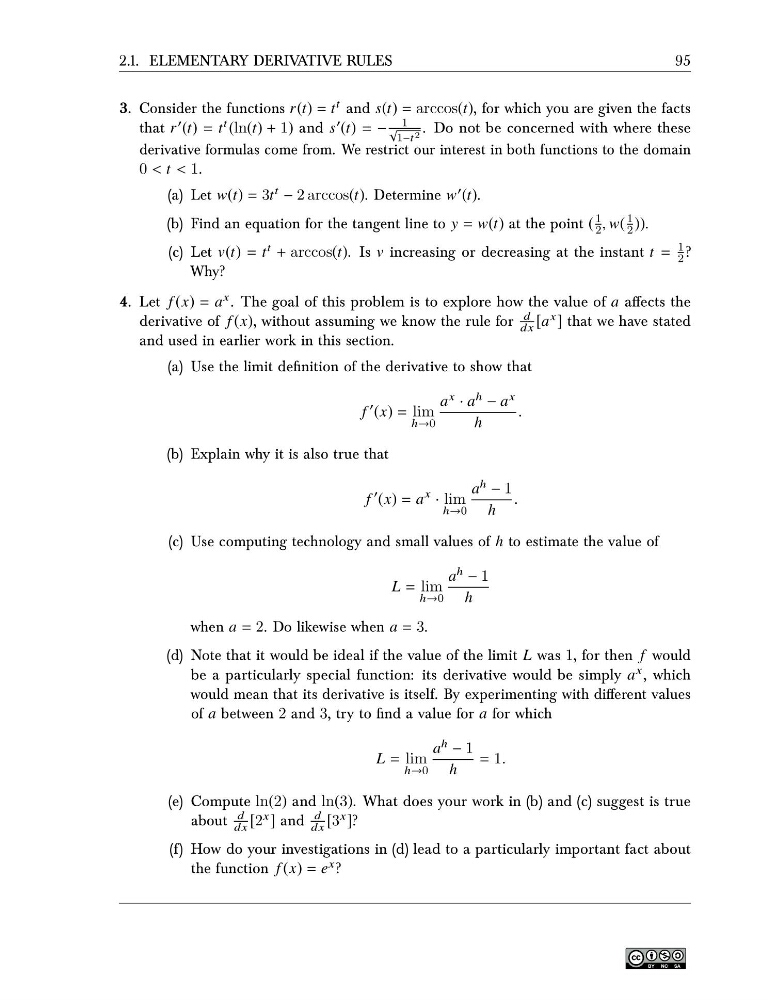
3. Consider the functions r(t) = t t and s(t) = arccos(t), for which you are given the facts
that r ′ (t) = t t (ln(t) + 1) and s ′ (t) = −
1
√
1−t 2 . Do not be concerned with where these
derivative formulas come from. We restrict our interest in both functions to the domain
0 < t < 1.
(a) Let w(t) = 3t t − 2 arccos(t). Determine w ′ (t).
(b) Find an equation for the tangent line to y = w(t) at the point (
1
2 , w(
1
2 )).
(c) Let v(t) = t t + arccos(t). Is v increasing or decreasing at the instant t =
1
2 ?
Why?
4. Let f (x) = a x . The goal of this problem is to explore how the value of a affects the
derivative of f (x), without assuming we know the rule for
d
dx [a x ] that we have stated
and used in earlier work in this section.
(a) Use the limit definition of the derivative to show that
f
′ (x) = lim
h→0
a x · a h − a x
h
.
(b) Explain why it is also true that
f
′ (x) = a
x · lim
h→0
a h − 1
h
.
(c) Use computing technology and small values of h to estimate the value of
L = lim
h→0
a h − 1
h
when a = 2. Do likewise when a = 3.
(d) Note that it would be ideal if the value of the limit L was 1, for then f would
be a particularly special function: its derivative would be simply a x , which
would mean that its derivative is itself. By experimenting with different values
of a between 2 and 3, try to find a value for a for which
L = lim
h→0
a h − 1
h
= 1.
(e) Compute ln(2) and ln(3). What does your work in (b) and (c) suggest is true
about
d
dx [2 x ] and
d
dx [3 x ]?
(f) How do your investigations in (d) lead to a particularly important fact about
the function f (x) = e x ?
95
3. Consider the functions r(t) = t t and s(t) = arccos(t), for which you are given the facts
that r ′ (t) = t t (ln(t) + 1) and s ′ (t) = −
1
√
1−t 2 . Do not be concerned with where these
derivative formulas come from. We restrict our interest in both functions to the domain
0 < t < 1.
(a) Let w(t) = 3t t − 2 arccos(t). Determine w ′ (t).
(b) Find an equation for the tangent line to y = w(t) at the point (
1
2 , w(
1
2 )).
(c) Let v(t) = t t + arccos(t). Is v increasing or decreasing at the instant t =
1
2 ?
Why?
4. Let f (x) = a x . The goal of this problem is to explore how the value of a affects the
derivative of f (x), without assuming we know the rule for
d
dx [a x ] that we have stated
and used in earlier work in this section.
(a) Use the limit definition of the derivative to show that
f
′ (x) = lim
h→0
a x · a h − a x
h
.
(b) Explain why it is also true that
f
′ (x) = a
x · lim
h→0
a h − 1
h
.
(c) Use computing technology and small values of h to estimate the value of
L = lim
h→0
a h − 1
h
when a = 2. Do likewise when a = 3.
(d) Note that it would be ideal if the value of the limit L was 1, for then f would
be a particularly special function: its derivative would be simply a x , which
would mean that its derivative is itself. By experimenting with different values
of a between 2 and 3, try to find a value for a for which
L = lim
h→0
a h − 1
h
= 1.
(e) Compute ln(2) and ln(3). What does your work in (b) and (c) suggest is true
about
d
dx [2 x ] and
d
dx [3 x ]?
(f) How do your investigations in (d) lead to a particularly important fact about
the function f (x) = e x ?