

94
2.1. ELEMENTARY DERIVATIVE RULES
straightforward to compute the derivative of the overall function. More formally, if f (x)
and g(x) are differentiable with derivatives f ′ (x) and g ′ (x) and a and b are constants,
then
d
dx
[a f (x) + bg(x)] = a f
′ (x) + bg
′ (x).
Exercises
1. Let f and g be differentiable functions for which the following information is known:
f (2) = 5, g(2) = −3, f ′ (2) = −1/2, g ′ (2) = 2.
(a) Let h be the new function defined by the rule h(x) = 3 f (x) − 4g(x). Determine
h(2) and h ′ (2).
(b) Find an equation for the tangent line to y = h(x) at the point (2, h(2)).
(c) Let p be the function defined by the rule p(x) = −2 f (x)+
1
2 g(x). Is p increasing,
decreasing, or neither at a = 2? Why?
(d) Estimate the value of p(2.03) by using the local linearization of p at the point
(2, p(2)).
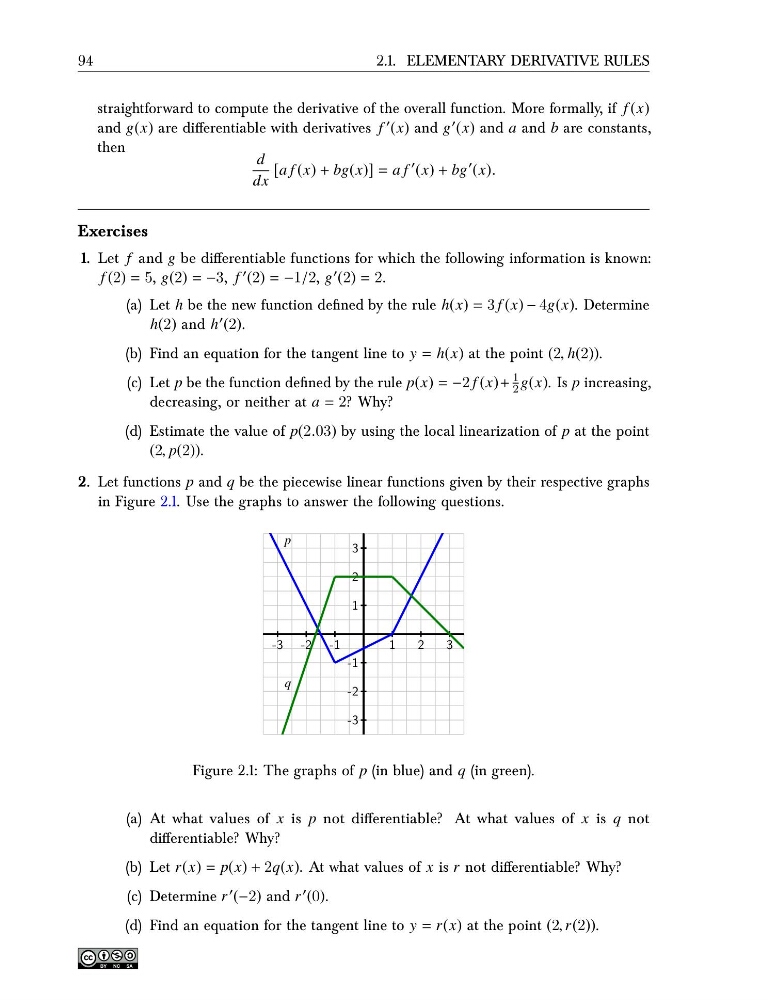
2. Let functions p and q be the piecewise linear functions given by their respective graphs
in Figure 2.1. Use the graphs to answer the following questions.
-3 -2 -1
1
2
3
-3
-2
-1
1
2
3
p
q
Figure 2.1: The graphs of p (in blue) and q (in green).
(a) At what values of x is p not differentiable? At what values of x is q not
differentiable? Why?
(b) Let r(x) = p(x) + 2q(x). At what values of x is r not differentiable? Why?
(c) Determine r ′ (−2) and r ′ (0).
(d) Find an equation for the tangent line to y = r(x) at the point (2, r(2)).
2.1. ELEMENTARY DERIVATIVE RULES
straightforward to compute the derivative of the overall function. More formally, if f (x)
and g(x) are differentiable with derivatives f ′ (x) and g ′ (x) and a and b are constants,
then
d
dx
[a f (x) + bg(x)] = a f
′ (x) + bg
′ (x).
Exercises
1. Let f and g be differentiable functions for which the following information is known:
f (2) = 5, g(2) = −3, f ′ (2) = −1/2, g ′ (2) = 2.
(a) Let h be the new function defined by the rule h(x) = 3 f (x) − 4g(x). Determine
h(2) and h ′ (2).
(b) Find an equation for the tangent line to y = h(x) at the point (2, h(2)).
(c) Let p be the function defined by the rule p(x) = −2 f (x)+
1
2 g(x). Is p increasing,
decreasing, or neither at a = 2? Why?
(d) Estimate the value of p(2.03) by using the local linearization of p at the point
(2, p(2)).
2. Let functions p and q be the piecewise linear functions given by their respective graphs
in Figure 2.1. Use the graphs to answer the following questions.
-3 -2 -1
1
2
3
-3
-2
-1
1
2
3
p
q
Figure 2.1: The graphs of p (in blue) and q (in green).
(a) At what values of x is p not differentiable? At what values of x is q not
differentiable? Why?
(b) Let r(x) = p(x) + 2q(x). At what values of x is r not differentiable? Why?
(c) Determine r ′ (−2) and r ′ (0).
(d) Find an equation for the tangent line to y = r(x) at the point (2, r(2)).