

INSTANTONS IN ABELIAN SYSTEMS
71
Following the tradition of previous sections let us explain how the
systems we have discussed look in the continuum formulation. As we
have already said, compact QED can be obtained from Non-Abelian
gauge theory. To give an example, let us consider SU(2) theory, which
contains three gauge bosons, and break the SU(2) so as to make two of
these bosons massive. This is the so-called Georgi-Glashow model for
unifying weak and electromagnetic interactions. All more complicated
unifications follow the pattern we encounter in this model. Its action is
given by:
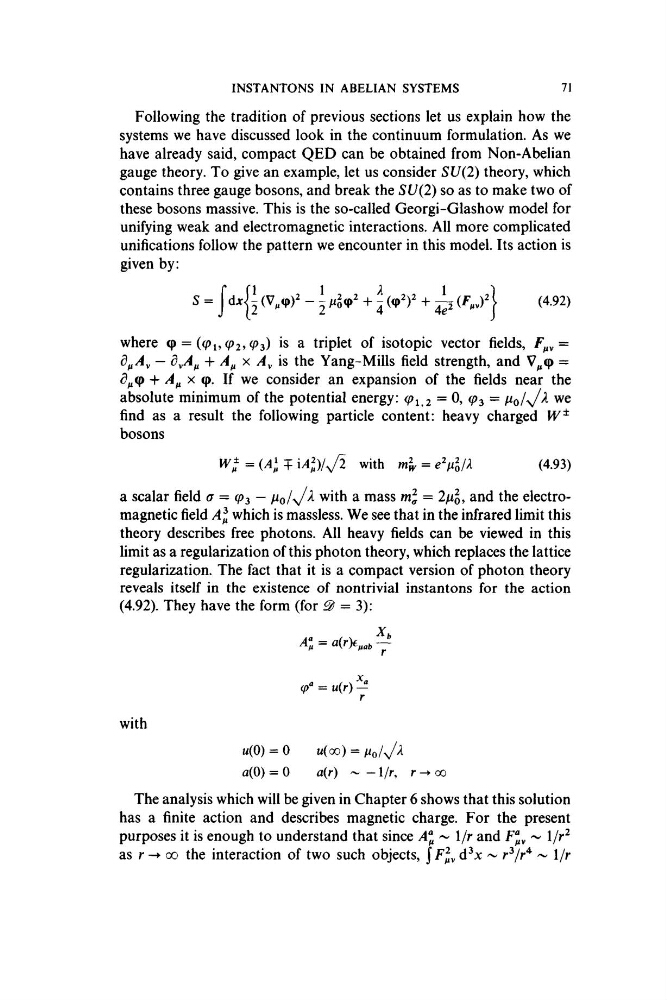
S = dxi \ (V,«p)^ - i
^
(4.92)
where = {(Pu(P2 ^(P3) is a triplet of isotopic vector fields, F^^ —
A^ X A^ is the Yang-Mills field strength, and V^cp =
-f
X (p. If we consider an expansion of the fields near the
absolute minimum of the potential energy: cp^ 2 = ^ 3 =
we
find as a result the following particle content: heavy charged
bosons
IF* = (Al -f
with mlr =
(4.93)
a scalar field a = (p^ —
with a mass ml = 2/Iq, and the electromagnetic field Al which is massless. We see that in the infrared limit this
theory describes free photons. All heavy fields can be viewed in this
limit as a regularization of this photon theory, which replaces the lattice
regularization. The fact that it is a compact version of photon theory
reveals itself in the existence of nontrivial instantons for the action
(4.92). They have the form (for ^ = 3):
with
cp^^uir)-^
r
m (0) = 0 m (go) = /Io/V2
a(0) = 0
a(r) ~ — 1/r, r -> 0 0
The analysis which will be given in Chapter 6 shows that this solution
has a finite action and describes magnetic charge. For the present
purposes it is enough to understand that since A" ^ 1/r and
~ 1/r^
as r ^ (X) the interaction of two such objects, j
d^x ~
^ 1/r
71
Following the tradition of previous sections let us explain how the
systems we have discussed look in the continuum formulation. As we
have already said, compact QED can be obtained from Non-Abelian
gauge theory. To give an example, let us consider SU(2) theory, which
contains three gauge bosons, and break the SU(2) so as to make two of
these bosons massive. This is the so-called Georgi-Glashow model for
unifying weak and electromagnetic interactions. All more complicated
unifications follow the pattern we encounter in this model. Its action is
given by:
S = dxi \ (V,«p)^ - i
^
(4.92)
where = {(Pu(P2 ^(P3) is a triplet of isotopic vector fields, F^^ —
A^ X A^ is the Yang-Mills field strength, and V^cp =
-f
X (p. If we consider an expansion of the fields near the
absolute minimum of the potential energy: cp^ 2 = ^ 3 =
we
find as a result the following particle content: heavy charged
bosons
IF* = (Al -f
with mlr =
(4.93)
a scalar field a = (p^ —
with a mass ml = 2/Iq, and the electromagnetic field Al which is massless. We see that in the infrared limit this
theory describes free photons. All heavy fields can be viewed in this
limit as a regularization of this photon theory, which replaces the lattice
regularization. The fact that it is a compact version of photon theory
reveals itself in the existence of nontrivial instantons for the action
(4.92). They have the form (for ^ = 3):
with
cp^^uir)-^
r
m (0) = 0 m (go) = /Io/V2
a(0) = 0
a(r) ~ — 1/r, r -> 0 0
The analysis which will be given in Chapter 6 shows that this solution
has a finite action and describes magnetic charge. For the present
purposes it is enough to understand that since A" ^ 1/r and
~ 1/r^
as r ^ (X) the interaction of two such objects, j
d^x ~
^ 1/r