

70
GAUGE FIELDS AND STRINGS
for ^ = 4, being minima of the potential energy for the hamiltonian
(3.34). This point will be discussed in detail in Chapter 6. Here it suffices
to realize that each time-independent classical solution with finite
energy (a soliton) corresponds in the limit of small coupling to a stable
particle. As we go to ^ = 4 the quantity which was action in ^ = 3
becomes energy.
The closed loops we discussed above are the world lines of monopole-antimonopole pairs. We see that at some coupling the vacuum
becomes filled with a monopole condensate. Such a medium confines
electric charges as is seen from the following physical analogy. Take a
superconductor in which in the ground state we have a condensate of
electrically charged fields (Cooper pairs). It is known that an external
magnetic field can penetrate inside a superconductor only by forming a
number of thin filaments, carrying quantized magnetic fiux. If we
imagine two magnetic charges inside the superconductor, we shall
deduce from the Ginzburg-Landau equations that their magnetic fiux
should be concentrated inside such a filament, connecting them. Their
interaction energy is proportional to the distance. If in this description
we interchange words “electric” and “magnetic” we conclude that two
electric charges in a medium formed by a monopole condensate are
confined.
Can we have an Abelian theory which confines even at ^ = 4 for all
couplings? We see that this equation is equivalent to finding a system
with point-like finite action instantons. It is easy to give an example of
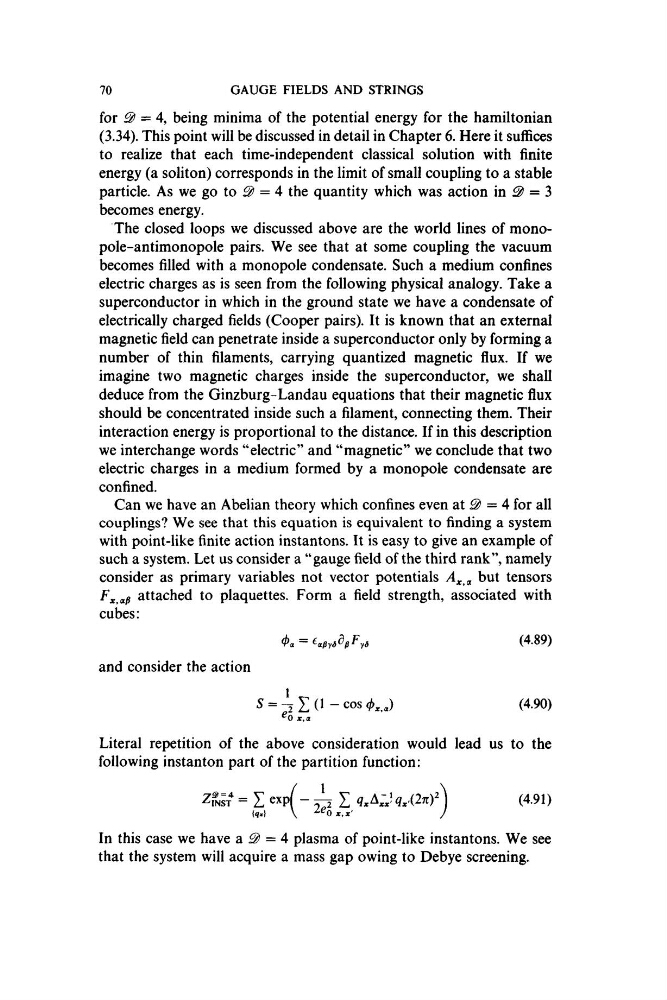
such a system. Let us consider a “gauge field of the third rank”, namely
consider as primary variables not vector potentials
but tensors
Fx^ap attached to plaquettes. Form a field strength, associated with
cubes:
^aPyô^P ^y ô
(4.89)
and consider the action
s = 3
(I - cos (j)^j
(4.90)
Literal repetition of the above consideration would lead us to the
following instanton part of the partition function:
Z,nÌt = Z exp
in .X \ ^^0 X .X '
(4.91)
In this case we have a ^ = 4 plasma of point-like instantons. We see
that the system will acquire a mass gap owing to Debye screening.
GAUGE FIELDS AND STRINGS
for ^ = 4, being minima of the potential energy for the hamiltonian
(3.34). This point will be discussed in detail in Chapter 6. Here it suffices
to realize that each time-independent classical solution with finite
energy (a soliton) corresponds in the limit of small coupling to a stable
particle. As we go to ^ = 4 the quantity which was action in ^ = 3
becomes energy.
The closed loops we discussed above are the world lines of monopole-antimonopole pairs. We see that at some coupling the vacuum
becomes filled with a monopole condensate. Such a medium confines
electric charges as is seen from the following physical analogy. Take a
superconductor in which in the ground state we have a condensate of
electrically charged fields (Cooper pairs). It is known that an external
magnetic field can penetrate inside a superconductor only by forming a
number of thin filaments, carrying quantized magnetic fiux. If we
imagine two magnetic charges inside the superconductor, we shall
deduce from the Ginzburg-Landau equations that their magnetic fiux
should be concentrated inside such a filament, connecting them. Their
interaction energy is proportional to the distance. If in this description
we interchange words “electric” and “magnetic” we conclude that two
electric charges in a medium formed by a monopole condensate are
confined.
Can we have an Abelian theory which confines even at ^ = 4 for all
couplings? We see that this equation is equivalent to finding a system
with point-like finite action instantons. It is easy to give an example of
such a system. Let us consider a “gauge field of the third rank”, namely
consider as primary variables not vector potentials
but tensors
Fx^ap attached to plaquettes. Form a field strength, associated with
cubes:
^aPyô^P ^y ô
(4.89)
and consider the action
s = 3
(I - cos (j)^j
(4.90)
Literal repetition of the above consideration would lead us to the
following instanton part of the partition function:
Z,nÌt = Z exp
in .X \ ^^0 X .X '
(4.91)
In this case we have a ^ = 4 plasma of point-like instantons. We see
that the system will acquire a mass gap owing to Debye screening.